Best Steaks for Cast Iron Skillet: A Butcher's Definitive Ranking
Cast iron is the closest thing a home cook has to a steakhouse broiler. A properly heated cast iron skillet hits 500°F and holds that temperature when cold meat hits the surface — something no stainless pan and certainly no non-stick can do. That sustained, brutal heat is what creates the Maillard reaction crust that defines a great steak.
But not every steak is built for cast iron. Some cuts are too thin and overcook before the crust forms. Others are too thick and char on the outside while staying raw in the center. Some have fat in the wrong places. After four decades of cutting and cooking beef, I can tell you exactly which steaks belong in your cast iron — and which ones don't.
Here are my eight best, ranked in order, with the reasoning that comes from cutting thousands of each.
What Makes a Great Cast Iron Steak?
Before I get into specific cuts, you need to understand what cast iron demands from a piece of beef. The cooking environment is unique: you've got a flat, heavy surface radiating consistent heat with nowhere for moisture to escape. That changes the equation compared to grilling, where fat drips away and airflow dries the surface.
Thickness between 1 and 1.5 inches is the sweet spot. Thinner than an inch, and you can't get a proper crust without overcooking the center. Thicker than 1.5 inches, and you'll need to finish in the oven — which works, but means you're not really doing a pure cast iron cook. The ideal steak gets a deep brown crust on both sides with a pink, juicy center without ever leaving the skillet.
Moderate-to-heavy marbling drives flavor. Fat renders in direct contact with that hot iron and essentially fries the steak's surface in its own fat. The more intramuscular fat, the more self-basting action you get. This is why lean cuts like eye of round are miserable in cast iron — they just dry out and stick.
Even shape matters more than you think. A steak with uneven thickness — thick in the middle and thin at the edges — means the thin parts are well-done while the center is still rare. You want a relatively uniform cross-section so the whole steak cooks at the same rate.
A dry surface is non-negotiable. Cast iron needs dry meat to sear properly. Wet surface = steam = no crust. This is about preparation, not the cut itself, but some cuts hold less surface moisture than others. Pat everything dry with paper towels before it hits the pan. Every time.
1. Ribeye: The Cast Iron Champion
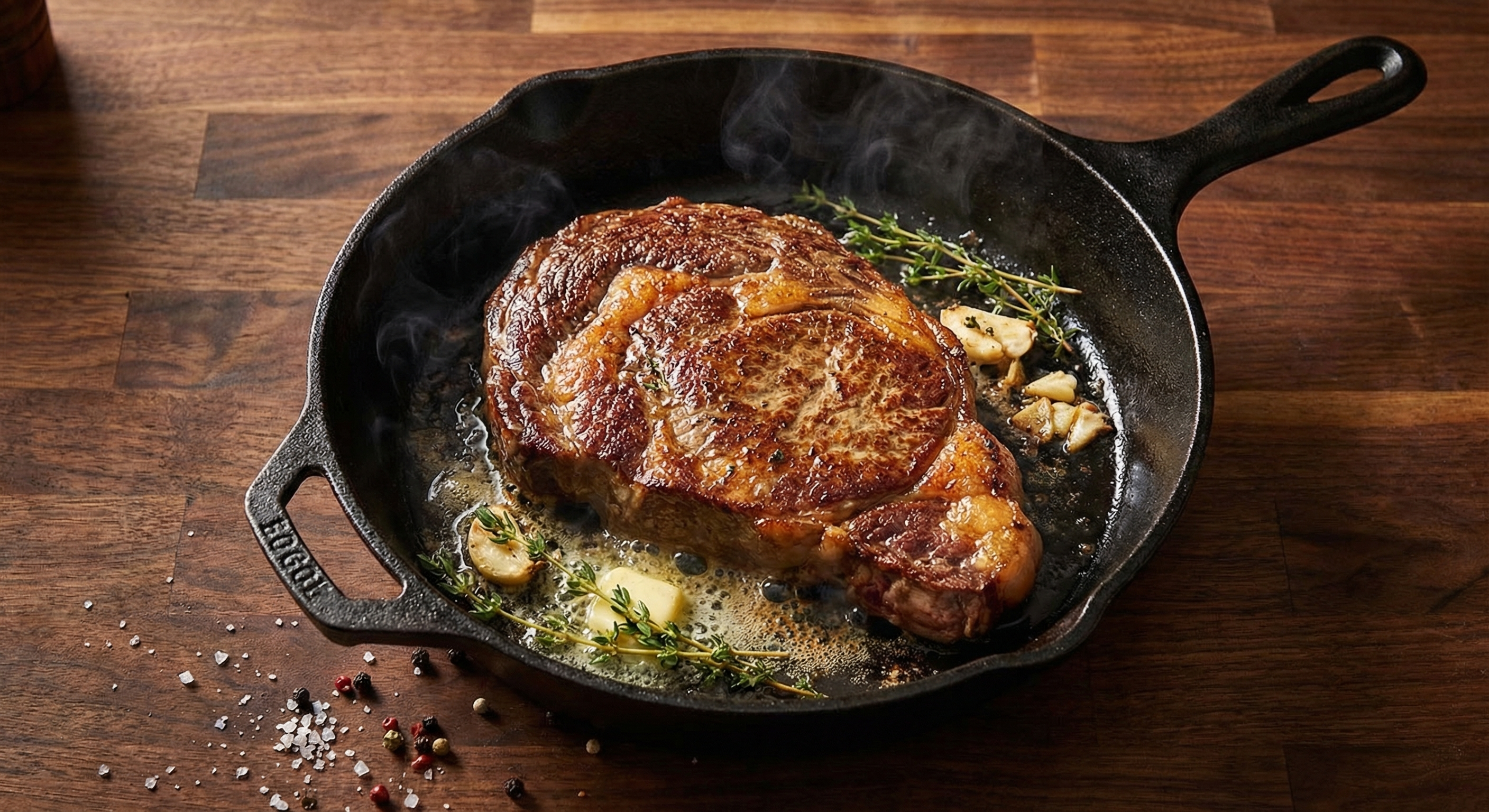
No steak performs better in cast iron than a ribeye. Period. The heavy marbling renders into the hot surface and creates a self-basting effect that no other cut can match. While leaner steaks need added fat to avoid sticking, the ribeye generates its own cooking medium as it sears.
The spinalis cap — that crescent of heavily marbled meat along the outer edge — caramelizes into what might be the single best bite of beef you'll ever eat. When that fat hits the screaming-hot iron and renders while the surface proteins undergo the Maillard reaction, you get a crust that's simultaneously crispy, buttery, and deeply beefy.
Buy it: 1.25 inches thick, bone-out. Bone-in ribeyes (cowboy steaks) don't lie flat in the pan, creating uneven contact. Save those for the grill. For cast iron, you want maximum surface contact.
Cook it: Sear 3-4 minutes per side in a 500°F skillet with a high smoke-point oil (avocado or refined canola). Add butter, garlic, and thyme in the last 90 seconds and baste. Rest 5 minutes.
Why it's #1:
- Heavy marbling creates unmatched self-basting in the pan
- Spinalis cap develops extraordinary crust
- Fat content means it's nearly impossible to overcook to dryness
- Uniform thickness when boneless ensures even searing
- Widely available at 1.25" thick ($14-22/lb for USDA Choice)
2. New York Strip: The Consistent Performer
If the ribeye is the flashy champion, the New York strip is the reliable workhorse. This cut from the short loin has a tighter grain and more consistent texture than ribeye, which means every bite is predictable — some people actually prefer that over the variable texture of a ribeye.
The fat cap running along one edge of the strip is a cast iron advantage. As the steak sears, you can press that fat cap against the hot surface to render it crispy. A rendered fat cap on a strip steak is one of the great underappreciated pleasures of home cooking. Most people trim it off. Don't. Sear it.
New York strips have moderate marbling — less than a ribeye but significantly more than tenderloin or sirloin. That's enough fat to develop a good crust without flooding the pan with rendered grease the way a heavily marbled ribeye sometimes can.
Buy it: 1.25-1.5 inches thick, USDA Choice or higher. Look for strips with visible marbling throughout, not just the fat cap. Avoid any with a thick band of gristle running through the center — that's the edge of the gluteus medius muscle intruding into the strip, and it won't render in a pan.
Cook it: Same method as ribeye. Sear fat-cap side first by holding the steak on its edge with tongs for 60-90 seconds to render the cap, then lay flat and sear 3 minutes per side.
Why it's #2:
- Consistent texture — no pockets of fat or gristle surprising you
- Fat cap renders beautifully when seared on its edge
- Firm structure holds its shape during aggressive searing
- Slightly leaner than ribeye, which some eaters prefer
- Natural rectangular shape provides excellent pan contact
3. Filet Mignon: The Tender Luxury
Here's where I'll get some pushback from steak purists. Yes, filet mignon is lean. Yes, it has less beefy flavor than a ribeye or strip. But in a cast iron skillet with proper technique, it develops a crust that transforms it from a tender-but-bland cylinder into something truly special.
The key is that filet mignon's round, compact shape gives you maximum thickness-to-surface ratio. A 2-inch thick filet can develop a serious crust on all sides — top, bottom, and the edges — while the center stays perfectly medium-rare. That contrast between the crispy seared exterior and the melt-in-your-mouth tender interior is what makes filet in cast iron a restaurant-quality experience.
Buy it: 2 inches thick, center-cut. Avoid the tapered tail end — it'll overcook. You want the barrel-shaped center of the tenderloin. Ask your butcher to cut it to spec if the pre-packaged options are thin.
Cook it: Sear all four "sides" for 2 minutes each (hold on edge with tongs for the sides), then add butter and baste for 60 seconds. The butter is essential here — filet doesn't have enough internal fat to self-baste the way a ribeye does. Rest 5-8 minutes.
Why it's #3:
- Compact shape allows crust development on all surfaces
- Extreme tenderness creates a dramatic textural contrast with the seared crust
- Thick cut means you can sear aggressively without overcooking
- Low fat content means the crust is pure Maillard — crispy and clean
- Impressive presentation for dinner guests
4. Flat Iron: The Best Value Play
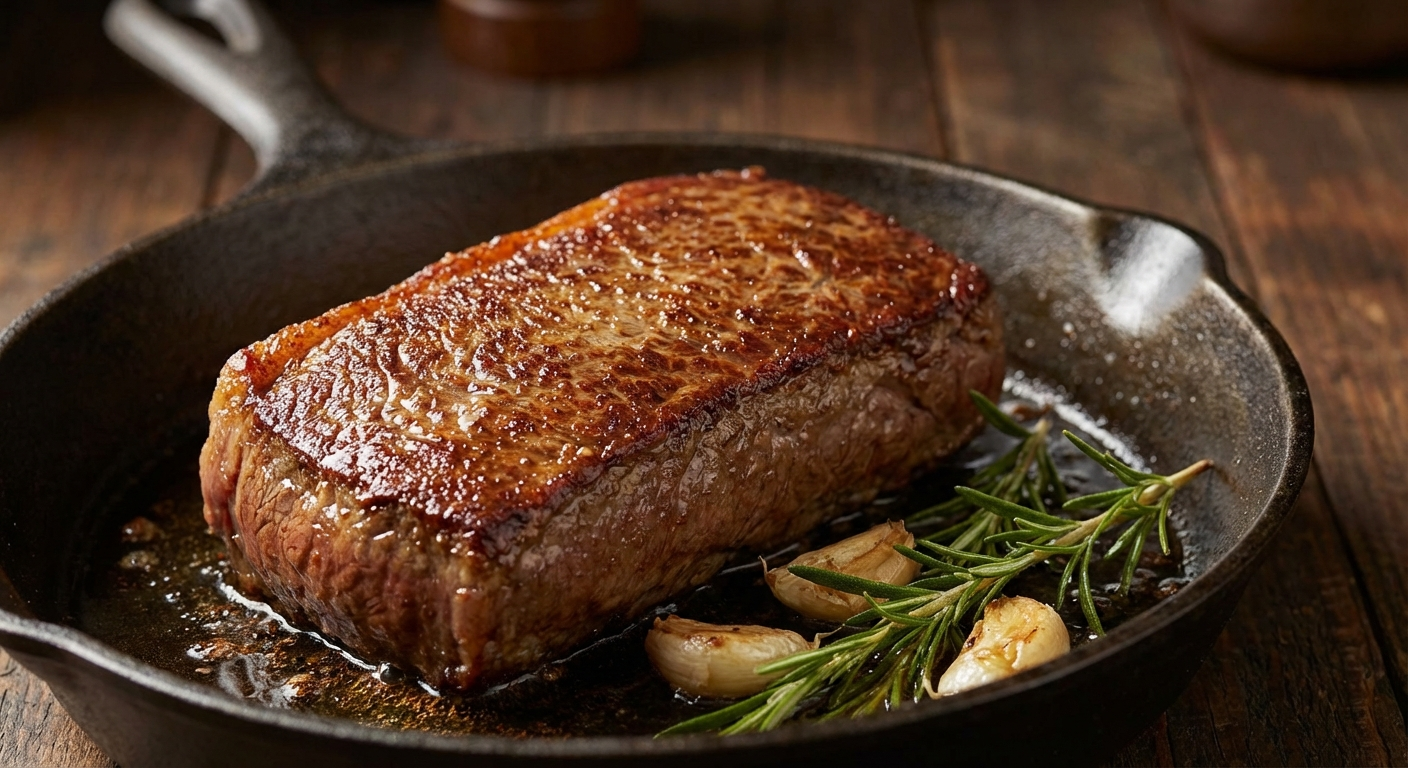
The flat iron is the second-most tender cut on the entire animal, trailing only the tenderloin. But unlike the tenderloin, it's loaded with marbling — nearly as much as a ribeye. And it costs a fraction of either. This cut is the best-kept secret in cast iron cooking.
Cut from the chuck shoulder (specifically the infraspinatus muscle), the flat iron is a flat, rectangular steak with incredibly uniform thickness. That flat profile means every square inch makes contact with the cast iron surface. No curved edges lifting off the pan. No thick spots staying raw. Just wall-to-wall contact and crust development.
The marbling in a flat iron is fine-grained and evenly distributed, which produces a consistent sear without big pools of rendered fat. The flavor is rich and buttery — not as intensely beefy as a ribeye's spinalis, but deeper and more complex than any other cut in its price range.
Buy it: Most flat irons come pre-portioned at about 8-10 ounces and 0.75-1 inch thick. If they're on the thinner side, compensate with extremely high heat and shorter sear times. The cut is thin enough that you don't need to worry about oven finishing.
Cook it: High heat, 2-3 minutes per side. Don't go past medium or you'll lose the tenderness that makes this cut special. Butter-baste in the last minute. Slice against the grain to serve.
Why it's #4:
- Uniform thickness = perfect pan contact
- Second-most tender cut on the animal
- Rich marbling rivals ribeye at half the price ($8-14/lb)
- Fine-grained fat produces a clean, consistent sear
- Rectangular shape fits perfectly in standard 12" cast iron
5. Denver Steak: The Underrated Workhorse
The Denver steak is a relatively new cut — seam-butchered from the chuck underblade — that the beef industry developed specifically because they knew there was great meat hiding in cheap primal cuts. And they were right. The Denver is tender, well-marbled, and has a deep, beefy flavor that punches well above its weight class.
What makes it especially good for cast iron is its consistent thickness and the way its moderate fat content renders at the surface. It develops a crust quickly without releasing so much fat that you're essentially shallow-frying the steak. The texture after cooking is somewhere between a strip and a flat iron — firm enough to have structure but tender enough to cut with a butter knife.
Buy it: 1-1.25 inches thick. Not every grocery store carries Denver steaks — you may need to ask the butcher to cut them, or look at specialty meat shops. They're becoming more common as word spreads about how good they are.
Cook it: Same as flat iron. High heat, 2.5-3 minutes per side, butter-baste to finish. Rest 5 minutes, slice against the grain.
Why it's #5:
- Excellent marbling from a budget-friendly primal cut
- Consistent thickness for even searing
- Deep, complex beef flavor
- Tender enough to cut with a butter knife when cooked to medium-rare
- Great conversation starter — most guests won't know the cut
6. Hanger Steak: The Butcher's Secret
There's a reason this cut is called "the butcher's steak" — for decades, butchers kept the hanger for themselves because there's only one per animal and it's one of the most flavorful cuts that exists. The hanger hangs (literally) from the diaphragm, supported between the last rib and the loin. It does almost no work, so it stays tender, but it has an incredibly concentrated, almost mineral beef flavor.
In cast iron, the hanger develops a dark, caramelized crust that's nearly black in spots — and that's exactly what you want. The coarse grain absorbs the butter baste beautifully, and the interior stays juicy because this cut has enough intramuscular fat to protect itself from the heat.
The catch: there's a thick central tendon running through the middle that must be removed before or after cooking. Your butcher should do this, splitting the hanger into two pieces. If it arrives whole, cut along each side of the tendon to separate the two lobes.
Buy it: Ask specifically for hanger steak with the tendon removed. Each side will be roughly 8-12 ounces and about 1 inch thick at the center, tapering toward the edges.
Cook it: Very high heat, 3 minutes per side. The tapered shape means the thin ends will cook faster — that's actually desirable, giving you a range from medium at the tips to rare in the center. Slice thin against the grain.
Why it's #6:
- Most intensely flavored steak cut on the animal
- Develops a dark, complex crust in cast iron
- Coarse grain absorbs butter baste perfectly
- Natural taper provides a range of doneness in one steak
- Butcher's secret that impresses anyone who loves beef
7. Coulotte (Picanha): The Brazilian Steakhouse at Home
The coulotte — known as picanha in Brazilian cooking — is the cap of the top sirloin with its thick layer of fat still attached. In Brazilian steakhouses, this cut is skewered and roasted over coals. But sliced into individual steaks and cooked in cast iron, it's a revelation.
That fat cap is the star. When you sear the fat side down first, it renders into the cast iron and creates a cooking medium that's pure beef flavor. The fat cap crisps up like pork belly crackling while the lean meat underneath stays juicy and tender. It's the contrast that makes this cut addictive.
Buy it: Look for coulotte roasts or picanha at Brazilian, Latin, or specialty butcher shops. Slice into steaks 1-1.25 inches thick, keeping the fat cap attached. Don't trim the fat — that's the entire point of this cut.
Cook it: Start fat-cap down in a medium-hot pan (not screaming hot — you want the fat to render slowly, not burn). Cook fat side 4-5 minutes until crispy and golden. Flip and sear the meat side 3 minutes. Rest 5 minutes.
Why it's #7:
- Fat cap renders into incredible crispy crackling
- Self-basting — the rendered fat keeps everything juicy
- Strong, distinctive flavor that stands alone without sauce
- Budget-friendly compared to premium cuts ($9-15/lb)
- Brings the Brazilian steakhouse experience to your kitchen
8. Chuck Eye: The Poor Man's Ribeye
The chuck eye is literally the next steak over from the ribeye — it's cut from the 5th rib, while ribeyes come from ribs 6-12. The muscle is the same (longissimus dorsi), but because it crosses the arbitrary line between the chuck and rib primals, it gets a different name and a much lower price tag.
In cast iron, a good chuck eye is nearly indistinguishable from a ribeye to anyone but an experienced butcher. The marbling is similar, the flavor is identical (it's the same muscle), and the crust development is just as impressive. The only real difference is that chuck eyes are slightly less tender because this end of the longissimus does a bit more work.
Buy it: 1-1.25 inches thick. Chuck eyes are often labeled "boneless chuck steak" — look for the ones with a clear, round eye of marbled meat resembling a ribeye. Avoid chuck steaks that are full of connective tissue and multiple muscles — those are from further up the chuck and are braising cuts.
Cook it: Exactly like a ribeye. Sear 3-4 minutes per side, butter-baste to finish. The slightly firmer texture actually holds up to aggressive searing slightly better than a ribeye.
Why it's #8:
- Same muscle as ribeye at 40-50% of the price ($8-12/lb)
- Heavy marbling creates excellent self-basting
- Nearly identical flavor to ribeye
- Firm enough to handle aggressive searing without falling apart
- The best value for a cast iron steak night
Steaks to Avoid in Cast Iron
Not every steak belongs in a cast iron skillet. Save these for other cooking methods:
T-Bone and Porterhouse: The bone prevents the meat from lying flat, creating dead spots with no sear. The strip side and tenderloin side also cook at different rates. Use the grill instead.
Bone-in Ribeye (Cowboy Steak): Same problem as the T-bone — the bone lifts meat off the surface. Beautiful on a grill, frustrating in a pan.
Eye of Round: Too lean, too tough, and too prone to drying out. No amount of cast iron magic can make this a good steak — roast it low and slow instead.
Skirt Steak: Too thin and too long to sear properly in a standard skillet. It curls, buckles, and steams instead of searing. Cook it on a flat-top griddle or a screaming-hot grill.
Sirloin Cap (Whole): The irregular shape and varying thickness make even contact impossible. Slice it into steaks first (that's coulotte — see #7 above).
Cast Iron Technique: The Fundamentals
The best cut in the world will disappoint if your technique is wrong. Here are the non-negotiable fundamentals for cast iron steak:
1. Preheat the pan for 5-7 minutes on high. A properly heated cast iron skillet should be smoking lightly before any food touches it. If you add the steak and don't hear an aggressive sizzle, the pan isn't hot enough. Take it back out and wait.
2. Dry the surface aggressively. Pat the steak with paper towels until they come away dry. Then pat again. Surface moisture is the enemy of the Maillard reaction. Some cooks salt the steak 45 minutes ahead and leave it uncovered in the fridge — the salt draws moisture out, then the moisture evaporates, leaving a perfectly dry surface. This is called the dry brine method and it works brilliantly.
3. Use the right fat. Start with a high smoke-point oil (avocado, refined canola, or grapeseed). Add butter in the last 90 seconds — not at the beginning, where it'll burn. The oil provides the initial sear; the butter provides flavor and browning in the final baste.
4. Don't touch it. Set the steak down and leave it alone for the full sear time. Pressing, poking, and flipping constantly interrupts crust formation. One flip. That's it.
5. Baste with butter. Tilt the pan toward you so the butter pools, then spoon it over the top of the steak repeatedly. Add crushed garlic, thyme sprigs, or rosemary to the butter for compound flavors that absorb into the crust.
6. Rest the steak. 5 minutes minimum. The internal temperature will rise 5-10°F during the rest (carryover cooking), so pull the steak when it's 5°F below your target doneness. Cutting too early means juices flood the plate instead of staying in the meat.
The Thickness Rule
For every cut in this guide, one rule applies: if it's thinner than 3/4 inch, don't cook it in cast iron. Thin steaks overcook before the crust develops. You end up with a gray, well-done steak with barely any browning — the worst of both worlds.
If your only option is a thin steak, use a different method. A hot grill with direct flame can sear a thin steak in 60 seconds per side. A broiler set to high can blast the surface with heat from above. But a cast iron skillet needs meat thick enough to survive 3-4 minutes of contact without overcooking, and that means 1 inch at minimum.
The ideal thickness by cut:
- Ribeye: 1.25 inches
- New York Strip: 1.25-1.5 inches
- Filet Mignon: 2 inches
- Flat Iron: 0.75-1 inch (gets a pass due to high tenderness and fat)
- Denver: 1-1.25 inches
- Hanger: 1 inch at center
- Coulotte: 1-1.25 inches
- Chuck Eye: 1-1.25 inches
Frequently Asked Questions
Frequently Asked Questions
What is the best steak to cook in a cast iron skillet?
A boneless ribeye, cut 1.25 inches thick, is the best steak for cast iron. The heavy marbling renders into the hot surface and bastes the meat as it sears, creating an unmatched crust while keeping the interior juicy. USDA Choice grade or higher gives you enough marbling to get that self-basting effect.
Should I use oil or butter in a cast iron skillet for steak?
Use both — but at different times. Start with a high smoke-point oil like avocado oil for the initial sear (it won't burn at 500°F). Add butter, garlic, and fresh herbs in the last 90 seconds and baste the steak. Starting with butter will cause it to burn and taste bitter.
How hot should a cast iron skillet be for steak?
Your cast iron should be preheated on high for 5-7 minutes until it begins to lightly smoke. That's approximately 500°F. You should hear an aggressive, immediate sizzle when the steak hits the surface. If you don't, the pan isn't hot enough — remove the steak and wait.
How thick should a steak be for cast iron cooking?
The ideal thickness is 1 to 1.5 inches. Steaks thinner than 3/4 inch will overcook before developing a proper crust. Steaks thicker than 1.5 inches may need to be finished in a 400°F oven after searing. The sweet spot — 1.25 inches — gives you a deep sear with a perfectly pink center.
Can you cook a T-bone steak in cast iron?
T-bone and porterhouse steaks are not ideal for cast iron because the bone prevents the meat from lying flat against the surface. This creates dead spots with no sear. The strip and tenderloin sides also cook at different rates. Use the grill for bone-in steaks and save your cast iron for boneless cuts.
What is the cheapest steak that works well in cast iron?
The chuck eye steak is the best budget option at $8-12 per pound. It's cut from the same muscle as a ribeye (longissimus dorsi) but comes from the 5th rib instead of ribs 6-12. The marbling and flavor are nearly identical to ribeye at roughly half the price. Flat iron steak ($8-14/lb) is another excellent value choice.
More Expert Guides
What Is Chateaubriand? (Cut, Cooking, & Best Sources)
Chateaubriand is a thick-cut roast from the center of the beef tenderloin, traditionally served for two. Learn what makes this classic French cut special and how to cook it.
14 min readWhat Is Round Steak? The Complete Guide to Beef's Most Versatile Budget Cut
Round steak comes from the rear leg of the cow — it's lean, affordable, and misunderstood. A master butcher breaks down every sub-cut, cooking method, and technique to turn this budget workhorse into genuinely delicious meals.
14 min readWhat Is Eye of Round? The Complete Butcher's Guide to This Lean Cut
Eye of round is one of the leanest, most affordable cuts in the entire beef case — and one of the most misunderstood. A butcher explains how to turn this budget-friendly roast into something genuinely delicious.