New York Strip vs Ribeye: A Butcher Breaks Down the Real Differences
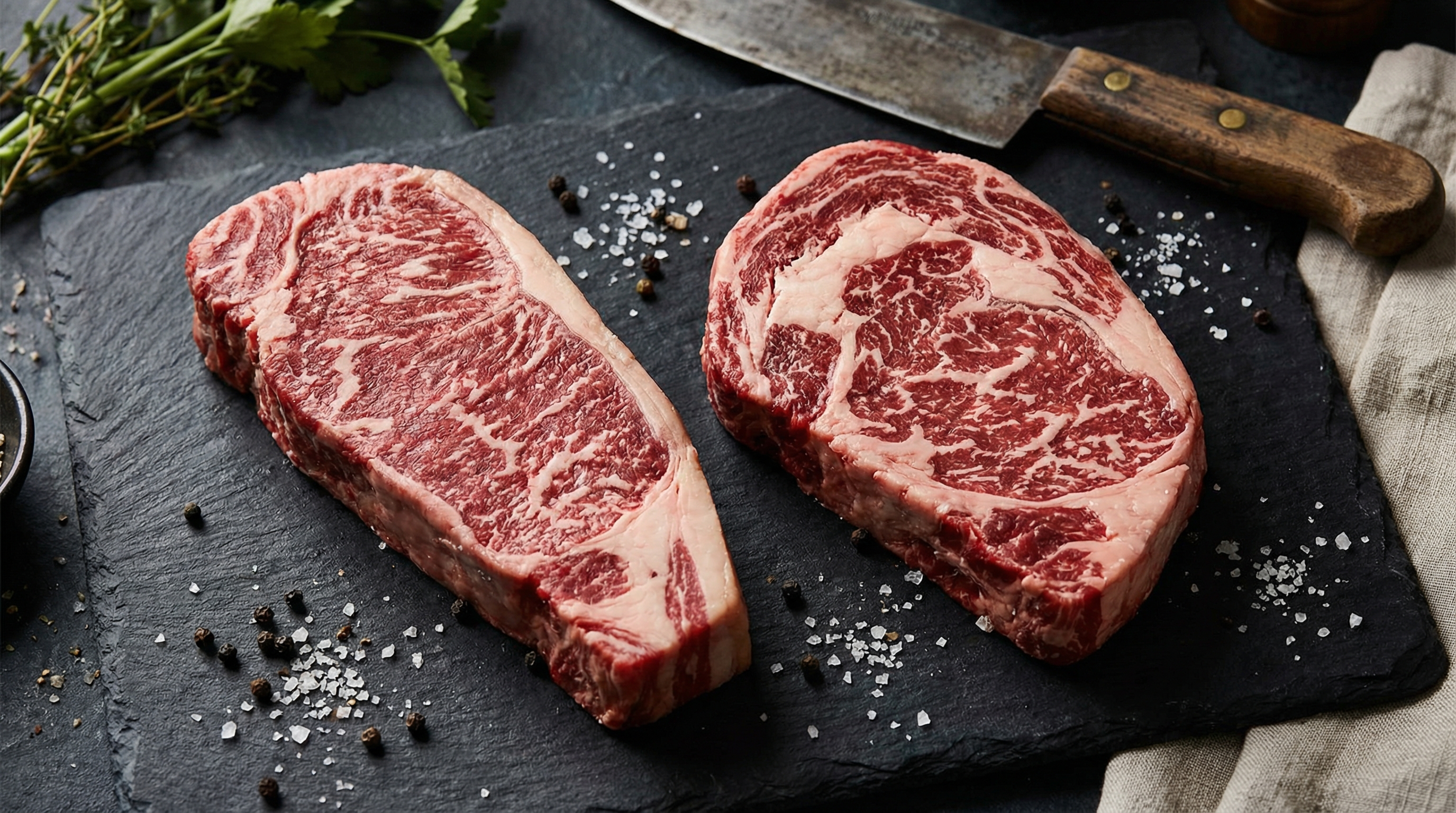
If you've ever stood at a butcher counter trying to decide between a New York strip and a ribeye, you're not alone. These are the two most popular premium steaks in America, and they sit right next to each other in almost every meat case. They're priced similarly, they're roughly the same thickness, and they both look like exactly what a great steak should look like.
But they're not the same steak. Not even close.
I've been cutting both of these steaks for over thirty years, and the number of customers who think they're interchangeable still surprises me. A New York strip and a ribeye come from different parts of the animal, they have fundamentally different fat structures, and they behave completely differently when you cook them. Choosing the right one depends on what kind of eating experience you're after — and understanding the real differences will save you from ever being disappointed by a steak again.
Where Each Cut Comes From on the Animal
The anatomy tells you almost everything you need to know about these two steaks, so let's start there.
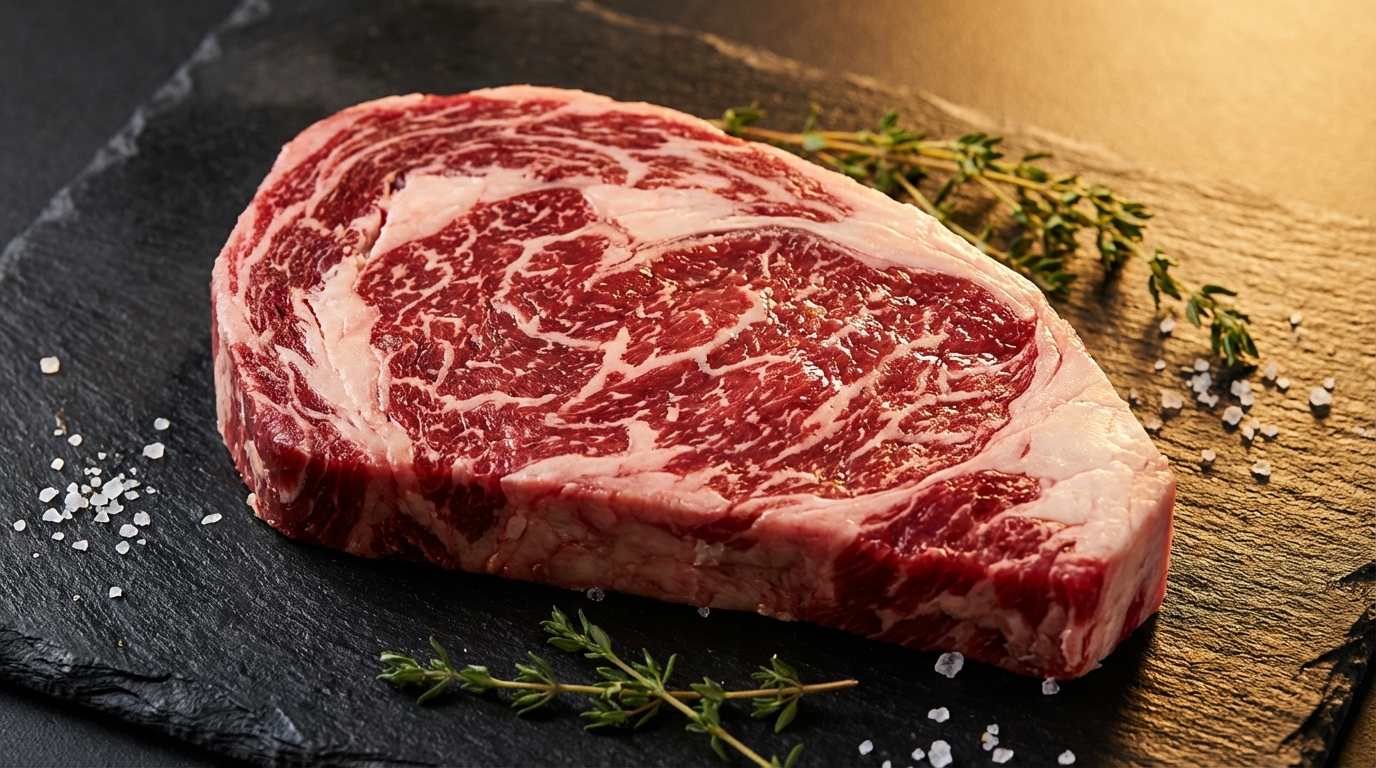
The ribeye comes from the rib primal — specifically ribs 6 through 12 along the upper back of the animal. This is one of the least-exercised areas on a steer. Muscles that don't work much stay tender and accumulate generous amounts of intramuscular fat (marbling). The ribeye is actually made up of several muscles: the main eye (longissimus dorsi), the cap (spinalis dorsi), and a section of the complexus. That multi-muscle structure is what gives ribeye its characteristic irregular marbling pattern and its famous "buttery" sections.
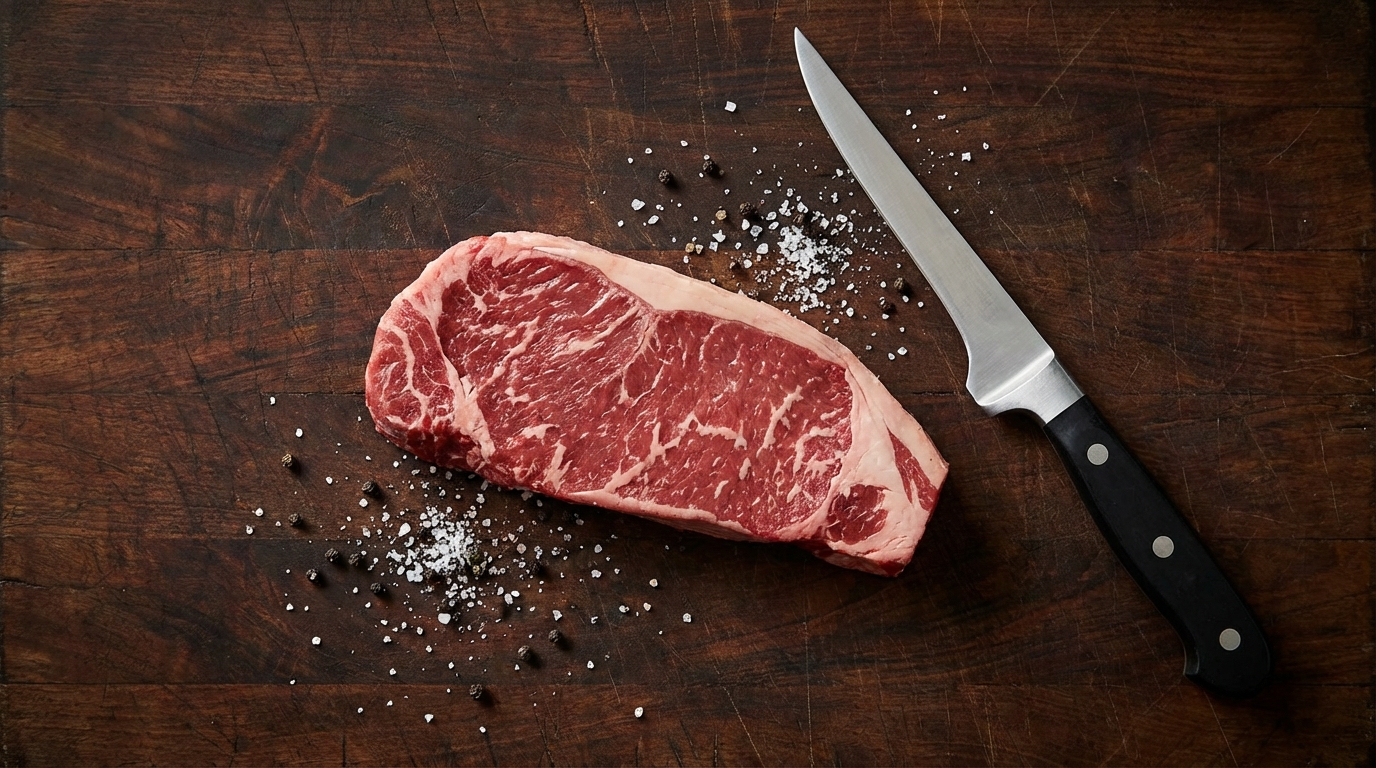
The New York strip — also called a strip steak, Kansas City strip, or shell steak — comes from the short loin primal, which sits just behind the rib section. It's cut from a single muscle: the longissimus dorsi, the same muscle that forms the eye of the ribeye. But here's the critical difference — by the time that muscle reaches the short loin, it has changed character. It's slightly leaner, slightly firmer, and it's working a bit harder. The strip also has a distinctive band of fat running along one edge (the fat cap) and a strip of connective tissue on one side, but the interior of the steak is notably more uniform than a ribeye.
Think of it this way: the ribeye is the relaxed, marbled section of a continuous muscle, and the strip is where that same muscle starts tightening up as it moves toward the hip. Same muscle, different neighborhood — and the neighborhood changes everything.
Marbling and Fat Content
This is where the biggest difference lives, and it's the single most important factor in how these steaks taste and cook.
A ribeye has significantly more intramuscular fat than a New York strip. We're not talking about the external fat you can trim off — we're talking about the white streaks and pockets of fat woven throughout the muscle itself. On the same animal, a ribeye will typically show 1 to 2 marbling grades higher than the corresponding strip steak. If the strip grades mid-Choice, the ribeye from that same carcass will often approach low Prime.
This matters because intramuscular fat does three things: it makes the steak more tender (fat melts during cooking and lubricates the muscle fibers), it adds richness and flavor (beef fat is where most of the "beefy" taste comes from), and it provides insurance against overcooking (more fat means more moisture retention, so a ribeye is more forgiving if you leave it on the heat a minute too long).
The New York strip, by contrast, is a leaner steak. It still has marbling — it's not a round steak — but the fat is distributed more evenly and in smaller amounts. The strip's fat is concentrated in the external cap along one edge and in a thin seam of connective tissue. The interior of the steak is predominantly clean, red muscle.
For many people, this is actually an advantage. A leaner steak lets the actual beef flavor come through more clearly without being masked by rendered fat. It also means fewer calories per ounce and a firmer, more satisfying chew. Whether "more fat" or "less fat" is better depends entirely on your personal preference — there is no objectively correct answer here.
Flavor and Texture Compared
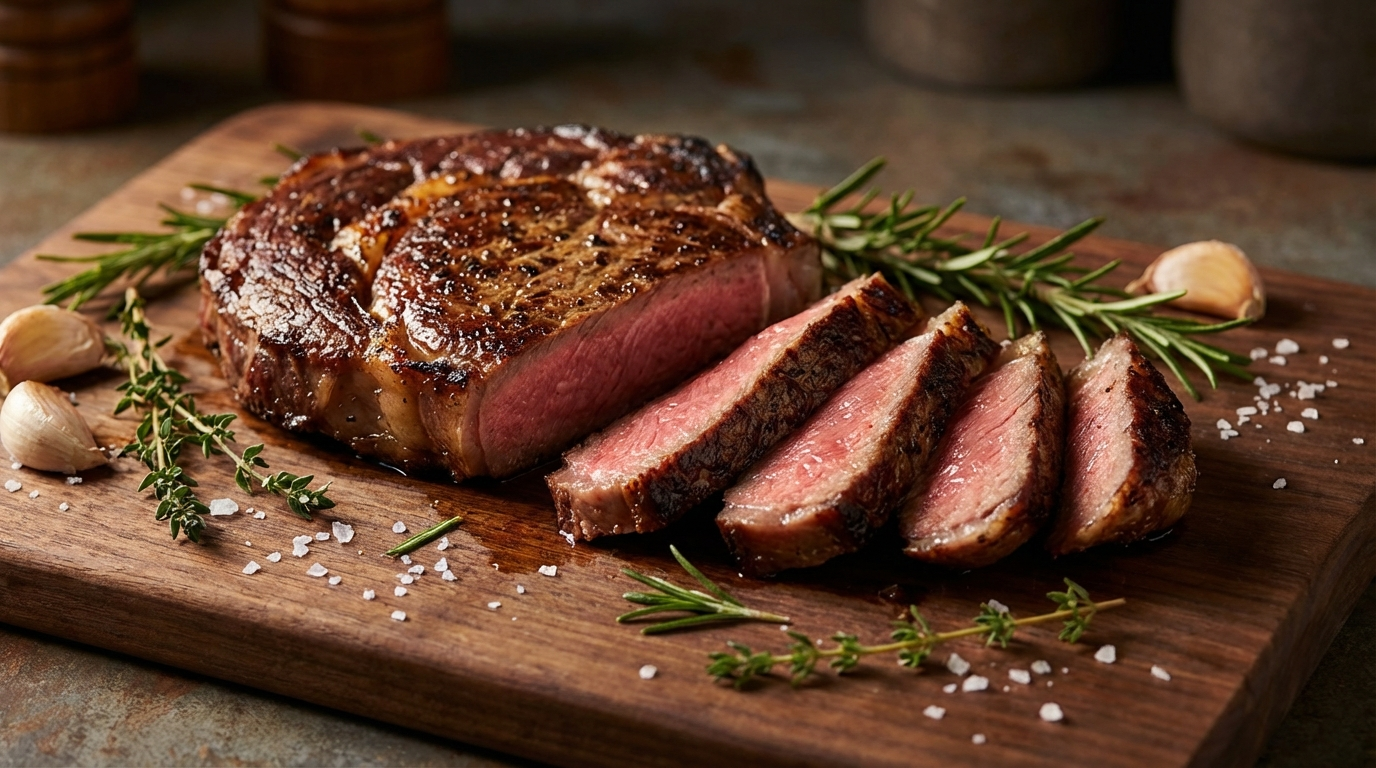
When you bite into a properly cooked ribeye, the first thing you notice is richness. The rendered intramuscular fat coats your palate, and the texture is soft, almost melting. The spinalis cap — that curved outer section of the ribeye — is widely considered one of the most flavorful pieces of beef on the entire animal. It's fattier and more tender than the center eye, and it delivers an almost decadent eating experience.
A New York strip delivers a completely different experience. The flavor is more concentrated — what butchers call "beefy." Because there's less fat diluting the muscle, you taste the actual protein more intensely. The texture is firmer, with a satisfying chew that ribeye doesn't provide. A good strip steak has a slight resistance when you bite through it, then releases clean, mineral-rich juice. It's the steak equivalent of a well-structured red wine versus a lush, fruit-forward one.
Here's something most comparison articles won't tell you: the strip has a more consistent eating experience from bite to bite. Every piece tastes roughly the same. A ribeye, because of its multi-muscle structure and irregular fat distribution, changes character across the steak. One bite might be incredibly tender and fatty (from the cap), the next might be leaner and chewier (from the eye near the center). Some people love that variety. Others find it inconsistent.
The fat cap on the strip also plays a role. When properly rendered (seared fat-side down for a minute), it becomes crispy and adds a textural contrast that the ribeye doesn't really offer. The strip's exterior fat is a feature, not a flaw — but you have to cook it right to enjoy it.
Best Cooking Methods for Each Cut
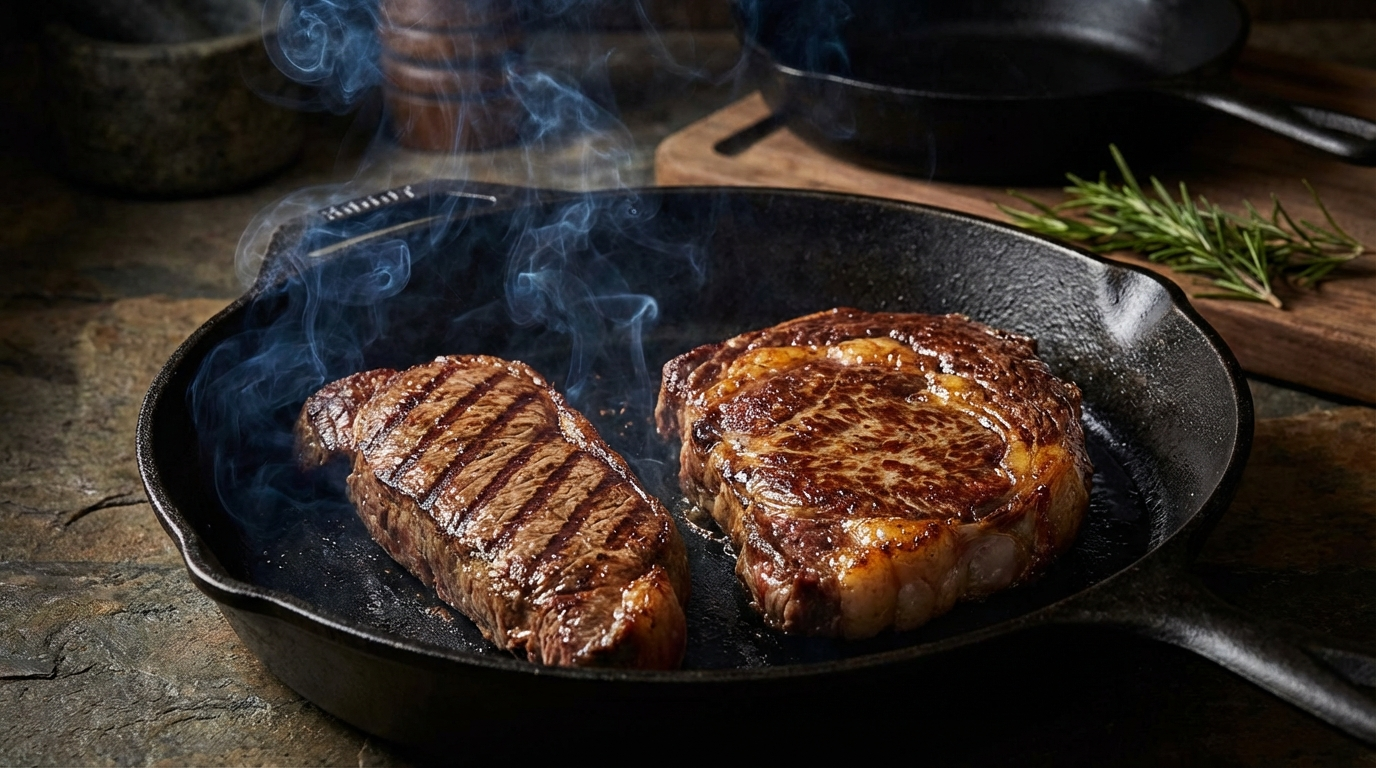
Both steaks respond well to high-heat cooking — this is not a braising situation — but they have different optimal approaches.
New York Strip: Best Methods
Cast iron sear: This is the strip's ideal cooking method. A screaming-hot cast iron pan with a thin film of high-smoke-point oil gives the strip the intense, even crust it deserves. The lean interior benefits from the aggressive Maillard reaction, and the fat cap renders beautifully when you prop the steak on its side for 60 seconds. Season with coarse salt and black pepper — nothing else.
Reverse sear: For thick-cut strips (1.5 inches or more), the reverse sear is nearly foolproof. Start in a 250°F oven until the internal temperature hits 115°F, then sear in a ripping-hot pan for 60-90 seconds per side. This method gives you edge-to-edge medium-rare with a dark, caramelized crust. The strip's uniformity makes it perfect for this technique because the consistent thickness cooks evenly.
Grilling: Strips do well on a grill, but they need attention. The lower fat content means less self-basting, so they can dry out over direct heat if you're not careful. Use the hottest zone for searing (90 seconds per side), then move to indirect heat to finish. Don't walk away.
Ribeye: Best Methods
Cast iron sear: Also excellent for ribeye, but expect more smoke and splatter. The rendering fat will pop, so use a splatter screen or accept the mess. The upside is that all that rendered fat essentially deep-fries the steak's surface, creating an incredibly rich crust.
Grilling: Ribeye is actually better suited to grilling than the strip. The fat content provides constant self-basting as it renders, keeping the meat moist over direct heat. The trade-off: expect flare-ups. Keep the grill's cool zone ready, and don't panic when flames lick up around the steak — a few seconds of flame kissing adds flavor. Just don't let it char.
Sous vide: If you want to maximize tenderness, sous vide at 130°F for 2 hours renders the intramuscular fat without overcooking the protein. Finish with a 60-second sear per side in a cast iron pan. This method transforms an already tender cut into something almost obscenely soft.
Avoid for both: Neither steak should be braised, stewed, or cooked past medium. These are premium cuts designed for dry-heat, high-temperature cooking. If you want well-done beef, buy chuck — seriously.
Price and Value
At most butcher shops and grocery stores, ribeye and New York strip are priced within $1-3 per pound of each other, with ribeye typically commanding a slight premium. As of early 2026, expect to pay roughly $16-22 per pound for Choice grade and $24-35 per pound for Prime grade, depending on your market.
But price per pound doesn't tell the whole story. A ribeye has more waste — the large pockets of exterior fat, the fatty seam between muscles, and the occasional gristly bit near the chuck end all reduce the amount of edible lean meat per dollar. A 16-ounce ribeye might deliver 12-13 ounces of actual steak eating. A 16-ounce strip delivers closer to 14-15 ounces of usable meat (you can eat the rendered fat cap if you like, and there's no waste seam).
From a pure value standpoint, the New York strip often gives you more edible meat per dollar. But value isn't just about volume — if you prefer the ribeye's rich, fatty experience, the premium is absolutely worth paying. This is steak, not economics.
Bone-In vs Boneless
Both cuts are available bone-in. A bone-in New York strip is sometimes called a shell steak or a bone-in Kansas City strip. A bone-in ribeye is sometimes called a cowboy steak (frenched bone) or simply a bone-in rib steak.
Bone-in versions cost slightly more per pound but include weight from the bone itself, which you're paying for but not eating. The bone does provide some insulation during cooking, keeping the meat nearest the bone slightly rarer than the rest — which can be a plus or a minus depending on your preference. The flavor difference from bone-in cooking is real but subtle; don't let anyone tell you it's transformative.
Which Steak Should You Buy?
After three decades of selling both, here's how I break it down for customers:
Choose the New York strip if:
- You prefer a firmer, more "steaky" texture with satisfying chew
- You want concentrated beef flavor without heavy fat richness
- You're watching your fat intake but still want a premium steak
- You value consistency — every bite should taste the same
- You're pan-searing at home and want less smoke and splatter
- You're serving steak as part of a composed plate with sides and sauce
Choose the ribeye if:
- You want the richest, most indulgent steak experience possible
- You love the buttery, melt-in-your-mouth texture that fat provides
- You enjoy textural variety within a single steak (cap vs eye)
- You're grilling and want a cut that self-bastes over flame
- You're less experienced — the extra fat is more forgiving of cooking mistakes
- The steak IS the meal, not a component
The uncomfortable truth: Most people who say they "always prefer ribeye" haven't had a properly cooked, properly sourced New York strip. And most people who say strips are "too chewy" have been eating Select-grade strips cooked to medium-well. At Choice grade or above, cooked to medium-rare, a New York strip is a world-class steak. Full stop.
My personal preference? I eat more strip steaks than ribeyes at home. The strip's consistency and clean flavor appeal to me after years of tasting both. But when I'm at a great steakhouse and someone else is cooking? Give me the ribeye, bone-in, medium-rare. Both steaks deserve a spot in your rotation.
Frequently Asked Questions
Is New York strip or ribeye more tender?
Ribeye is more tender due to its higher intramuscular fat content, which melts during cooking and lubricates the muscle fibers. New York strip is still tender — especially at Choice grade or above — but has a firmer, more satisfying chew.
Which is more expensive, New York strip or ribeye?
Ribeye typically costs $1-3 more per pound than New York strip, though prices vary by grade and market. However, strip steak offers more edible meat per pound since ribeye has more waste from fat pockets and seams.
Can you substitute New York strip for ribeye in recipes?
Yes, but adjust your technique. Strip steaks are leaner, so they cook slightly faster and are less forgiving of overcooking. Reduce cooking time by about 1 minute per side and consider basting with butter to add richness.
What temperature should I cook New York strip vs ribeye?
Both steaks are best at medium-rare (130-135°F internal). Ribeye can handle medium (140°F) better than strip because the extra fat keeps it moist. Neither cut should be cooked past medium — the quality premium you paid for is wasted.
Is a bone-in New York strip the same as a T-bone?
No. A T-bone includes both the strip and a section of tenderloin, separated by a T-shaped bone. A bone-in strip (shell steak) only has the strip muscle attached to a section of backbone. The T-bone gives you two steaks in one; the bone-in strip gives you one.
More Expert Guides
What Is Chateaubriand? (Cut, Cooking, & Best Sources)
Chateaubriand is a thick-cut roast from the center of the beef tenderloin, traditionally served for two. Learn what makes this classic French cut special and how to cook it.
14 min readWhat Is Round Steak? The Complete Guide to Beef's Most Versatile Budget Cut
Round steak comes from the rear leg of the cow — it's lean, affordable, and misunderstood. A master butcher breaks down every sub-cut, cooking method, and technique to turn this budget workhorse into genuinely delicious meals.
14 min readWhat Is Eye of Round? The Complete Butcher's Guide to This Lean Cut
Eye of round is one of the leanest, most affordable cuts in the entire beef case — and one of the most misunderstood. A butcher explains how to turn this budget-friendly roast into something genuinely delicious.