Filet Mignon vs New York Strip: Which Premium Steak Should You Choose?
Filet mignon and New York strip sit at the top of any steakhouse menu, but they couldn't be more different. One is the most tender cut of beef you'll ever eat. The other delivers bold, beefy flavor that steak purists crave. Choosing between them isn't about which is "better" — it's about what you want on your plate tonight.
After three decades behind the butcher counter, I've watched this debate play out thousands of times. The answer always comes back to the same question: do you eat steak for the texture or for the flavor?
The Quick Answer
Choose filet mignon when: You want butter-knife tenderness, a leaner steak, or you're serving someone who doesn't love heavy fat content.
Choose New York strip when: You want robust beef flavor, a satisfying chew, and a steak that can stand on salt and pepper alone.
Where Each Cut Comes From on the Cow
Both of these steaks come from the loin area of the cow, but from different muscles with very different characteristics.
The filet mignon is cut from the tenderloin (psoas major), a narrow muscle that runs along the spine beneath the ribs. This muscle bears almost no weight and does virtually no work during the animal's life. That lack of exercise is exactly why it's so tender — the muscle fibers never toughen up.
The New York strip comes from the short loin, specifically the longissimus dorsi muscle just behind the rib section. This is the same muscle that forms the larger side of a T-bone or porterhouse steak (the smaller side being the tenderloin). The strip gets slightly more use than the tenderloin, which means more developed muscle fibers and more intramuscular fat.
Tenderness: The Filet's Defining Advantage
If tenderness is your top priority, filet mignon wins — and it's not close. On the Warner-Bratzler shear force scale, the standard scientific measure of meat tenderness, the tenderloin consistently ranks as the most tender cut of beef on the entire carcass.
A properly cooked filet mignon has an almost velvety texture. The grain is fine and uniform. There's no connective tissue to fight through, no pockets of chewy fat, no variation from one bite to the next. You can cut it with a fork.
The New York strip is tender by steak standards — it's a premium cut for a reason — but it has a firmer bite. The muscle fibers are slightly coarser, and there's a strip of connective tissue running along one side that some people trim and others leave for extra flavor. The texture is more satisfying to chew, which many steak lovers actually prefer.
For guests who are new to steak, older diners who want something easy to eat, or anyone who values melt-in-your-mouth texture above all else, filet mignon is the definitive choice.
Flavor: Where the Strip Steak Shines
Here's the fundamental trade-off in beef: fat equals flavor. The New York strip carries significantly more intramuscular marbling than the filet, and that fat renders during cooking to create rich, buttery, deeply beefy flavor throughout the steak.
The strip also has a thick fat cap running along one edge. When you cook a strip steak properly — searing it fat-cap-side down first to render that cap — you get an extra layer of flavor and a satisfying crispy edge that filet simply can't deliver.
Filet mignon has a more delicate, subtle beef flavor. Some describe it as "clean" or "refined." Detractors call it mild. That's why filet mignon is traditionally served with bold accompaniments: béarnaise sauce, peppercorn cream, compound butter, or wrapped in bacon. These aren't just garnishes — they're doing the flavor work that the cut's low fat content can't.
If you want a steak that delivers knockout flavor with nothing but salt, pepper, and high heat, the New York strip is the better pick.
Marbling and Fat Content Compared
The numbers make the difference clear:
- Filet mignon: 7–10g of fat per 100g. Very little visible intramuscular marbling. Most fat is on the exterior and typically trimmed before cooking.
- New York strip: 12–18g of fat per 100g. Moderate to heavy marbling throughout, plus a distinct fat cap along one edge.
At USDA Choice grade, a New York strip will show roughly 50–80% more visible marbling than a filet from the same animal. At Prime grade, the gap widens — a Prime strip develops beautiful, lacy fat webbing throughout the meat, while a Prime filet simply has slightly more marbling than its Choice counterpart.
For calorie-conscious diners, the filet's lower fat content is an advantage. A 6-ounce filet mignon has roughly 300–350 calories, while a 12-ounce New York strip comes in around 550–700 calories. But you're also getting a significantly larger portion with the strip.
Size, Shape, and Portion Differences
These two steaks look nothing alike on the plate, and those shape differences affect cooking:
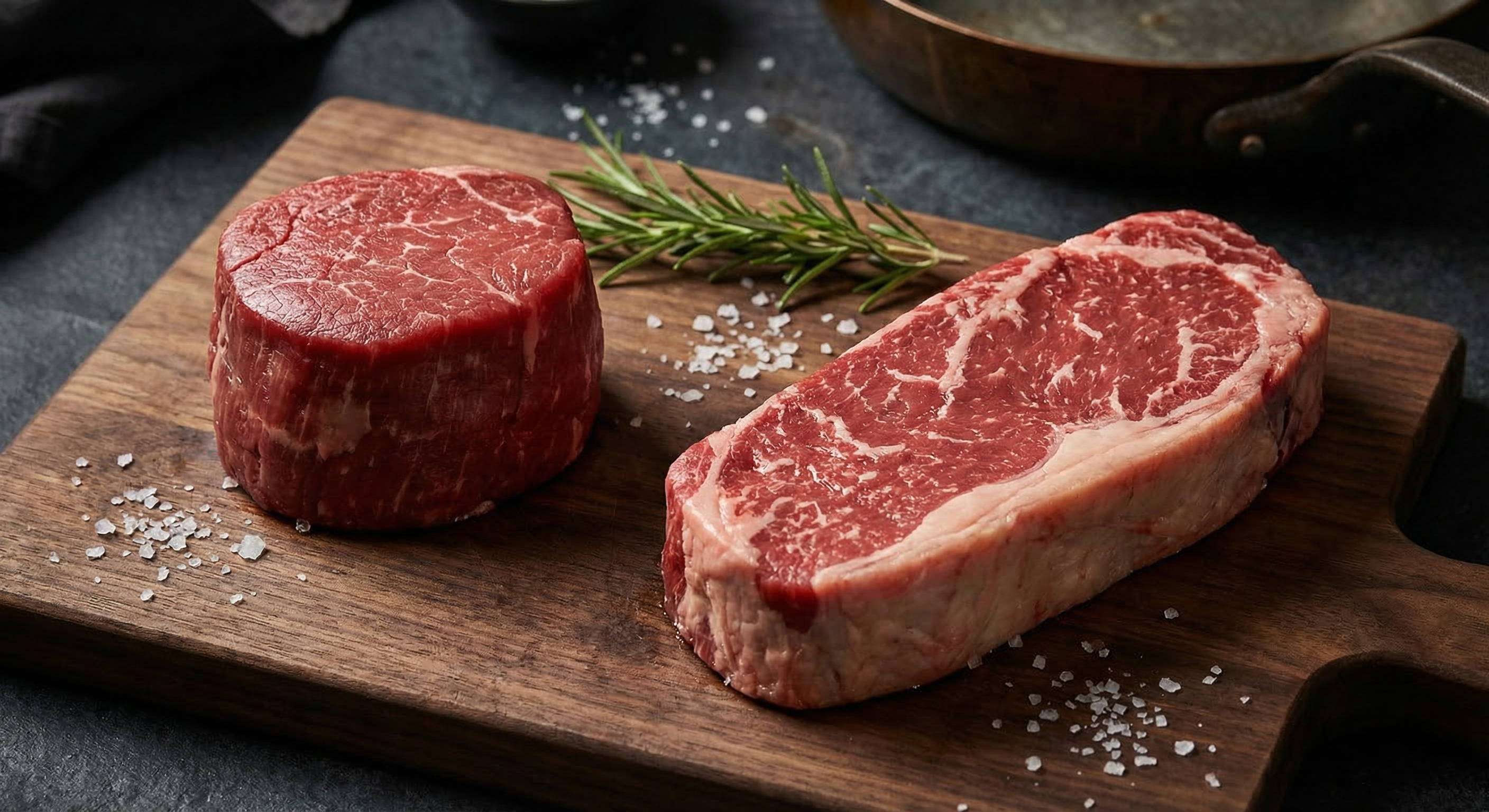
- Filet mignon: A thick, compact cylinder — typically 2–3 inches tall but only 2–3 inches in diameter. Standard portions weigh 6–8 ounces. Because the tenderloin tapers, center-cut filets are the most uniform and desirable.
- New York strip: A wider, flatter rectangle — usually 1–1.5 inches thick and 4–5 inches across. Standard portions run 10–14 ounces, making it a substantially bigger steak per serving.
The filet's tall, cylindrical shape means it takes longer to cook through to the center. It's also more prone to overcooking on the outside before the interior reaches your target temperature. That's why reverse searing works exceptionally well for filet — start it low and slow, then finish with a hard sear.
The strip's wider, thinner profile gives you more surface area for developing a flavorful crust, and its shape cooks more evenly edge-to-edge.
Best Cooking Methods for Each Cut
Filet Mignon
Because filet has minimal fat, it needs help from external fat sources and careful temperature control:
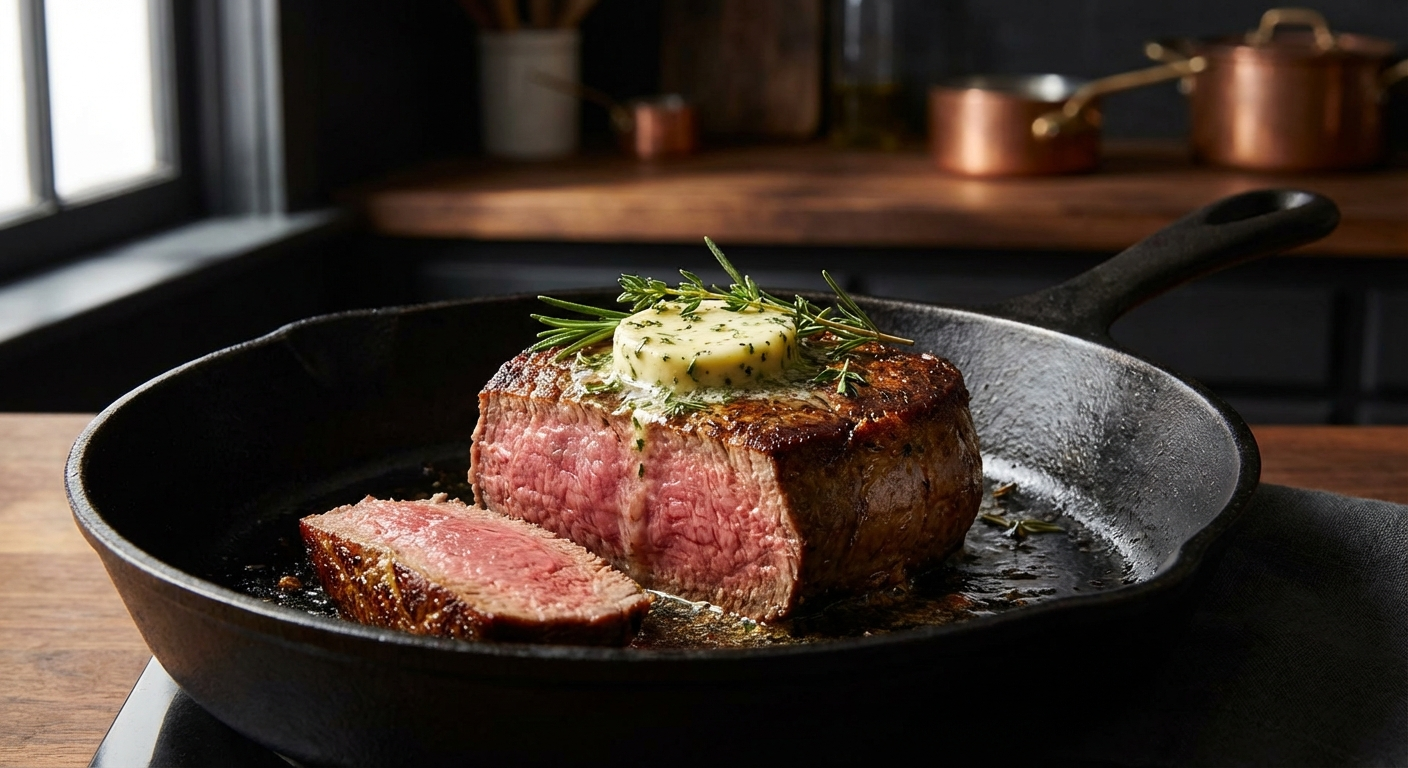
- Reverse sear (best method): Oven at 250°F until internal temp hits 115°F, then sear in a ripping hot cast iron skillet with butter for 60–90 seconds per side.
- Pan sear with butter baste: Sear in a hot skillet, then continuously baste with butter, garlic, and thyme as it finishes cooking.
- Bacon wrap: Wrap in bacon before searing to add the fat the cut naturally lacks.
- Sous vide: Set to 130°F for 2 hours, then sear. This is the most foolproof method for hitting perfect medium-rare edge to edge.
Internal temperature target: 125–130°F (medium-rare). Filet dries out quickly past medium — never cook it beyond 140°F.
New York Strip
The strip's higher fat content makes it more forgiving and gives you more cooking options:
- High-heat grill: Direct heat, 450–500°F, 4–5 minutes per side. The fat cap renders beautifully over open flame.
- Cast iron sear: Screaming hot pan with a neutral oil. Sear fat-cap edge first (hold it with tongs), then each flat side for 3–4 minutes.
- Reverse sear: Works great, especially for thick-cut strips over 1.5 inches.
- Broiler: A solid apartment-friendly option. The overhead heat mimics a steakhouse salamander.
Internal temperature target: 130–135°F (medium-rare to medium). The strip's fat keeps it juicy even at medium, making it more forgiving than filet if you slightly overshoot.
Price: What You'll Pay
Filet mignon commands the highest price per pound of any standard steak cut:
- Filet mignon (Choice): $30–$50 per pound
- New York strip (Choice): $18–$30 per pound
- Filet mignon (Prime): $50–$80+ per pound
- New York strip (Prime): $30–$45 per pound
The price gap comes down to supply. A whole beef carcass yields only about 4–6 pounds of tenderloin. The strip loin produces 10–14 pounds of steaks. When a cut is that scarce, the price reflects it.
At restaurants, expect to pay $55–$85 for a filet entrée versus $45–$65 for a strip at a comparable steakhouse. But consider this: since strip steaks are typically 50–75% larger by weight, the per-ounce cost difference is less dramatic than the sticker price suggests.
When to Choose Filet Mignon
- Special occasions where presentation and luxury matter
- Guests who prefer leaner meat or don't enjoy heavy fat
- When you're pairing with rich sauces (béarnaise, blue cheese, red wine reduction)
- Surf and turf — filet's smaller portion pairs better with lobster or crab
- Diners who want the most tender bite possible
When to Choose New York Strip
- Weeknight steak dinners — more forgiving to cook, bigger portions
- When you want bold beef flavor without accompaniments
- Grilling — the fat cap performs beautifully over open flame
- Feeding a group where value matters — more steak per dollar
- Anyone who appreciates a steak with character and chew
Side-by-Side Comparison
| Attribute | Filet Mignon | New York Strip |
|---|---|---|
| Source muscle | Psoas major (tenderloin) | Longissimus dorsi (short loin) |
| Tenderness | ★★★★★ | ★★★★☆ |
| Flavor intensity | ★★★☆☆ | ★★★★★ |
| Marbling | Low | Moderate–High |
| Fat per 100g | 7–10g | 12–18g |
| Typical portion | 6–8 oz | 10–14 oz |
| Shape | Thick cylinder | Wide rectangle |
| Price (Choice/lb) | $30–$50 | $18–$30 |
| Best for | Tenderness, lean eating | Flavor, grilling, value |
| Forgiveness | Low (overcooks easily) | High (fat keeps it juicy) |
Frequently Asked Questions
Is filet mignon or New York strip better?
Neither is objectively better — it depends on your priorities. Filet mignon is the most tender steak you can buy, with a delicate flavor and lean profile. New York strip delivers bolder beef flavor, more marbling, and is more forgiving to cook. Choose filet for tenderness and special occasions; choose strip for flavor and everyday steak nights.
Why is filet mignon more expensive than New York strip?
Filet mignon comes from the tenderloin, which yields only 4–6 pounds per 800-pound carcass. New York strip comes from the strip loin, which yields 10–14 pounds. The extreme scarcity of tenderloin drives the price premium — you're paying for limited supply more than any inherent quality difference.
Which steak has more flavor, filet mignon or strip steak?
New York strip has significantly more flavor due to its higher fat content (12–18g per 100g versus the filet's 7–10g). Intramuscular fat renders during cooking and creates rich, beefy flavor. Filet mignon has a more subtle, delicate taste, which is why it's often served with bold sauces or wrapped in bacon.
Can you grill filet mignon the same way as New York strip?
You can grill both, but they need different approaches. New York strip performs well over direct high heat thanks to its fat content. Filet mignon's low fat and thick cylindrical shape make it prone to drying out on the grill. For filet, use indirect heat to bring it to 115°F first, then sear over direct flame briefly — or stick to cast iron pan searing with butter.
What temperature should I cook filet mignon vs New York strip?
Both are best at medium-rare: 125–130°F for filet mignon, 130–135°F for New York strip. The strip can handle slightly higher temperatures (up to medium at 140°F) without drying out because its fat keeps it moist. Filet becomes noticeably dry and loses its signature tenderness above 135°F — never cook it past medium.
Is New York strip the same as Kansas City strip?
Yes. New York strip and Kansas City strip are the same cut — a boneless steak from the short loin. The name varies by region. In some areas, "Kansas City strip" specifically refers to a bone-in version, but the muscle and eating experience are identical.
More Expert Guides
What Is Chateaubriand? (Cut, Cooking, & Best Sources)
Chateaubriand is a thick-cut roast from the center of the beef tenderloin, traditionally served for two. Learn what makes this classic French cut special and how to cook it.
14 min readWhat Is Round Steak? The Complete Guide to Beef's Most Versatile Budget Cut
Round steak comes from the rear leg of the cow — it's lean, affordable, and misunderstood. A master butcher breaks down every sub-cut, cooking method, and technique to turn this budget workhorse into genuinely delicious meals.
14 min readWhat Is Eye of Round? The Complete Butcher's Guide to This Lean Cut
Eye of round is one of the leanest, most affordable cuts in the entire beef case — and one of the most misunderstood. A butcher explains how to turn this budget-friendly roast into something genuinely delicious.