T-Bone vs Porterhouse: What's the Real Difference?
Walk into any steakhouse in America and you'll see both T-bone and porterhouse on the menu, usually at very different price points. Ask your server what the difference is, and you'll get one of two answers: a confident but vague "the porterhouse is bigger," or an honest "I'm not really sure."
Neither answer tells you what you actually need to know. The difference between these two steaks is precise, regulated by the USDA, and once you understand it, you'll never confuse them again. More importantly, you'll know exactly which one is worth your money depending on what you care about eating.
I've been cutting both of these steaks from short loins for over thirty years, and the distinction matters — especially when you're paying premium prices.
The Short Answer
A T-bone and a porterhouse are both cut from the short loin of the steer. Both contain a T-shaped lumbar vertebra bone with strip steak (longissimus dorsi) on the long side and tenderloin (psoas major) on the short side. The only official difference is the size of the tenderloin section.
According to the USDA's Institutional Meat Purchase Specifications (IMPS), a porterhouse must have a tenderloin section that is at least 1.25 inches wide when measured parallel to the bone at the widest point. A T-bone only needs to be 0.5 inches wide at that same point. Anything with less than 0.5 inches of tenderloin is classified as a bone-in strip steak.
That's it. That's the rule. Everything else — the flavor, the cooking method, the muscle composition — is functionally identical.
Where Both Cuts Come From on the Cow
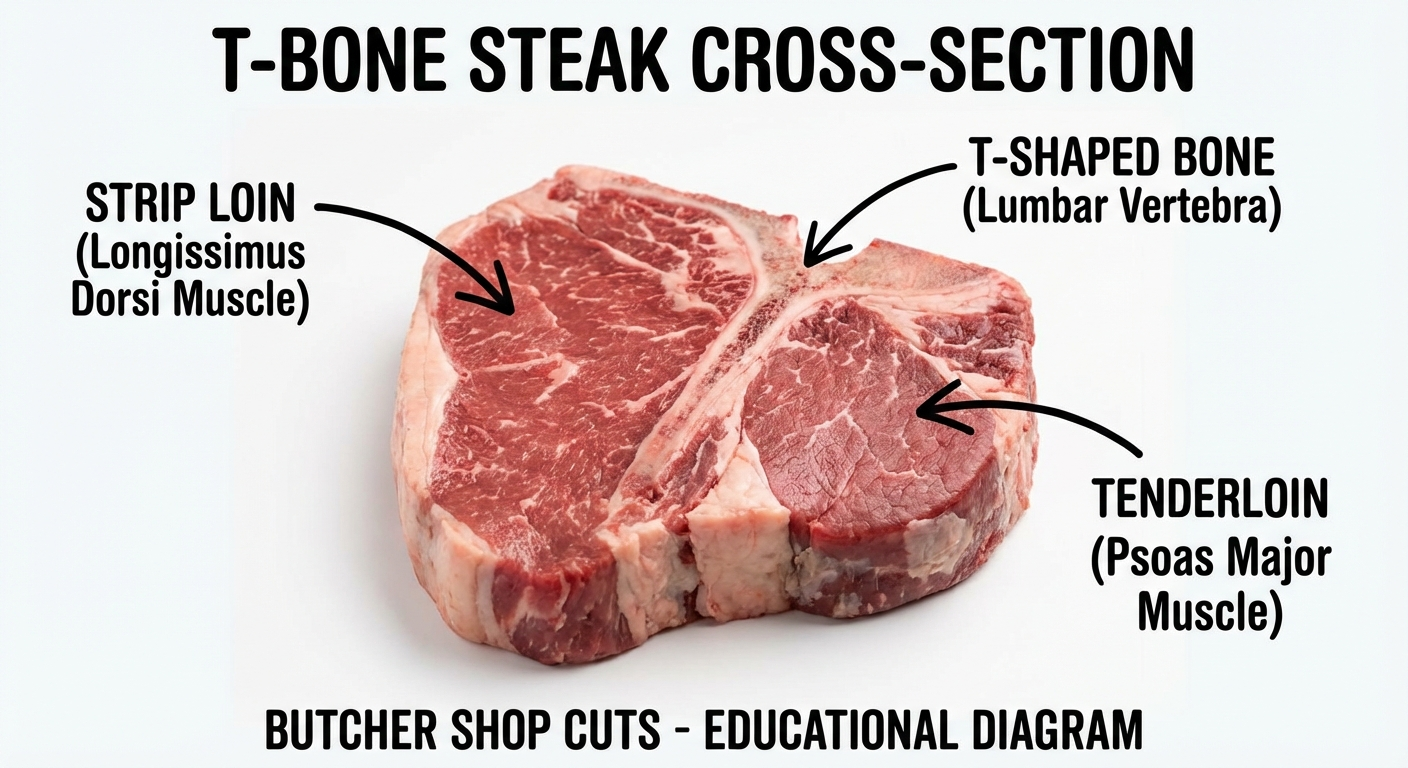
Both steaks are cross-cut slices from the short loin primal, which runs along the upper back of the animal between the rib primal (toward the front) and the sirloin (toward the rear). When a butcher breaks down a short loin, they cut perpendicular to the spine, producing steaks that include a cross-section of the vertebral bone.
The short loin contains two muscles separated by that T-shaped bone:
- Strip loin (longissimus dorsi) — the larger side, which becomes New York strip when cut boneless. Well-marbled, firm texture, robust beef flavor.
- Tenderloin (psoas major) — the smaller side, which becomes filet mignon when cut boneless. Extremely tender, mild flavor, very lean.
Here's the key to understanding the T-bone vs porterhouse distinction: the tenderloin muscle gets larger as you move toward the rear of the animal. At the front of the short loin (near the rib), the tenderloin is barely present — just a sliver. Steaks cut from this area are T-bones. At the back of the short loin (near the sirloin), the tenderloin is at its widest. Steaks cut from this area are porterhouses.
A whole short loin typically yields 2-4 porterhouse steaks from the rear end and 4-6 T-bones from the front. The steaks in between — where the tenderloin is right around that 1.25-inch threshold — are where butchers earn their pay. A sixteenth of an inch can mean the difference between labeling it a T-bone or a porterhouse, and that label change affects the price tag.
The USDA Rules in Detail
The USDA classifies these steaks under IMPS/NAMP specifications that the entire commercial meat industry follows:
- IMPS #1174 — Porterhouse: Tenderloin width must be at least 1.25 inches, measured from the closest point of the tenderloin to the bone, parallel to the bone's length.
- IMPS #1173 — T-Bone: Tenderloin width must be at least 0.5 inches but less than 1.25 inches, measured the same way.
- Bone-in Strip Steak: Tenderloin width less than 0.5 inches, or tenderloin removed entirely.
These aren't suggestions — they're federal labeling standards. A grocery store that labels a T-bone as a porterhouse is technically in violation. That said, enforcement at the retail level is inconsistent. Some butchers label generously, particularly at smaller shops. If you want to verify, bring a ruler. Measure the tenderloin at its widest point parallel to the bone. Over 1.25 inches? Porterhouse. Under? T-bone.
Flavor and Texture: Is There a Difference?
In terms of the strip side, there is zero difference. The longissimus dorsi muscle is essentially the same whether you're cutting from the front or back of the short loin. Marbling, grain, and flavor profile are consistent throughout.
The tenderloin side is where a distinction exists, but it's subtle. The tenderloin from the front of the short loin (T-bone territory) tends to be very slightly firmer and has marginally more connective tissue than the tenderloin from the rear (porterhouse territory). In practice, most people cannot tell the difference in a blind tasting.
The real difference you'll notice is quantity. A porterhouse gives you a meaningful portion of tenderloin — enough to be its own distinct eating experience on the plate. A T-bone's tenderloin is more of a bonus bite, a taste of filet alongside your strip. If you're the kind of person who orders filet mignon for the tenderness, the porterhouse is the better value because you're getting both a strip and a filet in one steak.
Size and Weight Comparison
Because the porterhouse includes more tenderloin, it's a heavier steak overall. Typical weights:
- T-bone: 12-20 oz (340-570g), with 1-3 oz of tenderloin
- Porterhouse: 20-36 oz (570g-1kg), with 4-8 oz of tenderloin
A thick-cut porterhouse — say, 1.5 to 2 inches — can easily weigh two pounds and serve two people comfortably. It's the classic steakhouse sharing steak. A T-bone is more of a single-serving cut, though a generous one.
This size difference directly impacts cooking. A 24-ounce porterhouse has significantly more thermal mass than a 14-ounce T-bone, which means longer cooking times and a greater risk of the tenderloin overcooking before the strip is done (more on that below).
How to Cook Each One
The cooking challenge with both T-bones and porterhouses is the same: the tenderloin cooks faster than the strip. The tenderloin is leaner, thinner, and has less connective tissue. If you cook both sides evenly, the tenderloin will be well-done by the time the strip reaches medium-rare.
This problem is more pronounced with the porterhouse because the tenderloin is larger. Here's how to handle it:
The Reverse Sear Method (Best for Porterhouse)
- Season generously with kosher salt 45 minutes before cooking (or dry brine overnight uncovered in the fridge)
- Place on a wire rack over a sheet pan in a 250°F oven
- Cook until internal temp reaches 115°F in the strip section (roughly 40-50 minutes for a 1.5-inch cut)
- Rest 5 minutes while you heat a cast iron skillet smoking hot with a high-smoke-point oil
- Sear 90 seconds per side, positioning the tenderloin side away from the hottest part of the pan
- Rest another 5 minutes before serving
The key technique: during the sear, angle the steak so the strip side gets more direct heat than the tenderloin. Some cooks hold the steak with tongs at a slight tilt. This compensates for the tenderloin's faster cooking rate.
The Grill Method (Great for T-Bone)
- Set up a two-zone fire — hot coals on one side, no coals on the other
- Start the steak on the cooler side with the tenderloin facing away from the coals
- Cook to 110°F internal, then move to the hot side for a hard sear
- Again, keep the tenderloin oriented toward the cooler zone during the sear
- Total cook time for a 1-inch T-bone: 12-16 minutes
For both cuts, target an internal temperature of 130°F (medium-rare) in the strip, measured near the bone. The tenderloin will read 5-10 degrees higher, which is fine — you want the tenderloin at medium-rare to medium for the best texture.
Pricing: What Should You Pay?
Porterhouse commands a premium over T-bone at every level of the market:
- Grocery store (USDA Choice): T-bone $14-18/lb, Porterhouse $17-22/lb
- Butcher shop (USDA Prime): T-bone $28-35/lb, Porterhouse $32-42/lb
- Steakhouse: T-bone $45-65, Porterhouse $65-120+ (often listed as "for two")
Is the porterhouse premium justified? It depends on how you value tenderloin. A boneless filet mignon typically costs $35-50/lb at a quality butcher. If you calculate the "embedded" filet value in a porterhouse, the math usually works out in the porterhouse's favor. You're getting a strip steak and a filet mignon for roughly the price of the strip plus 30%.
The T-bone, on the other hand, is a better value if you primarily want a strip steak and consider the small tenderloin portion a bonus. You're paying strip steak prices plus a small markup for the bone and that bite of filet.
Which One Should You Buy?
Here's my honest recommendation after decades of cutting and cooking both:
Buy a porterhouse when:
- You're feeding two people and want to share one impressive steak
- You love tenderloin and want a real portion of it alongside your strip
- You're cooking a special occasion dinner and want the "wow factor" presentation
- You're confident with reverse searing or have experience managing two-zone heat
Buy a T-bone when:
- You primarily want a strip steak and the tenderloin is a nice bonus
- You're grilling for one and want a bone-in steak with great presentation
- You want to spend less per pound without sacrificing strip quality
- You prefer a slightly easier cook (less tenderloin to worry about overcooking)
Skip both and buy boneless when:
- You want precise, even cooking (bones create heat shadows)
- You're pan-searing in a small skillet (bones prevent full contact with the pan)
- You want to slice the steak before serving (the bone is in the way)
Common Myths and Mistakes
"The bone adds flavor"
This is one of the most persistent myths in steak culture. Controlled taste tests have consistently shown that tasters cannot reliably distinguish between bone-in and boneless steaks cooked to the same internal temperature. What the bone does do is insulate the meat near it, creating a slightly less-cooked zone that some people prefer. It also makes for better presentation. But it's not infusing flavor into the meat — bone marrow doesn't migrate through solid bone into muscle tissue during a 15-minute cook.
"Porterhouse is always better"
Not necessarily. If you don't care about tenderloin, a T-bone gives you the same strip steak at a lower price. And some experienced steak eaters actually prefer the strip side to the tenderloin — it has more marbling, more beefy flavor, and a firmer texture that many find more satisfying than the tenderloin's buttery softness.
"You can substitute one for the other in any recipe"
Generally yes, but watch the cooking times. A recipe written for a 14-oz T-bone will overcook a 14-oz T-bone and significantly undercook a 28-oz porterhouse. Always cook to temperature, not time.
Frequently Asked Questions
Frequently Asked Questions
What is the main difference between a T-bone and a porterhouse steak?
The only official difference is the size of the tenderloin (filet) section. A porterhouse must have a tenderloin at least 1.25 inches wide, while a T-bone only requires 0.5 inches. Both come from the short loin and contain strip steak and tenderloin separated by a T-shaped bone.
Which is more expensive, T-bone or porterhouse?
Porterhouse is typically 15-25% more expensive per pound than T-bone because it contains a larger portion of tenderloin, which is the most expensive cut of beef. At a steakhouse, expect to pay $20-50 more for a porterhouse versus a T-bone.
Can you cut a porterhouse into a T-bone and a filet mignon?
Technically yes — you can cut the tenderloin portion off a porterhouse and you would have a bone-in strip steak and a small filet. However, this defeats the purpose of buying the steak. The porterhouse is meant to be cooked and served with both muscles attached to the bone.
What temperature should I cook T-bone and porterhouse steaks to?
Target 130°F internal temperature in the strip side for medium-rare. The tenderloin side will read 5-10 degrees higher, which is fine. Use a two-zone cooking method to prevent the tenderloin from overcooking before the strip is done.
Why is the tenderloin on my T-bone so small?
T-bones come from the front portion of the short loin where the tenderloin muscle is naturally smaller. If you want more tenderloin, ask your butcher for a porterhouse, which comes from the rear of the short loin where the tenderloin is at its widest.
More Expert Guides
What Is Chateaubriand? (Cut, Cooking, & Best Sources)
Chateaubriand is a thick-cut roast from the center of the beef tenderloin, traditionally served for two. Learn what makes this classic French cut special and how to cook it.
14 min readWhat Is Round Steak? The Complete Guide to Beef's Most Versatile Budget Cut
Round steak comes from the rear leg of the cow — it's lean, affordable, and misunderstood. A master butcher breaks down every sub-cut, cooking method, and technique to turn this budget workhorse into genuinely delicious meals.
14 min readWhat Is Eye of Round? The Complete Butcher's Guide to This Lean Cut
Eye of round is one of the leanest, most affordable cuts in the entire beef case — and one of the most misunderstood. A butcher explains how to turn this budget-friendly roast into something genuinely delicious.