Best Beef Cuts for Jerky: A Butcher's Guide to Perfect Homemade Jerky
I've spent over four decades behind a butcher counter, and every January the same thing happens: a wave of customers shows up asking me to slice beef thin for jerky. New Year's resolutions, hunting season prep, or just someone who finally got a dehydrator for Christmas. The first thing I tell every single one of them is this: the cut matters more than the marinade.
You can have the best jerky recipe in the world — soy sauce, Worcestershire, brown sugar, the works — but if you start with the wrong cut of beef, you'll end up with jerky that's either greasy, crumbly, or so tough it could double as a leather belt. The right cut gives you that perfect balance: chewy but not jaw-breaking, beefy but not gamey, and with enough structure to hold together without falling apart in the bag.
Here's everything I know about choosing beef for jerky, ranked from best to perfectly acceptable.
What Makes a Good Jerky Cut?
Before we talk specific cuts, you need to understand what you're looking for — and more importantly, what you're trying to avoid. Jerky is dehydrated meat. You're removing 60-70% of the moisture from raw beef, concentrating everything that's left. That means every characteristic of the raw meat gets amplified in the finished product.
Lean is essential. Fat doesn't dehydrate — it renders and goes rancid. A well-marbled ribeye makes a terrible jerky because all that beautiful intramuscular fat becomes greasy pockets that spoil quickly. You want cuts with minimal visible marbling. This is the one time in the butcher shop where I'll tell you to avoid fat.
Tight, uniform grain matters. The muscle fiber direction (the grain) determines how your jerky tears and chews. Cuts with a consistent, easily identifiable grain direction let you slice either with or against it for different textures. Cuts with complex, multi-directional grain patterns are harder to slice consistently and create uneven jerky.
Large, uniform shape helps. You want cuts that give you long, consistent slices. Irregularly shaped muscles with lots of seams and connective tissue mean more trimming waste and shorter, oddly shaped pieces. A long, cylindrical roast like eye of round gives you dozens of identical slices. A chuck roast gives you a patchwork.
Connective tissue is the enemy. Unlike braising, where collagen melts into gelatin, dehydration just turns connective tissue into inedible sinew. Cuts with heavy silverskin, thick fascia, or tough gristle seams need extensive trimming before slicing.
Eye of Round: The Undisputed Champion
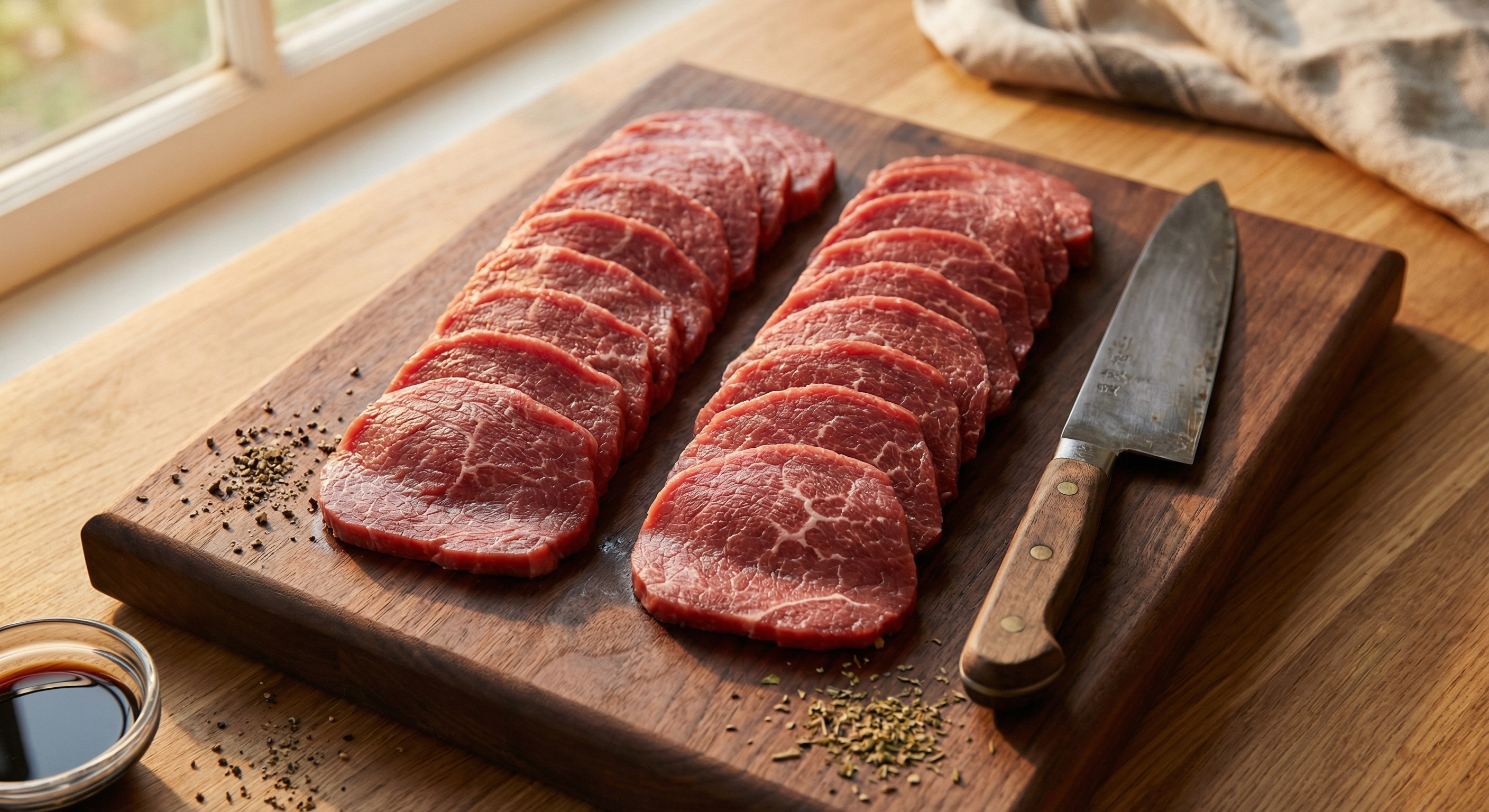
If there's one cut that was born to become jerky, it's eye of round. This small, football-shaped muscle from the rear leg is the single leanest major cut on the entire animal. It has virtually no marbling, minimal connective tissue, and a tight, uniform grain that runs in one clear direction from end to end.
The cylindrical shape is a jerky maker's dream. Set it on the cutting board, and you get slice after perfectly round slice of uniform thickness. No weird angles, no tapering ends, no thick-thin variation that causes some pieces to over-dry while others stay chewy. It's as close to factory-consistent as you'll get from a whole muscle.
Why it's #1:
- Extremely lean (2-3% fat)
- Uniform cylindrical shape for consistent slicing
- Tight, single-direction grain
- Minimal trimming waste
- Affordable ($5-7/lb)
- Widely available at any grocery store
Slicing tip: Put the roast in the freezer for 1-2 hours until it's firm but not frozen solid. This makes it dramatically easier to slice thin (1/8 to 1/4 inch). Slice against the grain for jerky that snaps cleanly with each bite, or with the grain for a chewier, more traditional pull-apart texture.
Yield: Expect about 1 pound of finished jerky from every 3 pounds of raw eye of round. A typical 3-4 pound roast gives you roughly a pound to a pound and a quarter of jerky — enough to fill a gallon zip-lock bag.
Bottom Round: The Budget Workhorse
Bottom round is the eye of round's bigger, slightly less refined cousin. It comes from the same rear leg area but it's a larger, flatter muscle with just a touch more fat and connective tissue. For jerky purposes, that barely matters — it's still extremely lean and slices beautifully.
The biggest advantage of bottom round is size and price. A bottom round roast typically weighs 4-6 pounds and costs $4-6/lb, making it the most cost-effective option when you're making jerky in bulk. If you're filling a dehydrator with five or six trays, bottom round is the cut that won't destroy your budget.
Why it works:
- Very lean, just a step below eye of round
- Large flat shape yields lots of long slices
- Budget-friendly for bulk batches
- Clear grain direction
Watch out for: Bottom round sometimes has a seam of connective tissue running through the middle. When you see it, just separate the roast into two pieces along that seam and trim it out. You'll lose maybe a few ounces of weight but your jerky won't have tough, chewy strips of gristle.
Top Round (London Broil): The All-Rounder
Top round, frequently labeled "London Broil" at the grocery store, is another excellent jerky cut. It's lean, it's large, and it has a consistent grain pattern that makes slicing straightforward. Many commercial jerky producers actually prefer top round over eye of round because the larger, flatter shape is more efficient for high-volume production.
Top round has marginally more intramuscular fat than eye of round — we're talking the difference between 3% and 5% — which some jerky makers actually prefer. That tiny bit of extra fat adds a slightly richer flavor to the finished jerky without creating greasiness or shelf-life problems.
Why it works:
- Lean enough for excellent jerky
- Large, flat shape for efficient slicing
- Slightly richer flavor than eye of round
- Widely available and affordable
Pro tip: If you see "London Broil" at a significantly lower price than "top round roast," buy it. It's the same cut — the name is a marketing holdover from a cooking method, not a different piece of beef.
Flank Steak: The Flavor King
Flank steak is where jerky starts getting interesting. It's not the most economical choice and it's not the easiest to slice, but many experienced jerky makers swear it produces the most flavorful jerky of any cut. The reason is simple: flank steak has an incredibly concentrated, beefy flavor that intensifies beautifully when dehydrated.
The grain on flank steak is extremely pronounced — you can see the long muscle fibers running lengthwise with your naked eye. This makes it easy to decide your slice direction, and slicing against that bold grain creates jerky with a satisfying snap that's hard to replicate with round cuts.
Why it works:
- Intensely beefy flavor — the best of any jerky cut
- Very lean with minimal marbling
- Pronounced grain for precise slicing
- Already flat — no need to break down a roast
The downsides: Flank steak runs $9-13/lb, making it significantly more expensive than round cuts. It's also thinner and more irregularly shaped, so you get less consistent slices and more odd-shaped end pieces. Best for small-batch, premium jerky rather than bulk production.
Deer Hunter's Favorite: Sirloin Tip (Knuckle)
Sirloin tip, also called the knuckle or round tip, comes from the front of the rear leg where it meets the sirloin. It's lean, moderately tender, and has a beefy flavor that sits between the mildness of eye of round and the intensity of flank steak. Many hunters and outdoor enthusiasts prefer this cut because its flavor profile pairs well with bold marinades — teriyaki, peppered, or spicy.
The sirloin tip is typically sold as a large roast (3-5 pounds) and has a somewhat triangular shape. It's not as uniformly shaped as eye of round, but with a little trimming, it yields plenty of good slices. There are usually one or two small seams of connective tissue to work around.
Why it works:
- Lean with good beefy flavor
- Moderate price point ($5-8/lb)
- Large enough for bulk batches
- Takes marinades exceptionally well
Lifter Meat (Cap and Wedge): The Butcher's Secret
Here's a cut most people have never heard of, and it makes fantastic jerky. Lifter meat — sometimes called the cap and wedge or blade meat — is a thin, flat muscle that gets trimmed off during rib and chuck processing. Most butcher shops sell it cheap or grind it into hamburger because customers don't know what to do with it.
But it's lean, it's flat, it has a great grain structure, and because it's essentially scrap from premium primal processing, it's dirt cheap. If your butcher breaks down whole primals in-house, ask them to save the lifter meat for you. You'll pay $3-5/lb for a cut that makes jerky every bit as good as eye of round.
Why it works:
- Extremely affordable
- Already thin and flat — minimal prep
- Lean with good beef flavor
- Available from butcher shops that break primals
Availability note: You won't find lifter meat at a typical grocery store. This is a butcher-shop-only cut. Call ahead and ask — they'll know what you mean, and most will be happy to set it aside instead of grinding it.
Brisket Flat: The Smoky Option
The flat portion of the brisket — specifically the flat, not the point — makes surprisingly good jerky with a unique character. The flat is the leaner half of the brisket, with a long, consistent grain and a uniform thickness that slices well. It has a slightly more complex flavor than round cuts, with a depth that reminds you of slow-smoked barbecue even before you add any smoke flavoring.
Brisket flat is more expensive than round cuts and requires more trimming (there's usually a fat cap on one side that needs to come off entirely for jerky). But if you catch a sale on whole packer briskets, separating the flat from the point and using the flat for jerky while smoking the point is an efficient use of the whole cut.
Why it works:
- Rich, complex flavor
- Long grain for clean slicing
- Uniform thickness when trimmed
- Great with smoky or peppery marinades
Cuts to Avoid for Jerky
Now that you know what to buy, let me save you some money and frustration by telling you what not to buy.
Ribeye and strip steak: Too much intramuscular fat. The marbling that makes these cuts amazing on the grill turns into greasy, quick-to-spoil jerky. Save your money.
Chuck roast: Too many connective tissue seams running in different directions. You'll spend half your time trimming and the grain is multi-directional, making consistent slicing nearly impossible. Use chuck for stew instead.
Pre-cut "stew meat": Those little cubes in the meat case are usually a mix of trim from different cuts. Different muscles, different grain directions, different fat content. You can't make consistent jerky from random cubes.
Ground beef: Ground beef jerky is a different product entirely — it's pressed, formed jerky made with a jerky gun. It's fine if that's what you want, but it's a completely different texture and process than whole-muscle sliced jerky. Don't try to dehydrate raw ground beef patties — it doesn't work and it's a food safety concern.
Tenderloin: Setting aside the absurd cost ($25-40/lb), tenderloin is so lean and tender that it makes crumbly, mealy jerky with no chew. Jerky needs some structure from tightly worked muscle fibers, and tenderloin has none.
Slicing: The Technique That Makes or Breaks Your Jerky
No matter which cut you choose, how you slice it determines the final texture of your jerky. This is where most home jerky makers struggle, and the fix is surprisingly simple.
Against the grain = snap. Slicing perpendicular to the muscle fibers (against the grain) creates jerky that breaks cleanly when you bend it. Each bite tears through shortened fibers, giving you that satisfying snap. This is what most people picture when they think of jerky.
With the grain = chew. Slicing parallel to the muscle fibers (with the grain) creates jerky with long, intact fibers that you tear and pull apart. It's chewier, more fibrous, and takes longer to eat. Traditional Native American-style jerky and pemmican were typically made this way.
Thickness matters enormously. Aim for 1/8 to 1/4 inch thick slices. Thinner slices (1/8") dry faster (4-6 hours) and create crispier, snappier jerky. Thicker slices (1/4") take longer (8-12 hours) but produce chewier, meatier jerky. Consistency is more important than the exact thickness — if some pieces are 1/8" and others are 1/4", the thin ones will be overdone by the time the thick ones are ready.
The freezer trick: This is the single best piece of advice I give to home jerky makers. Place your trimmed roast in the freezer for 1-2 hours until it's firm on the outside but not frozen through. A partially frozen roast holds its shape under the knife, allowing you to cut thin, uniform slices that would be impossible with room-temperature meat. If you have an electric slicer, even better — set it to 3/16" and let it do the work.
How Much Beef Do You Need?
The universal rule of jerky is that it takes about 3 pounds of raw beef to make 1 pound of finished jerky. The exact ratio depends on the cut's moisture content, your slice thickness, and how long you dehydrate, but 3:1 is a reliable planning number.
Here's a quick reference:
- Small batch (snacking): 2 lbs raw → about 10-11 oz finished
- Medium batch (sharing): 5 lbs raw → about 1.5-1.7 lbs finished
- Large batch (stocking up): 10 lbs raw → about 3-3.5 lbs finished
Factor in about 10-15% trimming waste for most cuts (less for eye of round, more for brisket flat). So if you want 1 pound of jerky, buy 3.5 pounds of raw beef to be safe.
A Note on Food Safety
One thing I always tell customers: jerky is a preserved food, but it's not invincible. The USDA recommends heating beef to 160°F before or during the drying process to kill any bacteria present on the surface or in the muscle. Most dehydrators don't reach 160°F on their own.
The safest approach is to briefly pre-cook your marinated slices — either by steaming them, boiling them in the marinade for 5 minutes, or bringing them to 160°F in an oven before transferring to the dehydrator. I know some jerky purists skip this step, but I've seen the food safety data, and the pre-heat step is the right call, especially if you're giving jerky to other people.
Store finished jerky in airtight containers or vacuum-sealed bags. Properly dried and stored jerky lasts 1-2 months at room temperature and up to 6 months in the freezer.
The Bottom Line
For most people making jerky at home, eye of round is the perfect cut. It's lean, affordable, easy to slice, and produces consistent, great-tasting jerky every time. If you want to experiment, try flank steak for maximum beef flavor or bottom round for the best value on large batches.
But here's the real secret: there's no single "best" cut because great jerky comes down to lean meat, consistent slicing, and a marinade you love. Pick any of the cuts on this list, slice it thin, season it well, and dry it properly. You'll be making jerky that puts the gas station stuff to shame.
Frequently Asked Questions
What is the best cut of beef for jerky?
Eye of round is the best overall cut for beef jerky. It's extremely lean (2-3% fat), has a uniform cylindrical shape for consistent slicing, tight single-direction grain, and is affordable at $5-7 per pound. Bottom round and top round are also excellent choices, especially for large batches.
Can you make jerky from fatty cuts like ribeye?
You should avoid fatty cuts like ribeye, strip steak, and well-marbled chuck for jerky. Fat doesn't dehydrate properly — it renders during drying and goes rancid quickly, creating greasy jerky with a much shorter shelf life. Stick to lean cuts with minimal visible marbling.
How much raw beef do you need to make one pound of jerky?
The general rule is 3 pounds of raw beef makes about 1 pound of finished jerky. The exact ratio depends on the cut's moisture content and your drying time, but 3:1 is a reliable planning number. Add 10-15% for trimming waste, so buy about 3.5 pounds of raw beef for every pound of jerky you want.
Should you slice jerky with or against the grain?
It depends on the texture you want. Slicing against the grain creates jerky that snaps cleanly when you bend it — this is the most popular style. Slicing with the grain creates chewier, more fibrous jerky that you pull apart. Both are valid; it's a matter of personal preference.
How thin should you slice beef for jerky?
Aim for 1/8 to 1/4 inch thick slices. Thinner slices (1/8 inch) dry faster in 4-6 hours and create crispier jerky. Thicker slices (1/4 inch) take 8-12 hours but produce chewier results. The most important thing is consistency — all slices should be the same thickness so they dry evenly.
Is flank steak good for jerky?
Flank steak makes excellent jerky with arguably the best beef flavor of any cut. Its pronounced grain allows for precise slicing and creates jerky with a satisfying snap. The downsides are higher cost ($9-13/lb) and irregular shape, so it's best for small premium batches rather than bulk production.
More Expert Guides
What Is Chateaubriand? (Cut, Cooking, & Best Sources)
Chateaubriand is a thick-cut roast from the center of the beef tenderloin, traditionally served for two. Learn what makes this classic French cut special and how to cook it.
14 min readWhat Is Round Steak? The Complete Guide to Beef's Most Versatile Budget Cut
Round steak comes from the rear leg of the cow — it's lean, affordable, and misunderstood. A master butcher breaks down every sub-cut, cooking method, and technique to turn this budget workhorse into genuinely delicious meals.
14 min readWhat Is Eye of Round? The Complete Butcher's Guide to This Lean Cut
Eye of round is one of the leanest, most affordable cuts in the entire beef case — and one of the most misunderstood. A butcher explains how to turn this budget-friendly roast into something genuinely delicious.