What Is Eye of Round? The Complete Butcher's Guide to This Lean Cut
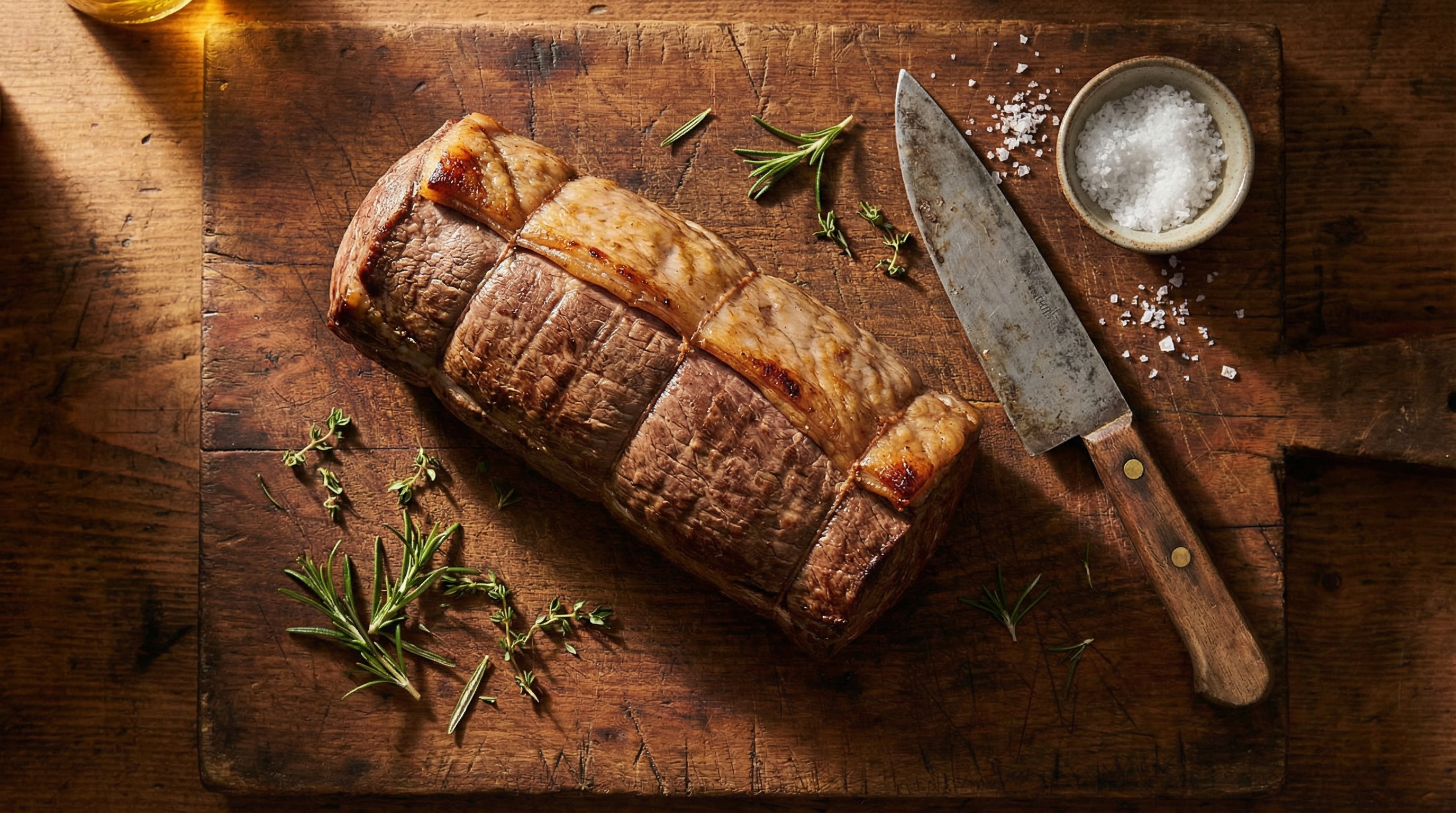
There's a roast in every grocery store meat case that costs half of what you'd pay for a rib roast, looks perfectly respectable, and has driven more home cooks to frustration than perhaps any other cut of beef. It's the eye of round — a tight, cylindrical roast from the rear leg that promises affordability but often delivers disappointment.
Here's the thing: it's not the cut's fault. It's a misunderstanding problem. People buy eye of round expecting it to behave like a tenderloin or a chuck roast, and it does neither. It's its own animal — lean, tight-grained, and unforgiving if you cook it wrong. But cook it right, and you've got one of the best value cuts in the entire case.
After three decades behind the block, I've sold thousands of eye of round roasts. The customers who love it are the ones who understand what it actually is. Let me make you one of those customers.
Where Does Eye of Round Come From?
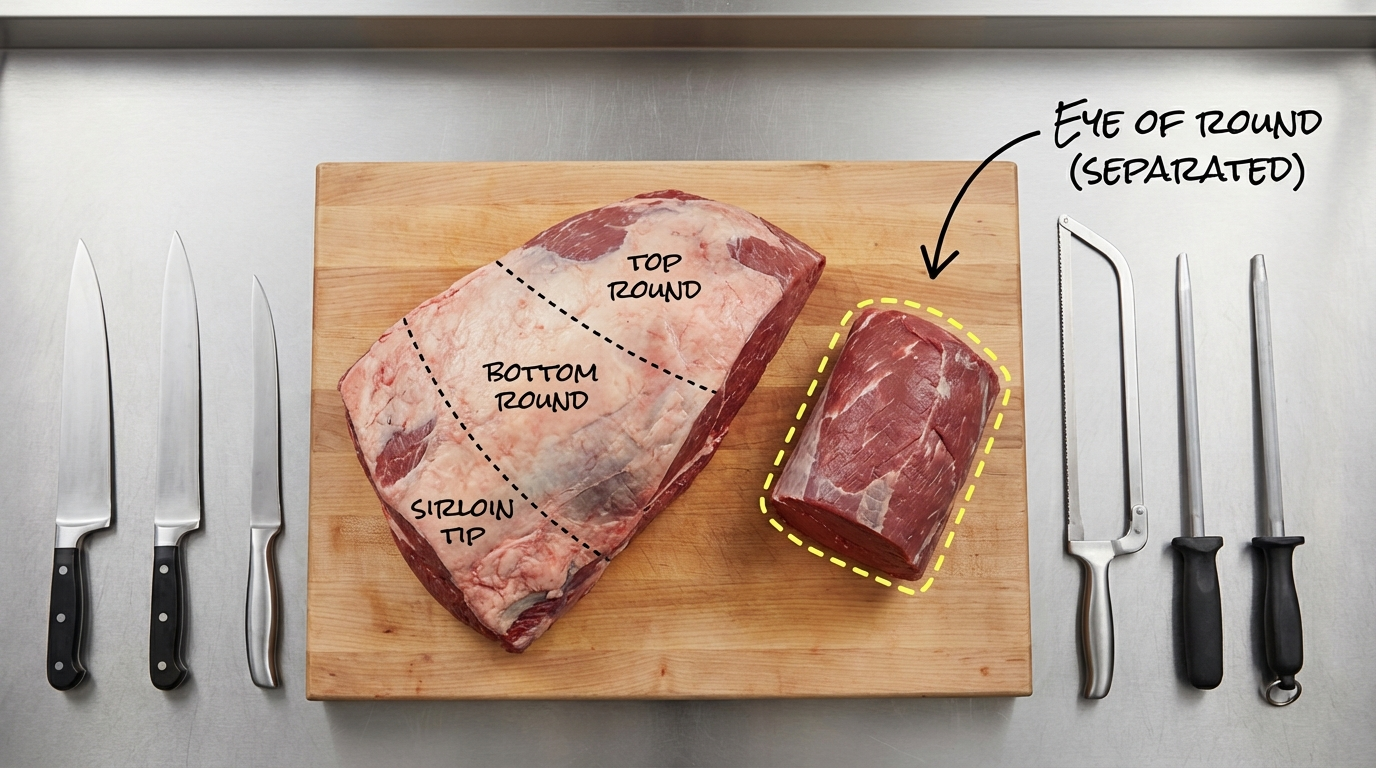
The eye of round comes from the round primal — the massive hindquarter section of the cow that includes the entire rear leg. This is the powerhouse of the animal, the muscle group responsible for standing, walking, and propelling a 1,200-pound animal forward.
Within the round primal, three main muscles dominate: the top round (inside round), the bottom round (outside round), and sandwiched between them, the eye of round. It's a small, oval-shaped muscle that sits against the femur bone, working constantly but in a limited range of motion.
Think of it anatomically: while the top round and bottom round are broad, flat muscles that handle the heavy lifting of locomotion, the eye of round is a stabilizer. It's a smaller, tighter muscle that helps control leg movement. That constant low-level engagement produces muscle fibers that are extremely lean, very tight, and remarkably uniform from one end to the other.
This anatomy explains everything about the cut's cooking behavior. There's almost no intramuscular fat (marbling) to keep it moist during cooking, no connective tissue to break down into gelatin, and no loose grain to absorb marinades easily. It's pure protein — which is both its greatest strength and its biggest cooking challenge.
Eye of Round vs Other Round Cuts
The round primal produces several cuts that often confuse shoppers:
- Top round (inside round): Larger, slightly more tender, often sold as "London broil." Better for roasting and slicing thin.
- Bottom round (outside round): Tougher than top round, best for braising or pot roast. More connective tissue means more forgiving with slow cooking.
- Eye of round: The leanest and most uniform of the three. Smallest diameter, making it ideal for even slicing. Least forgiving of overcooking.
- Round tip (sirloin tip): From the front of the round, slightly more tender, occasionally sold as steaks.
The key distinction: bottom round has enough connective tissue to braise successfully. Eye of round does not. Treating eye of round like a pot roast is the number one mistake people make with this cut.
What Does Eye of Round Look Like?
In the meat case, eye of round is one of the easiest cuts to identify. It's a tight, elongated cylinder — typically 3 to 4 inches in diameter and 8 to 12 inches long. The shape is remarkably uniform, almost like a large sausage, which is part of what makes it so useful for even slicing.
The color is a deep, rich red — darker than most cuts you'll see because of the low fat content. There's virtually no visible marbling when you look at a cross-section. The grain runs lengthwise in tight, parallel fibers. You may see a thin layer of external fat on one side (the fat cap), but the interior is almost entirely lean meat.
Typical weights range from 2 to 4 pounds for a whole eye of round roast. Some butchers sell it already sliced into steaks (eye of round steaks), which are circular, about ¾ to 1 inch thick, and look like lean, dark hockey pucks.
At the store, you might see it labeled as:
- Eye of round roast
- Eye round roast
- Round eye roast
- Eye of round steak (when sliced)
- Breakfast steak (thin-cut eye of round)
Nutritional Profile: Why Athletes Love This Cut
If you're looking for the highest protein-to-fat ratio in the entire beef case, eye of round is your cut. A 4-ounce serving of cooked eye of round delivers roughly:
- Calories: 140–160
- Protein: 25–28g
- Total fat: 4–5g
- Saturated fat: 1.5–2g
- Iron: 2.5mg (14% DV)
- Zinc: 5mg (45% DV)
- B12: 2.4mcg (100% DV)
Compare that to a ribeye at 250+ calories and 18g of fat per serving, and you understand why eye of round is a staple in bodybuilding meal prep, weight-loss programs, and any diet where lean protein is the goal. It's also significantly cheaper — often $5–7 per pound compared to $15–20+ for premium cuts.
The nutritional density extends beyond macros. Eye of round is an excellent source of heme iron (the most bioavailable form), zinc, selenium, and the full B-vitamin complex. Ounce for ounce, it delivers more micronutrients per calorie than almost any other protein source.
How to Cook Eye of Round: The Methods That Actually Work
Here's the fundamental rule of eye of round: it must be cooked to medium-rare or medium at most, then sliced thin against the grain. There is no Plan B. Overcook this cut and no sauce, no seasoning, and no amount of resting will save it. The lean, tight grain turns dry, chewy, and gray the moment internal temperature pushes past 135°F.
With that non-negotiable principle established, here are the methods that work:
Method 1: Reverse Sear Roast (Best Overall)
This is the gold standard for eye of round. Low oven first, sear second.
- Season the roast generously with salt and pepper. For best results, dry brine overnight — salt it, place it uncovered on a rack in the fridge for 12–24 hours. This draws moisture to the surface, then reabsorbs it, seasoning deep into the meat and creating a drier exterior for better browning.
- Place on a wire rack set over a sheet pan. Roast at 225°F until the internal temperature reaches 120°F (this takes roughly 60–90 minutes for a 3-pound roast).
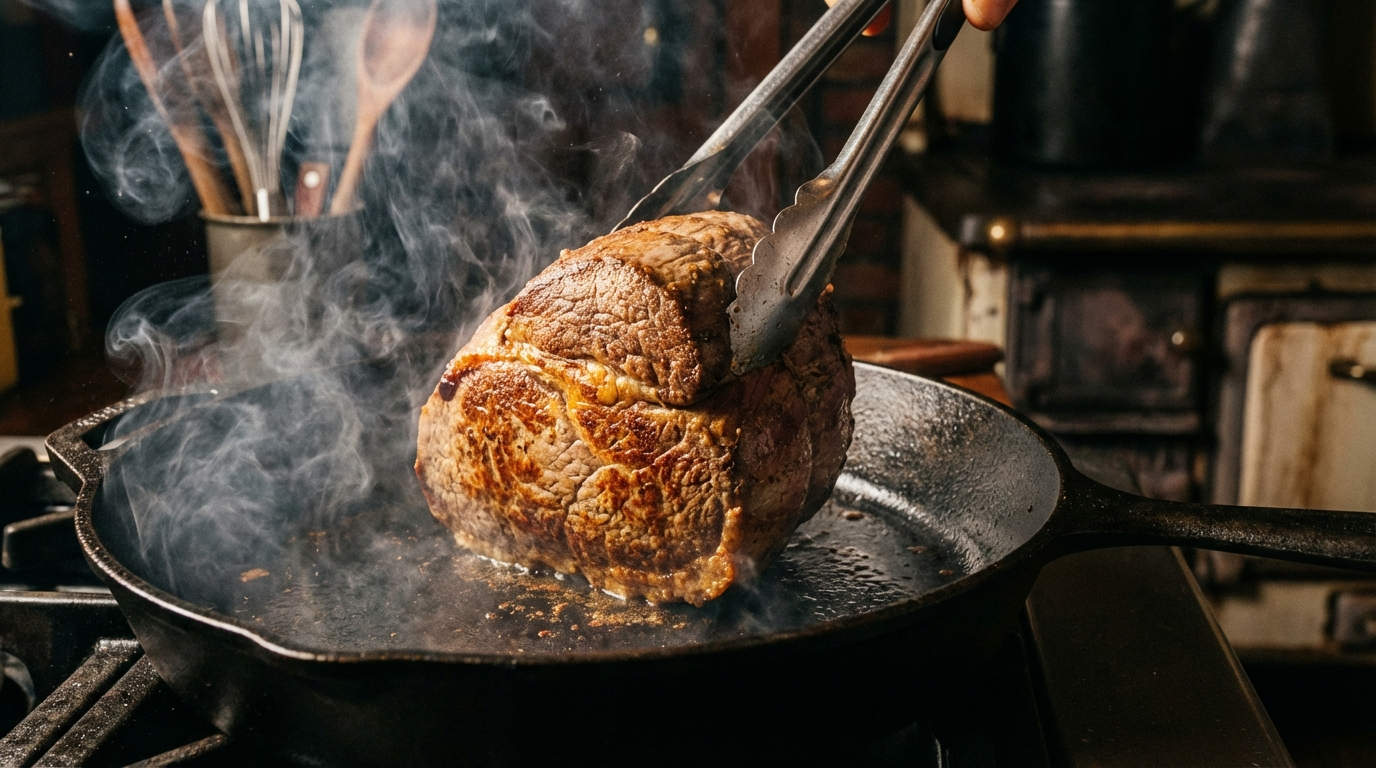
- Remove from oven. Heat a cast iron skillet screaming hot with a high-smoke-point oil (avocado, refined peanut).
- Sear the roast on all sides — about 45–60 seconds per side — until a deep brown crust forms.
- Rest for 15 minutes. The carryover heat will bring it to a perfect 130–135°F (medium-rare).
- Slice as thin as possible, against the grain.
Method 2: High-Heat Quick Roast
If you're short on time, this method works well for smaller roasts (under 2.5 pounds):
- Bring the roast to room temperature (30 minutes out of the fridge).
- Sear on all sides in a hot skillet.
- Transfer to a 500°F oven and roast for exactly 7 minutes per pound.
- Turn the oven off. Do not open the door. Leave the roast inside for 2.5 hours.
- The residual heat slow-cooks the roast to a perfect medium-rare throughout.
This method is nearly foolproof because it removes the guesswork — once you turn off the oven, the physics does the work. Just don't open the door.
Method 3: Sous Vide (Most Foolproof)
Sous vide and eye of round are a match made in heaven. The precise temperature control eliminates every risk this cut presents:
- Season and vacuum seal the roast.
- Cook at 131°F for 24–36 hours. Yes, that long. The extended time at a controlled temperature breaks down some of the tough muscle fibers without drying out the meat.
- Remove, pat dry, and sear hard on all sides.
- Slice thin against the grain.
The result after a 30-hour sous vide cook is genuinely transformative — tender enough to eat with a fork, still pink throughout, with a beefy depth of flavor that rivals cuts costing three times as much.
How to Slice Eye of Round: The Non-Negotiable Step
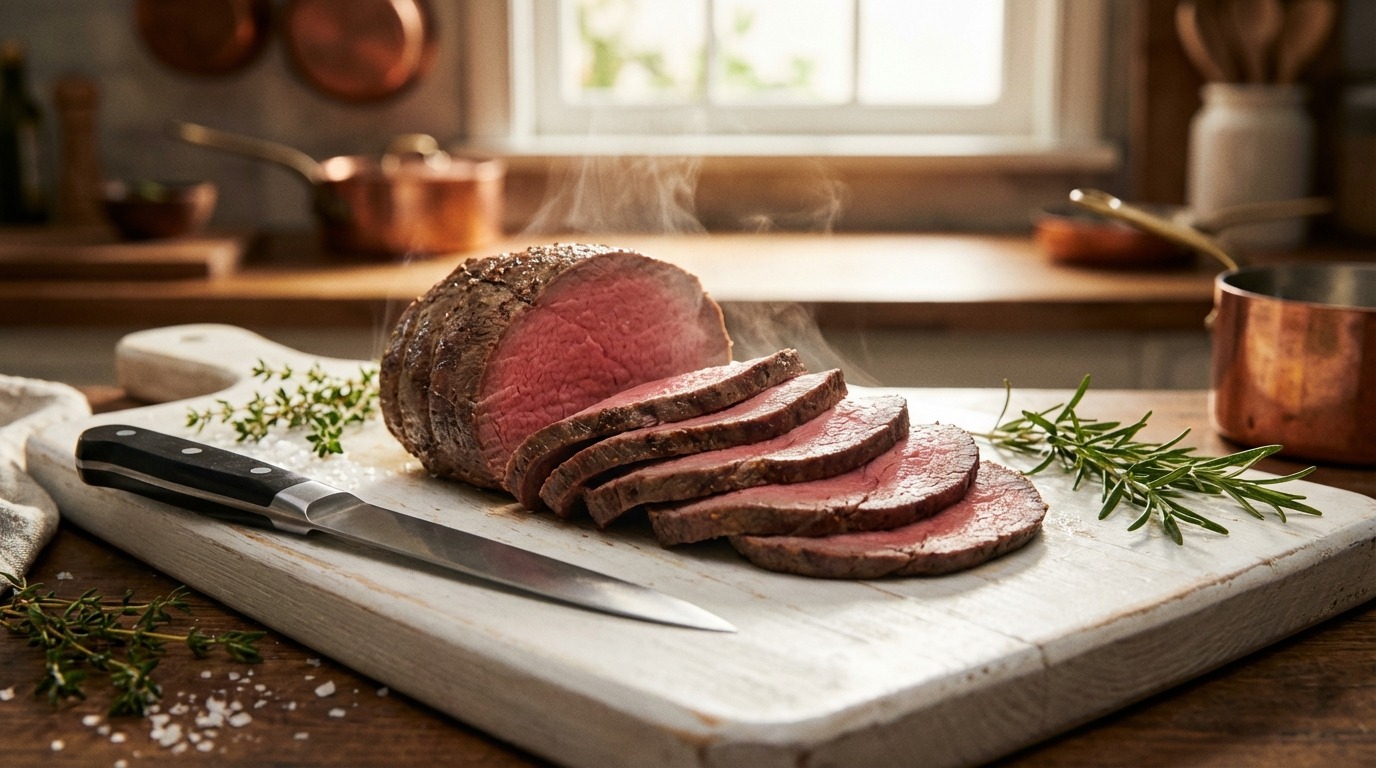
You could cook an eye of round to absolute perfection — 131°F dead center, beautiful crust, gorgeous color — and still ruin it by slicing wrong. This is not an exaggeration. Slicing against the grain is the single most important step with this cut.
The grain in eye of round runs lengthwise along the roast — those tight, parallel muscle fibers you can see on the surface. Cutting with the grain means you're serving people long, intact muscle fibers they have to chew through. Cutting against the grain — perpendicular to those fibers — shortens them to a fraction of an inch, making each bite dramatically more tender.
The second variable is thickness. Eye of round should be sliced as thin as you can manage — ideally ⅛ to ¼ inch. A sharp carving knife or an electric slicer makes this significantly easier. Thick slices of eye of round will always feel chewy regardless of how you cooked them. Thin slices melt in your mouth.
This is exactly why eye of round is the classic choice for homemade roast beef deli meat. The uniform cylindrical shape produces consistent circular slices, and when sliced thin against the grain, the texture is indistinguishable from the roast beef you'd buy at a premium deli counter — at a fraction of the cost.
Best Uses for Eye of Round
Once you understand this cut's personality — lean, tight-grained, best served thin — the ideal applications become obvious:
- Homemade deli roast beef: The #1 use. Roast to medium-rare, chill overnight, slice paper-thin on a mandoline or deli slicer. Better than store-bought and costs a third as much.
- Beef jerky: The low fat content is actually a feature here — fat causes jerky to spoil faster. Eye of round's lean, uniform grain makes it the butcher's first choice for homemade jerky.
- Stir-fry and fajitas: Slice thin against the grain, marinate for 30 minutes, cook over screaming-hot heat for 60–90 seconds. The quick cook time prevents drying out.
- French dip sandwiches: Thin-sliced roast eye of round on a crusty roll, dunked in au jus. A classic.
- Carpaccio and tartare: The ultra-lean, clean flavor works beautifully raw when the beef is high quality.
- Rouladen: The thin, uniform shape is perfect for pounding flat, filling, rolling, and braising — a classic German preparation.
- Meal prep: Roast on Sunday, slice, portion into containers. Reheats well when sliced thin and warmed gently.
What NOT to Do With Eye of Round
Equal to knowing the right methods is understanding the methods that will ruin this cut:
- Don't braise it. Unlike chuck or brisket, eye of round lacks the connective tissue that dissolves into gelatin during braising. Extended wet cooking just makes it drier and stringier.
- Don't cook it past medium. Internal temperature above 145°F produces gray, dry, inedible meat. Aim for 130–135°F (medium-rare).
- Don't slice it thick. Half-inch-thick slices of eye of round are a chewing workout. Think deli-thin.
- Don't skip the rest. This lean cut needs every minute of its 15-minute rest to redistribute juices. Cut it immediately and you'll lose significant moisture.
- Don't confuse it with top round. While related, top round is slightly more forgiving. Eye of round requires more precision.
How to Buy Eye of Round
Shopping for eye of round is straightforward because there's less variation between good and bad specimens than with fattier cuts:
Color: Look for deep cherry red. Avoid anything brownish or gray — that's oxidation from sitting too long.
Size: For roasting, 2.5 to 3.5 pounds is the sweet spot. Larger roasts over 4 pounds become harder to cook evenly. Smaller ones under 2 pounds are better suited for steaks.
Fat cap: A thin layer of external fat on one side is fine and actually helps with roasting (baste the top side during cooking). Excessive external fat just means you're paying meat prices for trim.
Grade: USDA Choice or Select both work fine here. Since marbling is nearly nonexistent in this cut regardless of grade, paying extra for Choice over Select provides minimal benefit. This is one of the few cuts where Select is genuinely a smart buy.
Price: Eye of round typically runs $5–8 per pound, making it one of the most affordable cuts in the case. If your store is charging more than $9/lb, shop elsewhere.
Storing Eye of Round
Proper storage keeps this lean cut at its best:
- Refrigerator: 3–5 days in original packaging, or up to 7 days if rewrapped tightly in plastic wrap.
- Freezer: 6–12 months if wrapped in plastic wrap then aluminum foil or placed in a vacuum-sealed bag. The low fat content actually means it freezes slightly better than fattier cuts — fat oxidizes over time, which causes off-flavors.
- Cooked: Sliced roast eye of round keeps 4–5 days refrigerated. Store slices in a sealed container with a small amount of jus or broth to prevent drying out.
Frequently Asked Questions
Frequently Asked Questions
Is eye of round a good cut of beef?
Eye of round is an excellent cut when cooked correctly — roasted to medium-rare and sliced thin against the grain. It's one of the leanest, most affordable cuts available with an outstanding protein-to-fat ratio. The key is understanding its limitations: it must not be overcooked or sliced thick.
What is eye of round best used for?
The top uses for eye of round are homemade deli roast beef, beef jerky, stir-fry, French dip sandwiches, and weekly meal prep. Its uniform cylindrical shape makes it ideal for consistent, even slicing.
Is eye of round tough?
Eye of round can be tough if overcooked (above medium) or sliced with the grain. When cooked to 130-135°F internal temperature and sliced paper-thin against the grain, it's surprisingly tender. Sous vide cooking at 131°F for 24-36 hours produces exceptionally tender results.
Can you braise eye of round?
Braising is not recommended for eye of round. Unlike chuck or brisket, it lacks the connective tissue that breaks down into gelatin during slow cooking. Braising eye of round typically produces dry, stringy results. Use dry-heat methods (roasting, searing) and cook to medium-rare instead.
How do you make eye of round tender?
Three keys to tender eye of round: (1) Cook to medium-rare only (130-135°F internal), (2) slice as thin as possible against the grain, and (3) rest for at least 15 minutes before slicing. Dry brining overnight and using the reverse sear or sous vide method produce the best results.
Is eye of round the same as top round?
No. While both come from the round primal (rear leg), they're different muscles. Eye of round is smaller, leaner, and more cylindrical. Top round is larger, slightly more tender, and often labeled 'London broil.' Eye of round requires more precise cooking but produces more uniform slices.
More Expert Guides
What Is Chateaubriand? (Cut, Cooking, & Best Sources)
Chateaubriand is a thick-cut roast from the center of the beef tenderloin, traditionally served for two. Learn what makes this classic French cut special and how to cook it.
14 min readWhat Is Round Steak? The Complete Guide to Beef's Most Versatile Budget Cut
Round steak comes from the rear leg of the cow — it's lean, affordable, and misunderstood. A master butcher breaks down every sub-cut, cooking method, and technique to turn this budget workhorse into genuinely delicious meals.
14 min readBottom Round vs Top Round: A Butcher Explains the Real Differences
Top round and bottom round look similar in the meat case but cook completely differently. A butcher with 30 years of experience explains where each cut comes from, which is more tender, and how to get the best results from both.