Best Beef Cuts for Stew: A Butcher's Guide to Rich, Tender Stew Meat
Here's a truth most home cooks get wrong about beef stew: they buy meat that's too lean. They pick up a nice-looking sirloin or round steak, cube it up, and wonder why their stew tastes flat and the meat turned into dry, stringy cubes floating in gravy. I've seen this mistake hundreds of times over four decades behind the butcher counter.
The secret to great beef stew isn't technique — it's the cut. The best stew meat comes from the toughest, most well-worked muscles on the animal. Cuts loaded with connective tissue, collagen, and intramuscular fat. The very things that make a steak terrible are exactly what make stew extraordinary. When you braise these cuts low and slow, all that tough collagen melts into gelatin, creating that rich, silky body that coats your spoon and makes you go back for seconds.
Let me walk you through every cut worth putting in your stew pot — and a few you should leave on the shelf.
Why Tough Cuts Make the Best Stew
Before we get into specific cuts, you need to understand the science. Beef stew is a braise — you're cooking meat submerged in liquid at a low temperature (around 300°F) for 2 to 3 hours. During that time, three things happen that transform tough meat into something extraordinary:
Collagen converts to gelatin. Connective tissue — those white, silvery threads running through tough cuts — is made of collagen protein. Starting around 160°F, collagen begins to break down. By the time you've braised for 2+ hours, it has dissolved into gelatin. That gelatin is what gives great stew its body. It's why the best stew coats the back of a spoon and has that luxurious mouthfeel. Lean cuts don't have enough collagen for this transformation.
Intramuscular fat renders and bastes. Fat marbled through the muscle slowly renders during braising, basting the meat from the inside. This keeps each cube moist and adds flavor. Lean cuts dry out because there's no internal fat to compensate for the long cook time.
Muscle fibers relax. Tough muscles have tightly wound fibers from heavy use. Extended braising breaks down these fibers until they can be pulled apart with a fork. But this only works with cuts that have enough fat and collagen to stay moist during the process. Lean meat just gets tighter and drier.
This is why a $6/lb chuck roast makes better stew than a $18/lb strip steak. You're not cutting corners — you're using the right tool for the job.
Chuck Roast: The Gold Standard
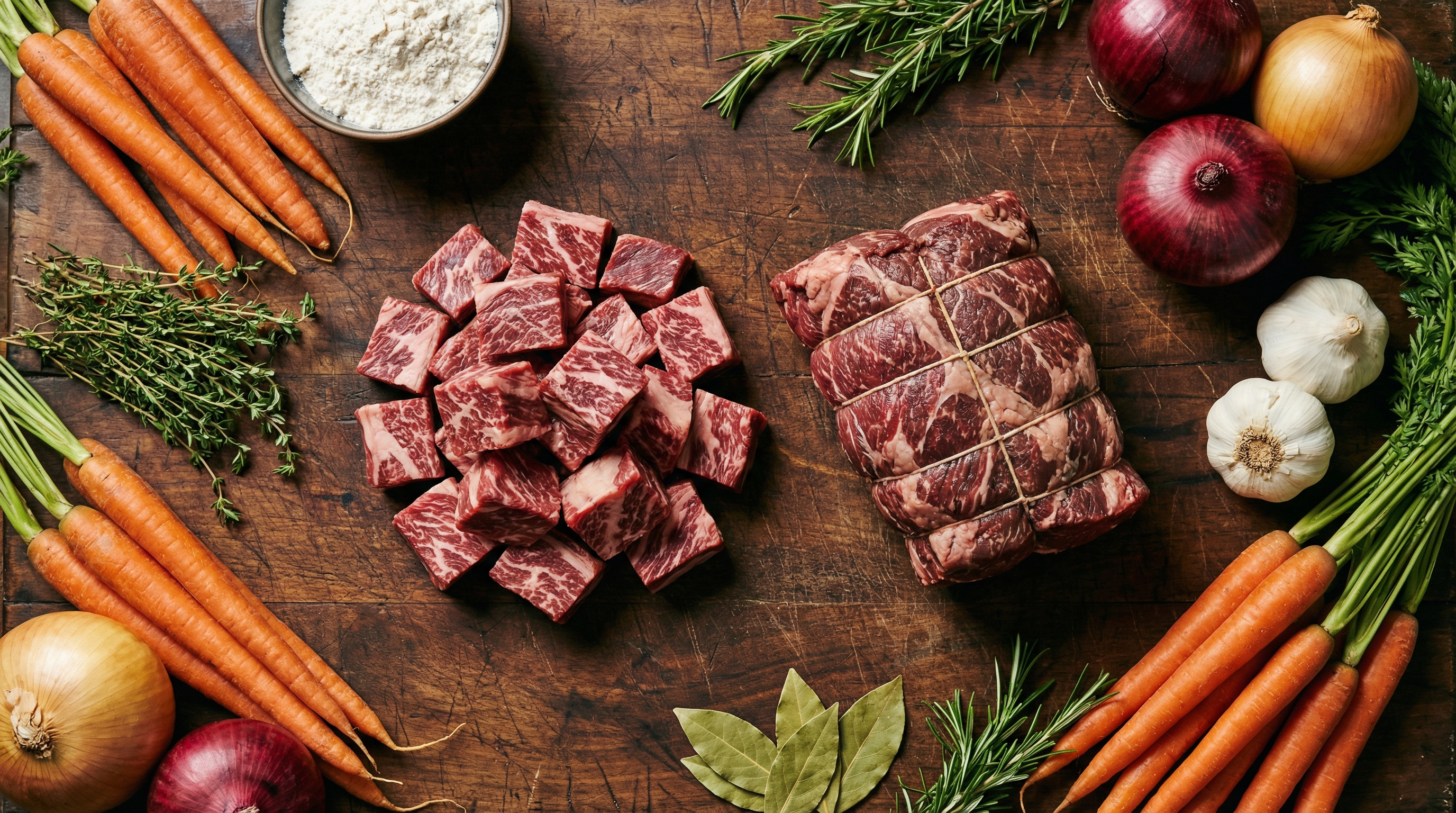
If I could only recommend one cut for stew, it's chuck roast, every single time. Cut from the shoulder (the chuck primal), this is one of the hardest-working muscles on the animal. Cattle use their shoulders constantly — standing, walking, grazing — which means the muscle develops deep flavor, significant marbling, and abundant connective tissue.
When you cube a chuck roast for stew, you get pieces with the perfect ratio of lean meat to fat to collagen. After 2-3 hours of braising, the collagen has melted completely, the fat has rendered through, and each cube is fork-tender with concentrated beefy flavor. The braising liquid turns into a naturally thickened, glossy gravy without you adding a single thing.
What to look for: A boneless chuck roast weighing 3-4 pounds, with visible white fat marbling throughout and some connective tissue seams. Avoid chucks that look uniformly lean — they've been trimmed too aggressively. You want that fat.
How to cut it: Trim off any large external fat caps (leave some), remove the thick central seam of gristle if it's very tough, then cut into 1.5 to 2 inch cubes. Don't go smaller — the pieces shrink during cooking and you want substantial bites in the finished stew.
Cost: $5-8/lb depending on region and grade. USDA Choice chuck is perfect for stew — there's no reason to buy Prime for braising.
Short Ribs: The Upgrade Pick
If chuck is the workhorse, short ribs are the premium option. Cut from the plate primal on the underside of the cow, short ribs have an even more intense beefy flavor than chuck, with a beautiful, even grain throughout the meat. The meat-to-bone ratio means you're paying for some bone weight, but the bones themselves contribute flavor and body to the braising liquid.
Short rib stew has a richness that chuck can't quite match. The fat content is higher, the collagen load is massive (each rib has a thick cap of connective tissue), and the flavor is deeper and more complex. It's the cut I use when I'm making stew for company or entering a cook-off.
Boneless vs. bone-in: For stew, I prefer boneless English-cut short ribs. You get pure meat without having to fish out bones later. But if you're making a stew where the presentation matters — like a Korean-style braised short rib stew — bone-in adds visual impact and the marrow enriches the broth.
Cost: $8-14/lb. More expensive than chuck, but you need less of it because the flavor is more concentrated. Three pounds of boneless short ribs will make a stew that serves 6-8.
Beef Shank: The Secret Weapon
This is my dark horse recommendation — the cut most home cooks have never used for stew, and it might be the best one for the money. Beef shank is the leg, and it is the most exercised muscle on the animal. It is absolutely loaded with connective tissue and surrounded by a dense, collagen-rich exterior.
Shank is usually sold as cross-cut rounds, 1-2 inches thick, with a marrow bone in the center. For stew, you cut the meat away from the bone, cube it, and throw the bone in the pot too. The marrow melts out during cooking and adds an incomparable richness to the broth. Italian cooks figured this out centuries ago — osso buco is essentially beef shank stew, and it's one of the greatest dishes in the world.
The texture of braised shank is different from chuck. It has a slightly more fibrous, pull-apart quality, almost like slow-cooked brisket. In a stew, that gives you interesting textural variety, especially if you mix it with chuck (my favorite combination — 50/50 chuck and shank).
Cost: $4-7/lb. One of the cheapest beef cuts available, and criminally underappreciated. The marrow bone alone is worth the price.
Oxtail: For the Richest Stew You've Ever Had
Oxtail makes the most luxurious stew possible. Period. The tail segments are cross-cut rounds of bone surrounded by intensely marbled meat and more collagen per ounce than any other cut on the animal. When braised, oxtail produces a stew that is almost obscenely rich — the broth gels solid when refrigerated because of the massive gelatin content.
The downside? Oxtail is expensive (it's become trendy), the meat-to-bone ratio is low, and it takes longer to braise — 3 to 4 hours minimum. But if you're making a special-occasion stew, something for a cold winter night when you want the best possible bowl of comfort, oxtail is unmatched.
Cost: $8-15/lb, and prices have been climbing. The bones are heavy, so the effective cost of meat is even higher. Worth it for a special pot.
Brisket: The Flavor Champion
The flat end of the brisket — the leaner portion — makes excellent stew with a distinctively beefy, almost mineral flavor that's different from chuck. Brisket comes from the chest of the animal, a muscle that supports roughly 60% of the cow's body weight. That constant work creates dense, flavorful meat with long muscle fibers.
The key with brisket in stew is using the right part. The flat (also called the first cut) has a more uniform texture and braids beautifully. The point (second cut, or deckle) is fattier and works well too, but can be almost too rich in a stew context. I'd save the point for smoking.
Why butchers like brisket for stew: It holds its shape better than chuck during long cooking. Chuck cubes can start to fall apart after 3 hours; brisket cubes maintain their integrity and give you a cleaner-looking stew with distinct, tender pieces.
Cost: $5-9/lb for the flat. Brisket prices have been volatile lately due to BBQ demand, so shop around.
Bottom Round: The Budget Option (With a Caveat)
Bottom round is lean. Very lean. And I just spent 500 words telling you lean cuts make bad stew. So what's it doing on this list?
Bottom round works in stew — barely — if you compensate for its lack of fat by adding extra richness elsewhere. Use bone broth instead of regular stock. Add a tablespoon of tomato paste for body. Throw a split pig's foot in the pot for gelatin (old French trick). With these additions, bottom round makes a perfectly acceptable stew at a rock-bottom price.
I wouldn't call it the best option, but it's the best option when you're feeding a crowd on a tight budget. And the flavor of the meat itself — that clean, mineral, beefy taste — is genuinely good. It's just not self-sufficient the way chuck or shank is.
Cost: $4-6/lb. Among the cheapest beef cuts available.
What About Pre-Cut "Stew Meat" Packages?
Ah, the question I've been waiting for. Those plastic-wrapped trays labeled "Beef Stew Meat" at the grocery store — should you buy them?
Honest answer: usually not. Here's why.
Pre-cut stew meat is often a mix of trimmings from various primals. The butcher is cleaning up chuck roasts, rounds, and other cuts throughout the day, and the odd-shaped pieces that don't fit neatly into another package get cubed and labeled as stew meat. The problem is inconsistency — you get pieces with wildly different amounts of fat, connective tissue, and density. Some cubes will be meltingly tender at the 2-hour mark while others in the same pot are still tough.
If you buy pre-cut stew meat, ask the butcher what it actually is. If they say "it's all chuck," you're fine. If they shrug or say "assorted," pass on it and buy a whole chuck roast to cube yourself. The ten minutes of knife work saves you from a pot of uneven stew.
Cuts to Avoid for Stew
Not every beef cut belongs in a stew pot. These are the ones I'd steer you away from:
Tenderloin / filet mignon: The leanest, most tender cut on the animal. Zero connective tissue, minimal fat. In a braise, it turns to dry, flavorless cardboard. It's like using a Ferrari to haul mulch — wrong tool for the job.
Ribeye: Too expensive and the marbling pattern doesn't braise well. The fat pockets between the muscles render out completely, leaving you with separated, stringy meat. Grill it instead.
Strip steak / sirloin: Lean enough to dry out but too expensive to justify. These cuts are designed for quick, high-heat cooking. Braising them is fighting against their nature.
Eye of round: I know it's cheap, and I know it's tempting. But eye of round is the driest, tightest muscle on the cow. Even 3 hours of braising can't fully tenderize it, and the flavor is flat. Spend an extra dollar per pound and get chuck.
The Perfect Stew Meat Blend
If you really want to take your stew to the next level, mix your cuts. My personal formula after 40 years of making stew:
The Butcher's Blend: 60% chuck roast, 30% beef shank (meat only, bones in the pot), 10% short rib. The chuck provides the foundation, the shank adds collagen and body, and the short rib contributes richness and depth. Brown all three separately — each cut sears differently — then combine in the pot.
This blend gives you stew with layers of texture and flavor that a single cut can't achieve. The braising liquid is naturally thick and glossy from all that melted collagen. The meat is a mix of fork-tender chunks and pull-apart shreds. It's the best pot of stew I know how to make.
Shopping list for 6-8 servings: 2 lbs chuck roast, 1 lb beef shank cross-cuts, 0.5 lb boneless short ribs. Total cost: roughly $20-25 at USDA Choice grades. That feeds your whole family with leftovers.
Frequently Asked Questions
What is the best cut of beef for stew?
Chuck roast is the best all-around cut for beef stew. It has an ideal balance of lean meat, intramuscular fat, and collagen-rich connective tissue that breaks down during braising to create tender, flavorful meat and a naturally thick, silky gravy.
Can you use steak cuts for stew?
Steak cuts like ribeye, strip, and tenderloin make poor stew meat. They lack the connective tissue that melts into gelatin during braising, so they dry out and lose flavor over long cooking times. Tough, collagen-rich cuts like chuck, shank, and short ribs are far better choices.
Is pre-packaged stew meat worth buying?
Pre-packaged stew meat is often a mix of trimmings from different cuts, leading to uneven cooking — some pieces tender while others stay tough. It's better to buy a whole chuck roast and cube it yourself for consistent results. If you do buy pre-cut, ask the butcher what cut it actually is.
How big should you cut beef for stew?
Cut beef stew meat into 1.5 to 2 inch cubes. Smaller pieces shrink too much during the 2-3 hour braise and can fall apart. Larger cubes maintain their structure and give you satisfying, substantial bites in the finished stew.
Why is my beef stew meat tough?
Stew meat is usually tough for one of two reasons: the cut is too lean (lacking collagen that melts into gelatin during cooking), or it hasn't cooked long enough. Collagen-rich cuts like chuck need at least 2 hours of braising at 300°F to become tender. Using lean cuts like eye of round or sirloin will often result in dry, tough stew regardless of cook time.
More Expert Guides
What Is Chateaubriand? (Cut, Cooking, & Best Sources)
Chateaubriand is a thick-cut roast from the center of the beef tenderloin, traditionally served for two. Learn what makes this classic French cut special and how to cook it.
14 min readWhat Is Round Steak? The Complete Guide to Beef's Most Versatile Budget Cut
Round steak comes from the rear leg of the cow — it's lean, affordable, and misunderstood. A master butcher breaks down every sub-cut, cooking method, and technique to turn this budget workhorse into genuinely delicious meals.
14 min readWhat Is Eye of Round? The Complete Butcher's Guide to This Lean Cut
Eye of round is one of the leanest, most affordable cuts in the entire beef case — and one of the most misunderstood. A butcher explains how to turn this budget-friendly roast into something genuinely delicious.