Picanha vs Tri-Tip: A Butcher's Complete Comparison
Picanha and tri-tip are two of the most misunderstood cuts in American butchery. Both come from the back end of the cow — the sirloin region — and both deliver outstanding flavor for their price. But they're fundamentally different cuts with different fat structures, different textures, and very different culinary traditions behind them.
Walk into a Brazilian steakhouse and picanha is the star of the show, skewered and roasted over open flame with its thick fat cap crackling. Drive through California's Central Valley and tri-tip is religion — rubbed with garlic salt and smoked over red oak until the bark is jet black. Both cuts have passionate followings, and both deserve a place in your rotation.
After years of breaking down whole carcasses, I can tell you the choice between picanha and tri-tip isn't about quality. It's about understanding what each cut does best — and why swapping one for the other doesn't always work.
The Quick Answer
Picanha (also called the sirloin cap or coulotte) is a crescent-shaped muscle with a thick fat cap on one side. It's tender, juicy, and rich — the fat cap bastes the meat as it cooks. Tri-tip is a triangular muscle that's leaner, with a more pronounced beef flavor and a firmer bite. It's versatile and forgiving but doesn't have picanha's built-in basting system.
If you want richness and fat-rendered luxury, go picanha. If you want a clean, beefy steak that takes well to smoke and rubs, go tri-tip.
Where Each Cut Comes From
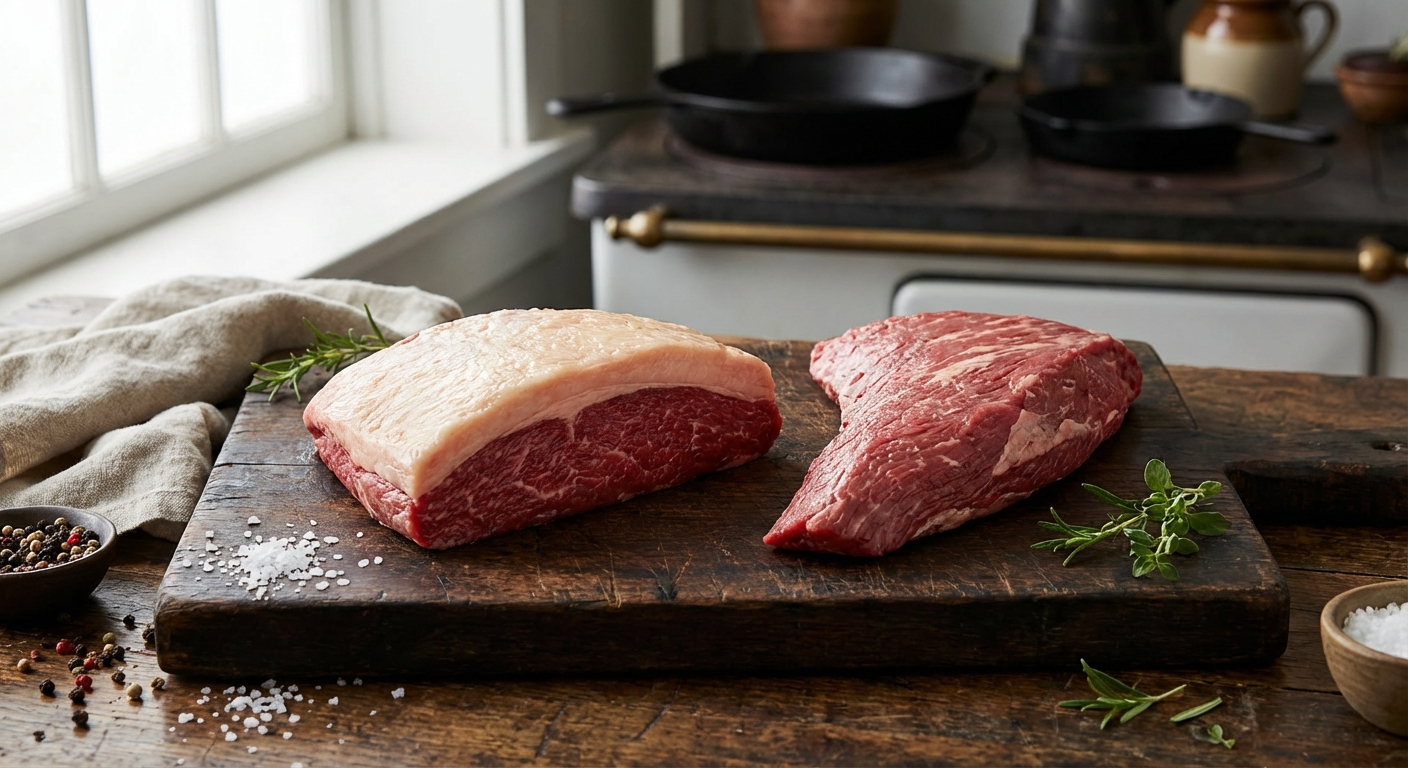
Both cuts come from the sirloin primal, which sits behind the short loin and in front of the round. But they're located in different parts of that primal, and the muscles do very different jobs.
Picanha sits on top of the rump — specifically, it's the cap muscle that covers the top sirloin. In anatomical terms, it's the biceps femoris muscle with its fat cap intact. In American butcher shops, this same cut is often sold as the coulotte or sirloin cap, sometimes with the fat cap trimmed off (which, in my opinion, defeats the purpose entirely).
The muscle itself doesn't do a tremendous amount of heavy lifting. It's more of a stabilizer, which means the fibers stay relatively tender. The real magic is the fat cap — a thick layer of subcutaneous fat that sits on one side of the muscle, typically 1/4 to 1/2 inch thick. That fat cap is everything.
Tri-tip comes from the bottom sirloin subprimal — specifically from the tensor fasciae latae muscle. It gets its name from its distinctive triangular shape, with a thick end and a thin, tapered point. A whole tri-tip weighs between 1.5 and 3 pounds, making it one of the few cuts that works as both a roast and individual steaks.
The tri-tip does moderate work as part of the hip and hind leg structure. It has less intramuscular fat than picanha but good connective tissue that breaks down nicely with proper cooking. The grain runs in two different directions across the triangle — a detail that matters enormously when it's time to slice.
Fat Structure and Marbling
This is where the two cuts diverge most dramatically.
Picanha's fat cap is the defining feature. That thick layer of external fat doesn't just add flavor — it fundamentally changes how the meat cooks. As the fat renders, it bastes the muscle fibers from the outside in, keeping the meat moist even at higher temperatures. The fat cap also creates a natural barrier against direct heat, giving you more control over doneness.
Inside the muscle itself, picanha has moderate marbling — not ribeye-level, but respectable. Combined with the fat cap, the overall eating experience is rich and juicy without being overwhelmingly fatty. Think of it as the best of both worlds: a lean-ish muscle with a built-in basting mechanism.
Tri-tip is leaner. There's a thin fat cap on one side, but it's nowhere near as thick as picanha's. The intramuscular marbling varies by grade — Choice grade tri-tip will have decent marbling, while Select will be noticeably leaner. Without that thick external fat layer, tri-tip relies more on proper cooking technique to stay juicy.
The practical difference? Picanha is harder to dry out. Tri-tip punishes overcooking. If you tend to leave things on the grill a few minutes too long, picanha is more forgiving.
Flavor Profile
Both cuts deliver strong beef flavor, but the character is different.
Picanha has a buttery, rich quality that comes from the fat cap rendering during cooking. The meat itself is mild compared to something like a skirt steak, but the fat adds a depth and mouthfeel that elevates the whole experience. It's the kind of flavor that makes you close your eyes and slow down. Brazilian churrascarias understand this — they season picanha with nothing but coarse salt, because the fat does the heavy lifting.
Tri-tip has a more pronounced, "beefy" flavor. Without the fat cap dominating the palate, you taste the actual muscle more directly. There's a slight mineral quality — almost like a less intense version of hanger steak. This cleaner flavor profile is exactly why tri-tip takes so well to bold rubs and smoke: the meat doesn't fight with seasonings, it absorbs them.
If you've ever wondered why California BBQ crews use aggressive garlic-pepper rubs on tri-tip while Brazilian grill masters use only salt on picanha — now you understand. Each cut's flavor profile dictates the seasoning approach.
Cooking Methods
Best Ways to Cook Picanha
Skewered and grilled (churrasco style): The traditional method. Slice the picanha into thick C-shaped steaks following the curve of the fat cap, thread onto skewers, and roast over high heat. The fat cap faces the fire first, rendering and crisping while protecting the meat. This is the gold standard.
Reverse sear: Roast the whole picanha fat-cap-up at 250°F until the internal temperature hits 120°F, then sear the fat cap in a screaming-hot cast iron pan until it's golden and crackling. Rest, slice against the grain. Exceptional results with minimal effort.
Whole roast: Score the fat cap in a crosshatch pattern, season generously with coarse salt, and roast at 400°F until medium-rare (130°F internal). The scored fat renders beautifully and creates those crispy bits everyone fights over.
Avoid: Braising, slow cooking, or anything that would fully render away the fat cap. You'd lose everything that makes picanha special.
Best Ways to Cook Tri-Tip
Smoked (Santa Maria style): The classic. Rub with garlic, salt, pepper, and maybe some paprika. Smoke over red oak at 225-250°F until 130°F internal, then sear over direct heat for bark. This is Central California barbecue at its finest.
Reverse sear: Works beautifully on tri-tip. Low oven at 250°F until 120°F internal, then a hard sear in cast iron or over charcoal. The two-zone approach handles the uneven thickness of the triangle — the thin end gets more done, the thick end stays pink.
Direct grill: Over medium-high heat, 4-5 minutes per side for medium-rare on a standard 2-inch thick tri-tip. Let it rest for at least 10 minutes — tri-tip releases a lot of juice if you cut too early.
Avoid: Overcooking past medium. Tri-tip doesn't have enough fat to compensate. Also avoid slicing without identifying the two grain directions — you'll end up with tough, stringy pieces from half the roast.
Temperature Targets
Both cuts are best served medium-rare to medium. But there's a subtle difference in the sweet spots.
| Doneness | Picanha | Tri-Tip |
|---|---|---|
| Rare | 125°F — fat cap won't render enough | 120-125°F — works if you sear well |
| Medium-Rare (ideal) | 130-135°F | 130-135°F |
| Medium | 140°F — still excellent, fat cap keeps it moist | 140°F — acceptable, starting to dry |
| Medium-Well+ | 150°F+ — fat cap helps but meat toughens | 150°F+ — noticeably dry and chewy |
One important note: picanha's fat cap needs at least medium-rare temperatures to start rendering properly. If you serve picanha truly rare, the fat cap will be rubbery and unpleasant. The sweet spot for picanha is actually a touch higher than for most steaks — 135°F lets the fat fully render while keeping the meat pink and juicy.
Slicing Technique
How you slice these cuts matters more than most people realize.
Picanha: Always slice against the grain, perpendicular to the muscle fibers. The grain runs lengthwise through the crescent, so you'll be cutting across the narrow dimension. Each slice should include both meat and a strip of that rendered fat cap. Aim for 1/4-inch thick slices for the best ratio of crispy fat to tender meat.
Tri-tip: This is where people go wrong. The tri-tip has two distinct grain directions — one running through the thick end and another through the thin end, meeting roughly in the middle. The proper technique: find the midpoint where the grain shifts, cut the roast in half there, then slice each half against its own grain direction. Skip this step and half your slices will be tough and stringy.
Size and Yield
Picanha typically weighs 2.5 to 4 pounds untrimmed. After the fat cap renders during cooking, expect about 20-25% weight loss. A 3-pound picanha will comfortably serve 4-5 people as a main course.
Tri-tip runs 1.5 to 3 pounds, with less shrinkage during cooking (10-15% weight loss since there's less external fat to render). A 2.5-pound tri-tip serves 4-5 people, making it slightly more economical per serving.
Price Comparison
Both cuts occupy the "excellent value" tier of the beef world, but pricing varies significantly by region.
Picanha typically runs $10-16 per pound, depending on grade and your location. It's more expensive in areas where Brazilian steakhouses have driven demand. Some butchers still sell it as "sirloin cap" at a lower price — if you see coulotte or sirloin cap with the fat cap intact, that's your picanha.
Tri-tip ranges from $8-14 per pound. It's cheapest in California where demand keeps supply chains optimized, and more expensive on the East Coast where it's less commonly stocked. USDA Choice tri-tip hits the best value sweet spot — the extra marbling over Select makes a real difference.
On a per-serving basis, they're very close. Tri-tip's lower price per pound is offset by picanha's richer flavor (you might eat less per sitting because the fat is more satiating).
Availability
This is where geography plays a major role.
Tri-tip is readily available across the Western United States, especially California. Most grocery stores from Safeway to Costco carry it year-round. East of the Rockies, availability drops — many butchers break the bottom sirloin into different cuts rather than isolating the tri-tip. If your local store doesn't carry it, any full-service butcher can cut one from a bottom sirloin.
Picanha is harder to find in standard American grocery stores. The issue isn't scarcity — the muscle is there on every animal. American butchery tradition typically removes the fat cap and sells the muscle as coulotte steaks or top sirloin cap. Finding true picanha with the fat cap intact usually means visiting a Brazilian or Latin American butcher, ordering from a specialty meat purveyor, or requesting it specifically from your butcher.
Which Should You Buy?
Here's my honest recommendation based on the situation:
Choose picanha when:
- You want the most flavorful, impressive presentation for a dinner party
- You have a rotisserie, grill with skewers, or good oven setup
- You enjoy fat-rendered richness (think ribeye lovers)
- You're cooking for people who appreciate something different
- You can find it with the fat cap intact
Choose tri-tip when:
- You're smoking or grilling and want a bold, beefy flavor
- You prefer leaner meat with a firmer bite
- You want a quick weeknight roast (tri-tip cooks faster due to smaller size)
- You plan to use bold rubs or marinades that need a cleaner-flavored base
- You want something readily available at most grocery stores
Both cuts punch well above their price point. If you've been stuck in a ribeye-and-strip rotation, either one will open up new possibilities without breaking the budget.
Frequently Asked Questions
Frequently Asked Questions
Is picanha the same as tri-tip?
No. While both come from the sirloin region, picanha (sirloin cap) sits on top of the rump with a thick fat cap, while tri-tip comes from the bottom sirloin and is a leaner, triangular-shaped muscle. They have different textures, fat content, and are best suited to different cooking methods.
Can I substitute tri-tip for picanha in a recipe?
You can, but adjust your expectations. Tri-tip is leaner and cooks faster, so reduce cooking time and consider adding a fat source (like basting with butter) to compensate for the missing fat cap. The flavor profile will also be different — more purely beefy, less rich.
Which is more tender, picanha or tri-tip?
Picanha is generally more tender due to its fat cap keeping the meat moist during cooking. When cooked to the same doneness, picanha has a softer, more buttery bite while tri-tip has a slightly firmer, chewier texture. Both are tender cuts when not overcooked.
Why is picanha so hard to find in the US?
American butchery tradition typically breaks down the sirloin cap differently than Brazilian butchery. The fat cap is often trimmed and the muscle sold as coulotte steaks. To find true picanha, visit Brazilian butcher shops, Latin American markets, or ask your butcher to leave the fat cap on the sirloin cap.
What temperature should I cook picanha and tri-tip to?
Both are best at medium-rare (130-135°F internal). However, picanha benefits from reaching at least 130°F so the fat cap renders properly — too rare and the fat stays rubbery. Tri-tip should not go past medium (140°F) as it dries out quickly without the protective fat cap.
More Expert Guides
What Is Chateaubriand? (Cut, Cooking, & Best Sources)
Chateaubriand is a thick-cut roast from the center of the beef tenderloin, traditionally served for two. Learn what makes this classic French cut special and how to cook it.
14 min readWhat Is Round Steak? The Complete Guide to Beef's Most Versatile Budget Cut
Round steak comes from the rear leg of the cow — it's lean, affordable, and misunderstood. A master butcher breaks down every sub-cut, cooking method, and technique to turn this budget workhorse into genuinely delicious meals.
14 min readWhat Is Eye of Round? The Complete Butcher's Guide to This Lean Cut
Eye of round is one of the leanest, most affordable cuts in the entire beef case — and one of the most misunderstood. A butcher explains how to turn this budget-friendly roast into something genuinely delicious.