What Is Tri-Tip? The Complete Guide to This Underrated Cut
If you live on the West Coast, you already know tri-tip. It's the cut that built Santa Maria-style barbecue, the centerpiece of California cookouts since the 1950s. But if you're east of the Rockies, there's a good chance you've walked past this cut a hundred times without ever picking it up — or your butcher ground it into hamburger without a second thought.
That's a shame, because tri-tip is one of the best values in the entire beef case. It's got more flavor than tenderloin, it's more forgiving than flank steak, and it costs a fraction of what you'd pay for a ribeye. You just need to understand what you're working with.
I've been breaking down cattle for over three decades, and tri-tip is the cut I cook at home more than any other. Let me tell you why — and how to get it right every time.
What Is Tri-Tip?
Tri-tip is a triangular muscle cut from the bottom sirloin subprimal, located at the very tip of the sirloin near where it meets the round (hindquarter). Its official NAMP designation is cut #185D — the tensor fasciae latae muscle, though most butchers just call it the triangle roast.
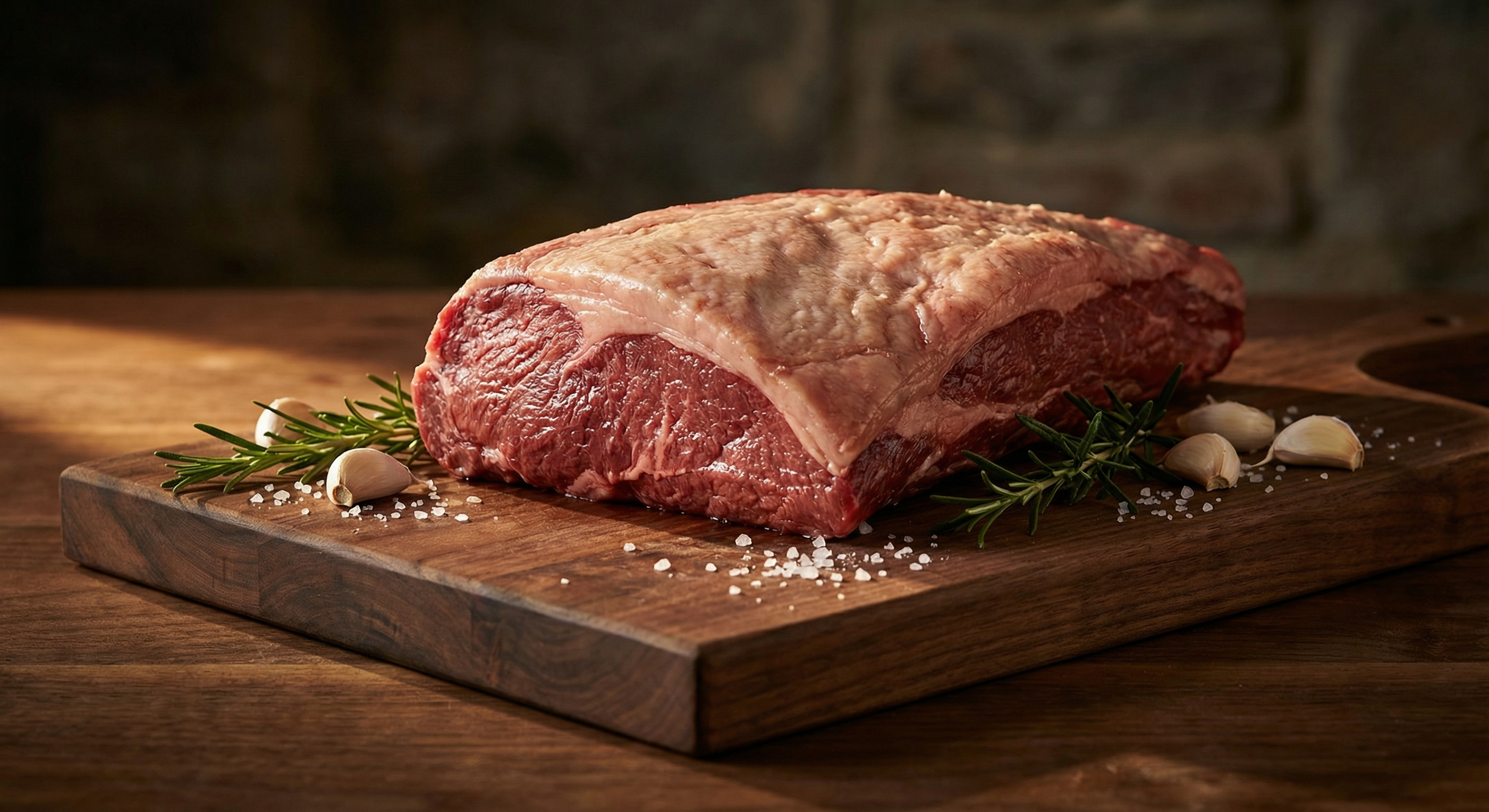
A whole tri-tip typically weighs between 1.5 and 3 pounds, making it one of the smaller roasts you'll find. It's a single muscle with a distinctive triangular shape, a layer of fat cap on one side, and a visible grain that changes direction partway through the cut. That grain shift is important — we'll come back to it when we talk about slicing.
There are only two tri-tips per animal, one from each side. That relative scarcity, combined with the fact that it was historically ground into burger meat in most of the country, means it's still underpriced for the quality of eating it delivers.
Where Does Tri-Tip Come From on the Cow?
To understand tri-tip, you need to understand the bottom sirloin. The sirloin sits behind the short loin and in front of the round. It's divided into the top sirloin (which gives us sirloin steaks) and the bottom sirloin.
The bottom sirloin contains three main muscles:
- Tri-tip (triangle) — the triangular muscle at the very bottom, against the flank
- Ball tip — a round muscle used for roasts and kabob meat
- Flap meat (sirloin flap) — a thin, loose-grained muscle popular for carne asada
The tri-tip sits at the junction where the sirloin, round, and flank all meet. It's a relatively low-use muscle compared to the round, which means it's naturally more tender than leg cuts, but it still has enough structure and connective tissue to develop real beef flavor.
The History: How Santa Maria Made Tri-Tip Famous
For most of American beef history, tri-tip didn't exist as a retail cut. Butchers either left it attached to the sirloin, cut it into steaks (poorly), or ground it. The cut as we know it was popularized in the 1950s in Santa Maria, California, a small town on the Central Coast.
The story most often told credits Bob Schutz, a local butcher and rancher, with separating the tri-tip as its own cut and cooking it over red oak coals at community barbecues. Whether Schutz was truly the first is debated, but what's not debated is that Santa Maria-style barbecue — seasoned simply with salt, pepper, and garlic, cooked over red oak — turned tri-tip into a regional icon.
For decades, tri-tip remained a California secret. Butchers in the Midwest and East Coast didn't stock it. Even today, availability varies dramatically by region. If your local supermarket doesn't carry it, ask the butcher to cut one from a whole bottom sirloin — they'll know what you mean.
Tri-Tip vs Other Beef Cuts
Understanding where tri-tip fits in the landscape of beef cuts helps you know when to choose it and when to reach for something else.
Tri-Tip vs Brisket
Both are popular barbecue cuts, but they're fundamentally different. Brisket is a tough, heavily worked chest muscle that requires 10-16 hours of low-and-slow smoking to break down the collagen. Tri-tip is naturally tender enough to cook in under an hour. Brisket feeds a crowd (10-15 lbs); tri-tip feeds a family (2-3 lbs). Think of tri-tip as the weeknight barbecue answer to brisket's weekend project.
Tri-Tip vs Flank Steak
Both are lean, flavorful cuts that benefit from slicing against the grain. Flank is thinner and more uniform, making it better for quick-sear applications like fajitas and stir-fry. Tri-tip is thicker and more forgiving — you can cook it like a roast, which is harder to do with flank. Price-wise, they're often comparable, but tri-tip delivers a more steak-like eating experience.
Tri-Tip vs Sirloin Steak
Top sirloin steaks come from the same general area, but the top sirloin muscle is leaner and can be chewier if overcooked. Tri-tip has slightly more intramuscular fat and a more forgiving texture. If you've been disappointed by dry sirloin steaks, give tri-tip a try — it's the better-eating cut from the same neighborhood.
How to Select a Good Tri-Tip
When you're at the meat counter, here's what to look for:
- Grade: USDA Choice is the sweet spot. Prime tri-tip is excellent but harder to find and the price premium isn't as justified as it is for ribeye or strip. Choice gives you plenty of marbling for this cut.
- Fat cap: Look for a tri-tip with the fat cap still intact. Some stores trim it off, which is a mistake — that fat bastes the meat during cooking and adds flavor. You can always trim it after cooking.
- Color: Deep cherry-red meat with visible flecks of white intramuscular fat. Avoid anything that looks gray or has excessive purge (liquid) in the package.
- Size: 2 to 2.5 pounds is ideal for most cooking methods. Smaller ones can overcook easily; larger ones may need more time management.
- Shape: The triangle should be well-defined with a thick end and a thin tapered end. This shape variation is actually an advantage — it gives you a range of doneness in a single roast.
How to Cook Tri-Tip: 4 Methods That Work
1. Grilled (Santa Maria Style) — The Classic
This is the original and still the best way to cook tri-tip if you have an outdoor grill.
- Season simply: Coat the tri-tip generously with coarse salt, black pepper, and granulated garlic. That's it. Santa Maria purists don't use rubs or marinades — the beef speaks for itself.
- Set up two-zone heat: Build a hot side and a cooler side on your grill. If using gas, one burner on high, one on medium-low.
- Sear first: Place the tri-tip fat-cap-down over direct high heat for 5-7 minutes until you get a deep brown crust. Flip and sear the other side for another 5 minutes.
- Move to indirect: Slide the roast to the cooler side, close the lid, and cook until internal temperature reaches 130-135°F for medium-rare (about 20-30 minutes depending on thickness).
- Rest: Pull it off the grill and let it rest on a cutting board for 10 minutes. This is non-negotiable — cutting into it immediately loses juice.
Total cook time: 35-45 minutes. That's the beauty of tri-tip — it's a roast you can cook on a weeknight.
2. Reverse Sear (Oven + Skillet)
If you don't have a grill, the reverse sear method produces outstanding results.
- Season the tri-tip and place it on a wire rack set over a sheet pan.
- Cook in a 250°F oven until internal temp hits 120°F (about 45-60 minutes).
- Heat a cast-iron skillet ripping hot with a high-smoke-point oil.
- Sear the tri-tip on all sides, including the fat cap, for 1-2 minutes per side.
- Rest 10 minutes before slicing.
The reverse sear gives you edge-to-edge even doneness with a killer crust. It's the method I use most often in winter.
3. Smoked
Smoking tri-tip splits the difference between Santa Maria grilling and Texas-style brisket. Set your smoker to 225-250°F, use oak or hickory, and smoke until internal temp hits 130°F (about 1.5-2 hours for a 2.5 lb tri-tip). You can finish with a quick sear over hot coals or in a skillet for crust.
Smoked tri-tip won't have the bark of a brisket, but it picks up smoke beautifully and stays juicy. It's an excellent introduction to smoking for beginners because the margin for error is wide.
4. Sous Vide
For absolute precision, sous vide at 131°F for 4-6 hours delivers a perfectly medium-rare tri-tip from edge to edge. Pat dry thoroughly after the bath and sear in a screaming-hot skillet or with a torch. The texture from sous vide is remarkably tender — almost too tender for some people's taste, but the flavor is outstanding.
How to Slice Tri-Tip (The Most Important Step)
Here's where most people go wrong with tri-tip, and it's the single biggest factor in whether your guests say "this is amazing" or "this is chewy."
Tri-tip has two different grain directions. The grain runs one way on the thick end and shifts about 90 degrees on the thin end. If you slice the whole roast in one direction, half your slices will be cut with the grain — which means tough, stringy meat.
The solution:
- Find the grain direction on each half of the tri-tip. Look at the lines running through the meat.
- Cut the tri-tip in half, roughly perpendicular to the seam where the grain shifts (usually across the middle of the triangle).
- Slice each half separately, cutting against (perpendicular to) the grain of that piece.
- Cut slices about ¼ inch thick — thin enough to be tender, thick enough to have presence.
This two-direction slicing technique is the secret that separates a great tri-tip from a mediocre one. Every slice will be tender and easy to chew.
Common Mistakes to Avoid
- Overcooking: Tri-tip is best at medium-rare to medium (130-140°F internal). Beyond 145°F, it dries out and tightens. Use an instant-read thermometer — don't guess.
- Not resting: Ten minutes minimum. The internal temperature will rise 5-8 degrees during rest (carryover cooking), and the juices redistribute. Pull it at 130°F and it'll be a perfect 135°F after resting.
- Slicing wrong: As described above, you must identify the grain change and slice each half separately.
- Trimming all the fat: Leave the fat cap on during cooking. It renders and bastes the meat. Trim it at the table if you prefer lean slices.
- Cooking it low and slow like brisket: Tri-tip doesn't have enough collagen to benefit from 12-hour cooks. It's a tender cut that just needs to reach temperature. Treat it like a thick steak, not a roast that needs to break down.
Tri-Tip Seasoning and Marinades
The Santa Maria original — salt, pepper, garlic — is hard to beat. But tri-tip takes well to other flavor profiles too:
- Coffee rub: Ground coffee, brown sugar, smoked paprika, black pepper. The coffee creates a dark, complex crust.
- Chimichurri: Don't marinate in it — grill the tri-tip plain and serve chimichurri on the side. The bright herb sauce cuts the richness.
- Soy-garlic marinade: Soy sauce, garlic, sesame oil, rice vinegar. Marinate 4-8 hours. Works beautifully for Asian-inspired preparations.
- Dry brine: Salt the tri-tip heavily 24-48 hours ahead, uncovered in the fridge. The salt penetrates deeply, seasons the meat throughout, and dries the surface for better browning. This is my preferred method.
How Much Tri-Tip Per Person?
Plan for about ⅓ to ½ pound of raw tri-tip per person. A 2.5-pound tri-tip comfortably feeds 5-6 people as a main course, or 8-10 as part of a larger spread. For sandwiches or tacos, you can stretch it further — thin-sliced tri-tip on a crusty roll with horseradish cream is one of the great sandwiches.
Where to Buy Tri-Tip
Availability depends heavily on where you live:
- West Coast: Widely available at supermarkets, Costco, and butcher shops. You'll find it pre-seasoned, pre-marinated, and plain.
- Midwest and East Coast: Hit or miss. Check Costco first — they're the most consistent national source. Otherwise, ask your butcher to special-order it or cut one from a whole bottom sirloin.
- Online: Several quality online beef retailers ship vacuum-sealed tri-tip nationwide. Look for USDA Choice or higher.
Price typically runs $8-$14/lb for Choice, making it one of the best dollar-for-dollar cuts in the case. Compare that to $18-$25/lb for a ribeye and the value is obvious.
Leftover Tri-Tip Ideas
Cold tri-tip is almost as good as hot — maybe better in some applications:
- Steak sandwiches: Thin-sliced on sourdough with arugula, pickled onions, and horseradish aioli
- Tacos: Chopped and warmed in a skillet with a squeeze of lime
- Steak salad: Sliced over mixed greens with blue cheese, cherry tomatoes, and balsamic
- Fried rice: Diced and tossed into fried rice in the last minute of cooking
- Hash: Cubed with crispy potatoes, peppers, and a fried egg on top
Frequently Asked Questions
What is tri-tip steak?
Tri-tip is a triangular cut of beef from the bottom sirloin subprimal. It typically weighs 1.5 to 3 pounds and is known for its rich beefy flavor, moderate tenderness, and affordability. It's sometimes sold as a "triangle roast" or "Santa Maria steak."
Is tri-tip a good cut of meat?
Yes, tri-tip is an excellent cut that offers outstanding flavor-to-price ratio. It has more flavor than tenderloin, more marbling than flank steak, and costs significantly less than premium cuts like ribeye. It's best cooked to medium-rare (130-135°F) and sliced against the grain.
How long does it take to cook tri-tip?
On a grill, tri-tip takes about 35-45 minutes total (including searing and indirect cooking). Reverse seared in the oven, it takes about 60-75 minutes. Smoked, it takes 1.5-2 hours. Unlike brisket, tri-tip does not require long low-and-slow cooking.
Why is my tri-tip tough?
The two most common reasons for tough tri-tip are overcooking (anything past 145°F internal will dry out and tighten) and slicing with the grain instead of against it. Tri-tip has two different grain directions, so you need to cut it in half and slice each half separately against its grain.
What is a good substitute for tri-tip?
The closest substitutes are sirloin flap meat (bavette), flank steak, or top sirloin roast. Flap meat has a similar loose grain and beefy flavor. Flank steak is leaner and thinner but works in many of the same recipes. Top sirloin roast is from the same area but slightly leaner.
More Expert Guides
What Is Chateaubriand? (Cut, Cooking, & Best Sources)
Chateaubriand is a thick-cut roast from the center of the beef tenderloin, traditionally served for two. Learn what makes this classic French cut special and how to cook it.
14 min readWhat Is Round Steak? The Complete Guide to Beef's Most Versatile Budget Cut
Round steak comes from the rear leg of the cow — it's lean, affordable, and misunderstood. A master butcher breaks down every sub-cut, cooking method, and technique to turn this budget workhorse into genuinely delicious meals.
14 min readWhat Is Eye of Round? The Complete Butcher's Guide to This Lean Cut
Eye of round is one of the leanest, most affordable cuts in the entire beef case — and one of the most misunderstood. A butcher explains how to turn this budget-friendly roast into something genuinely delicious.