Tri-Tip vs Brisket: Which Cut Should You Cook?
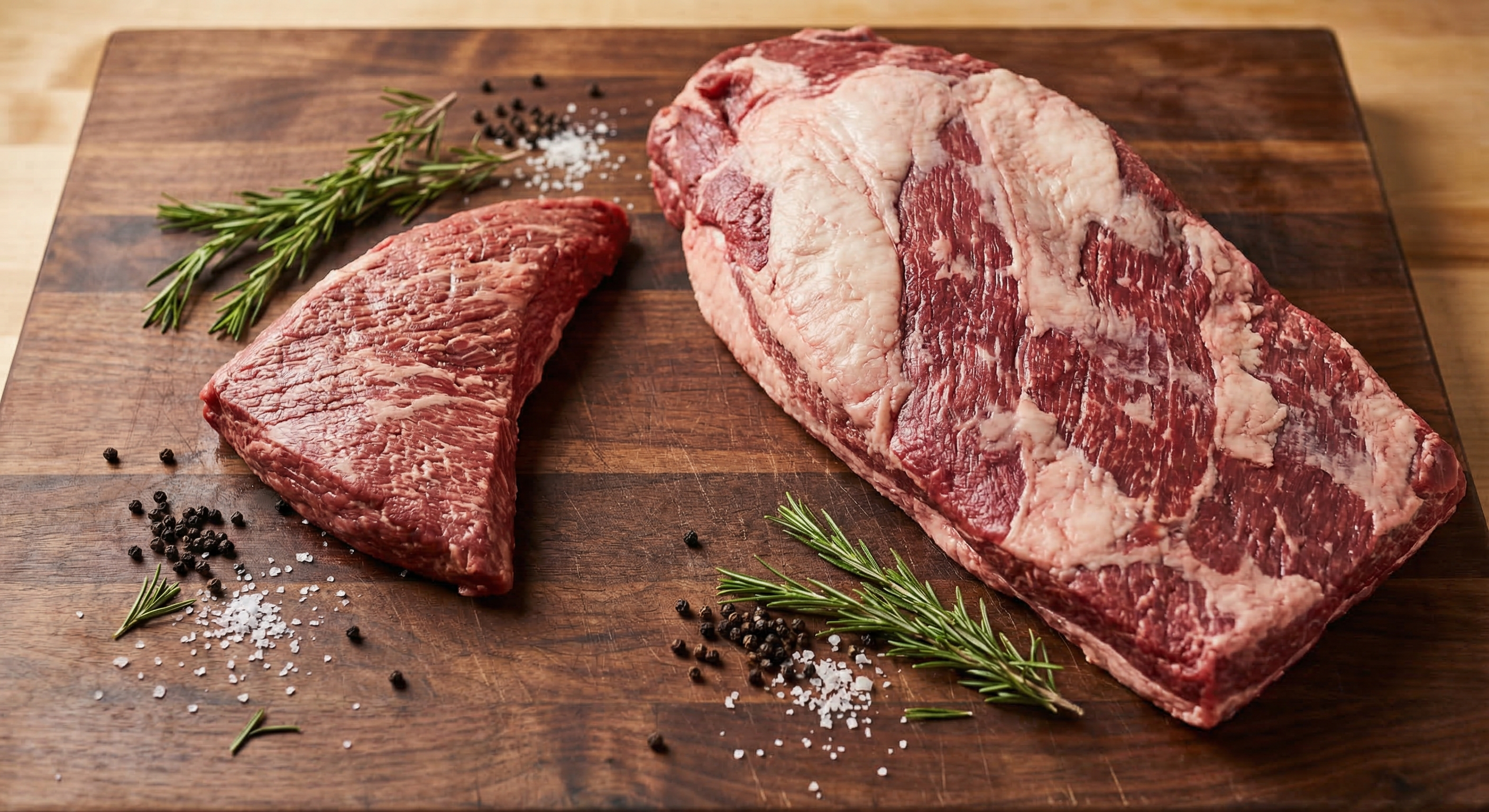
Tri-tip and brisket are two of the most popular cuts for smoking, grilling, and feeding a crowd. They both come from the lower half of the cow, they both respond beautifully to smoke, and they both have passionate followings. But that is where the similarities end.
After three decades of breaking down beef, I can tell you these cuts demand completely different approaches. Cook a tri-tip like a brisket and you will get dry cardboard. Cook a brisket like a tri-tip and you will need a chainsaw to cut it. Understanding the fundamental differences between these two cuts is the key to getting both right.
The Quick Answer
Choose tri-tip when: You want bold beef flavor in under 90 minutes, you are cooking for 4-6 people, you prefer medium-rare meat, or you do not have time for an all-day cook.
Choose brisket when: You are feeding a crowd (10+ people), you want that melt-in-your-mouth slow-smoked texture, you enjoy the process of a 12-16 hour cook, or you want both lean slices and rich burnt ends from one cut.
Neither cut is objectively better. They solve different problems. The best pitmasters have both in their rotation.
Where Each Cut Comes From
Tri-tip comes from the bottom sirloin subprimal, a triangular muscle at the very tip of the sirloin near the rear of the cow. Its official NAIS/UPC name is the tensor fasciae latae muscle. It sits right where the sirloin meets the round, and it is one of the few muscles in that region that has enough marbling to cook well at medium-rare.
Brisket comes from the breast or lower chest of the cow, between and below the front legs. It is a heavily worked muscle that supports about 60% of the animal's body weight when standing. A whole packer brisket consists of two muscles separated by a thick fat seam: the flat (pectoralis profundus) and the point (pectoralis superficialis).
These anatomical differences explain almost everything about how the two cuts behave in the kitchen. Tri-tip is a relatively tender muscle with moderate connective tissue. Brisket is packed with collagen from constant use, which is why it needs long, slow cooking to break down into that signature silky texture.
Size and Weight Comparison
This is one of the most obvious differences and it dictates everything from cooking time to how many people you can feed.
Tri-tip: A typical tri-tip weighs 1.5 to 3 pounds. It is roughly triangular, about 1.5 to 2.5 inches thick at the widest point, tapering to a thin edge. One tri-tip feeds 4-6 people comfortably.
Brisket: A whole packer brisket weighs 10 to 18 pounds untrimmed. After trimming excess fat, you are looking at 8 to 14 pounds of cookable meat. The flat alone can be 6-10 pounds. One brisket feeds 12-20 people depending on sides and appetite.
If you are cooking for a small weeknight dinner, buying a whole brisket makes no sense unless you plan to freeze portions. Tri-tip is the practical choice for smaller gatherings. If you are hosting a backyard party or competition, brisket gives you the volume and variety (flat slices plus point burnt ends) that tri-tip cannot match.
Fat Content and Marbling
Tri-tip has moderate intramuscular marbling, comparable to a sirloin steak. It has a thin fat cap on one side that helps with moisture retention during cooking but does not contribute the kind of internal basting you get from a heavily marbled cut. USDA Choice tri-tip typically has enough marbling for excellent flavor at medium-rare to medium.
Brisket has two very different fat profiles depending on whether you are looking at the flat or the point. The flat is relatively lean with long, thin fat striations running through the meat. The point is heavily marbled with thick veins of intramuscular fat and the large fat seam (the deckle) that separates it from the flat. This is why the point is preferred for burnt ends — all that internal fat renders during the long cook, creating incredibly rich, almost sticky bites.
Overall, a whole packer brisket has significantly more total fat than a tri-tip. This is not a disadvantage — it is what makes the long cook work. Without that fat and collagen, brisket would dry out during a 14-hour smoke. Tri-tip, with less fat to protect it, needs to be pulled at a lower internal temperature to stay juicy.
Cooking Methods Compared
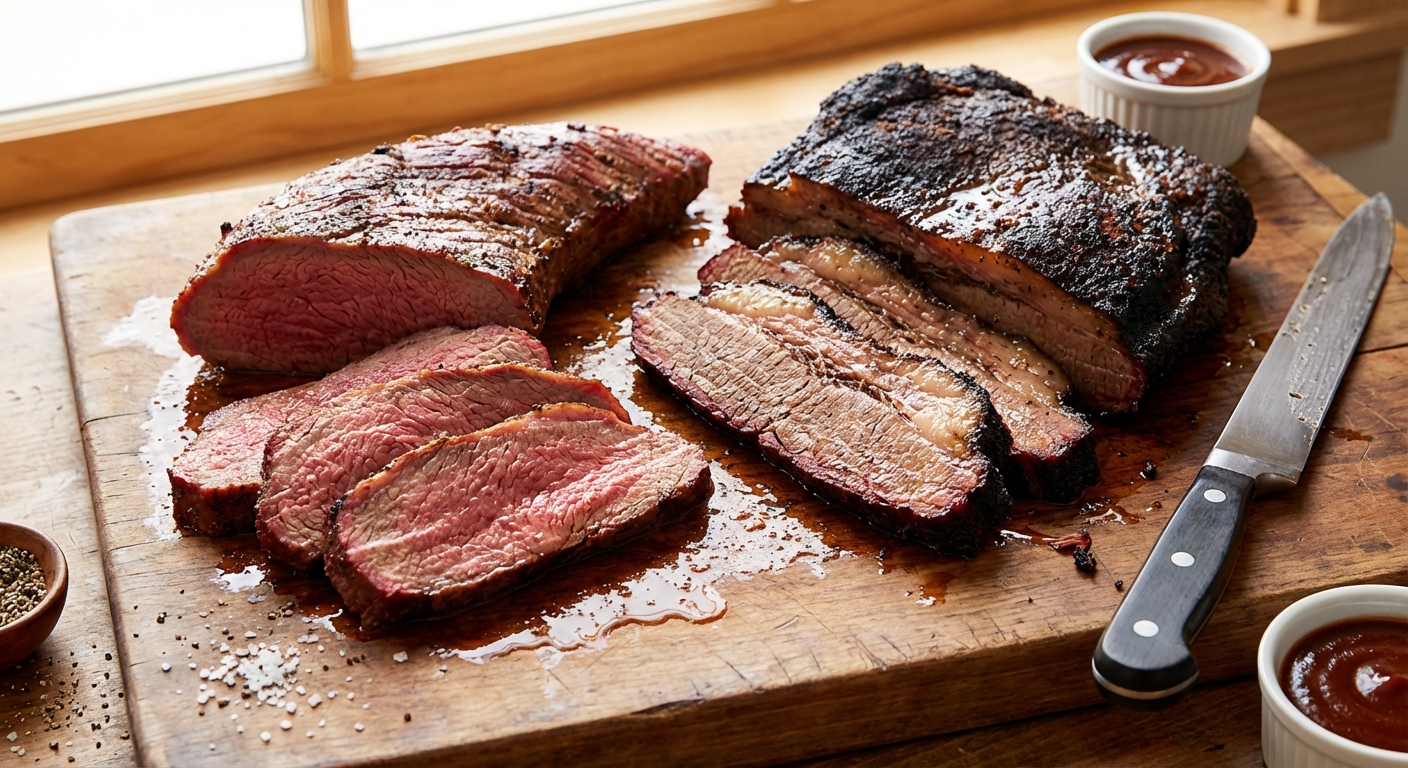
Tri-Tip: Fast and Versatile
Tri-tip shines with methods that keep it at medium-rare to medium (130-140°F internal). It cooks more like a large steak than a traditional barbecue cut.
- Grilling (direct + indirect): Sear over high heat for 4-5 minutes per side, then move to indirect heat until 130°F internal. Total time: 25-40 minutes.
- Smoking: Smoke at 225-250°F until internal temp hits 130-135°F, then sear over high heat. Total time: 60-90 minutes.
- Reverse sear (oven + skillet): Bake at 275°F until 120°F internal, rest 10 minutes, then sear in a ripping hot cast iron. Total time: 45-60 minutes.
- Santa Maria style: The traditional California method — grilled over red oak coals on an adjustable-height grate, seasoned with just salt, pepper, and garlic. Total time: 30-45 minutes.
Brisket: Low, Slow, and Patient
Brisket needs sustained low heat to convert tough collagen into gelatin. There are no shortcuts that produce the same result.
- Smoking (offset or pellet): 225-275°F for 10-16 hours depending on size. Wrap in butcher paper around 165°F internal (the Texas crutch). Pull at 200-205°F when a probe slides in like butter.
- Oven braising (flat only): Low oven at 275°F for 4-6 hours, covered tightly. Works for the flat when you do not have a smoker.
- Hot and fast (competition style): 300-325°F for 6-8 hours. Requires more attention but delivers great results. Gaining popularity among competition cooks.
The critical difference: tri-tip is done when it hits temperature (130-140°F). Brisket is done when it hits tenderness (probe-tender, usually around 200-205°F). You cannot rush collagen breakdown with higher heat — it needs time at temperature to convert properly.
Flavor Profile
Tri-tip delivers a clean, concentrated beef flavor. It tastes like the best possible sirloin — beefy, slightly mineral, with a satisfying chew that reminds you that you are eating steak. When smoked, it picks up a lighter smoke flavor than brisket because it spends less time in the smoker. The Santa Maria seasoning (salt, pepper, garlic, sometimes rosemary) has become the classic pairing because it highlights the meat's natural flavor without competing with it.
Brisket has a deeper, more complex flavor profile that develops over hours of cooking. The collagen breakdown creates a richness and body that tri-tip cannot replicate. The bark — that dark, seasoned crust that forms during the long cook — adds layers of pepper, smoke, and Maillard reaction flavors. Brisket from the point is richer and more succulent than from the flat, which is leaner and more traditionally "beefy."
If you like your beef to taste like beef, tri-tip wins. If you want that transformative, fall-apart, smoke-saturated experience that only comes from a long cook, brisket is irreplaceable.
Cost and Value
Tri-tip runs $7-12 per pound for USDA Choice, making a typical roast $15-30. It is an extremely cost-effective cut given its quality, though prices have risen as the cut has gained national popularity beyond its California roots.
Brisket runs $4-8 per pound for USDA Choice whole packers, with prime brisket hitting $8-12 per pound. A whole packer at $5/lb costs $50-90. However, you lose 30-40% to trimming and moisture loss during the long cook. Your actual cost per pound of finished, servable meat is closer to $8-14.
On a per-serving basis, both cuts offer excellent value compared to premium steaks like ribeye or filet mignon. Brisket is harder to find at some grocery stores — you may need to visit a butcher shop or order whole packers in advance, especially for prime grade.
Difficulty Level
Tri-tip is beginner-friendly. If you can cook a thick steak, you can cook a tri-tip. The margin for error is reasonable — even slightly overcooked tri-tip (medium-well) is still edible, just less juicy. Use a meat thermometer, pull it at 130°F for medium-rare, let it rest 10 minutes, and slice against the grain. The trickiest part is identifying the grain direction, which changes partway through the roast (slice the narrow end in one direction and the thick end in another).
Brisket is expert territory. Everything matters: trimming, seasoning, fire management, wood selection, when to wrap, when to pull, how long to rest. The stall (when the internal temperature plateaus around 150-170°F for hours as moisture evaporates from the surface) tests your patience. Resting is critical — a properly rested brisket (1-4 hours in a cooler) can mean the difference between good and legendary. Your first brisket will probably be mediocre. Your tenth will be significantly better. Your fiftieth might be great.
Which Cut Is Better for Specific Situations?
- Weeknight dinner: Tri-tip. Done in under an hour.
- Weekend cookout (small group): Tri-tip. Easy, impressive, no stress.
- Weekend cookout (big group): Brisket. Feeds 15+ people from one cut.
- BBQ competition: Brisket. It is the king of competition BBQ for a reason.
- Tacos: Both work beautifully. Tri-tip sliced thin or brisket chopped with some bark mixed in.
- Sandwiches: Brisket. That combination of tender meat, bark, and melted fat in a sandwich is transcendent.
- Meal prep: Brisket. Cook once, eat all week. Reheats better than most meats because the gelatin keeps it moist.
- First-time smoker: Tri-tip. Learn your smoker with a forgiving cut before attempting brisket.
Side-by-Side Comparison
- Weight: Tri-tip 1.5-3 lbs vs Brisket 10-18 lbs
- Cook time: Tri-tip 30-90 min vs Brisket 10-16 hours
- Target temp: Tri-tip 130-140°F vs Brisket 200-205°F
- Smoke time: Tri-tip 60-90 min vs Brisket 10-16 hours
- Difficulty: Tri-tip beginner vs Brisket intermediate-advanced
- Feeds: Tri-tip 4-6 people vs Brisket 12-20 people
- Price/lb: Tri-tip $7-12 vs Brisket $4-8 (whole packer)
- Best for: Tri-tip quick meals, small groups vs Brisket big events, meal prep
- Primal: Tri-tip bottom sirloin vs Brisket breast/chest
- Texture: Tri-tip steak-like chew vs Brisket melt-in-your-mouth tender
Common Mistakes to Avoid
Tri-Tip Mistakes
- Overcooking past medium: Tri-tip has limited fat to compensate for moisture loss. Past 145°F internal, it gets dry and tough rapidly.
- Slicing with the grain: The grain direction changes partway through a tri-tip. Cutting with the grain turns tender meat into chewy strips.
- Skipping the rest: Even 10 minutes of resting lets juices redistribute. Cut into it immediately and you lose flavor all over your cutting board.
- Treating it like brisket: Cooking tri-tip low and slow to 200°F will turn it into dry, gray shoe leather. It does not have enough collagen or fat for that approach.
Brisket Mistakes
- Pulling at temperature instead of tenderness: Brisket is not done at 200°F — it is done when a thermometer probe slides in with no resistance. Sometimes that is 197°F, sometimes 207°F.
- Not resting long enough: Minimum 1 hour rest, ideally 2-4 hours wrapped in butcher paper in a cooler. This is not optional.
- Over-trimming the fat cap: Leave 1/4 inch of fat cap to protect the flat during the long cook. Trimming it all off exposes the lean flat to direct heat for 12+ hours.
- Panicking during the stall: The temperature plateau around 150-170°F is normal. Either wrap it (Texas crutch) or wait it out. Do not crank the heat.
Frequently Asked Questions
Frequently Asked Questions
Can I substitute tri-tip for brisket in a recipe?
Not directly. If the recipe calls for slow-cooking brisket for hours, tri-tip will dry out completely. If you want a similar flavor in less time, cook the tri-tip using a steak method (grill or reverse sear) and serve it sliced. For braises or slow-cooker recipes, chuck roast is a better brisket substitute than tri-tip.
Which cut has more protein?
Per 100g of cooked meat, they are nearly identical — both provide about 26-28g of protein. Brisket (especially the point) has more total fat, so on a calorie-per-gram basis, tri-tip is slightly leaner. But the difference is minimal for practical purposes.
Is tri-tip just a small brisket?
No. They come from completely different parts of the cow. Tri-tip is from the bottom sirloin (rear) and brisket is from the chest (front). They have different muscle structures, fat content, and connective tissue levels, which is why they require different cooking methods.
Why is tri-tip hard to find on the East Coast?
Tri-tip has historically been a California and West Coast cut. Many East Coast butchers break down the bottom sirloin differently, grinding the tri-tip into hamburger or cutting it into sirloin tips. Demand is growing nationally, but you may need to ask your butcher to cut one specifically or order online.
Can I smoke tri-tip like brisket?
You can smoke tri-tip, but not like brisket. Smoke it at 225-250°F until the internal temperature reaches 130-135°F (about 60-90 minutes), then sear it over high heat. Do not try to take it to 200°F — it will be completely dried out. Think of smoked tri-tip as a smoke-kissed steak, not a barbecue brisket.
Which is better for beginners?
Tri-tip, without question. It is faster, more forgiving, and requires no special equipment. A good brisket takes practice — most people do not nail it until their fifth or tenth attempt. Start with tri-tip to learn your grill or smoker, then graduate to brisket when you are confident managing fire and temperature over a long cook.
More Expert Guides
What Is Chateaubriand? (Cut, Cooking, & Best Sources)
Chateaubriand is a thick-cut roast from the center of the beef tenderloin, traditionally served for two. Learn what makes this classic French cut special and how to cook it.
14 min readWhat Is Round Steak? The Complete Guide to Beef's Most Versatile Budget Cut
Round steak comes from the rear leg of the cow — it's lean, affordable, and misunderstood. A master butcher breaks down every sub-cut, cooking method, and technique to turn this budget workhorse into genuinely delicious meals.
14 min readWhat Is Eye of Round? The Complete Butcher's Guide to This Lean Cut
Eye of round is one of the leanest, most affordable cuts in the entire beef case — and one of the most misunderstood. A butcher explains how to turn this budget-friendly roast into something genuinely delicious.