Tomahawk Steak Cut: The Complete Butcher's Guide
The tomahawk steak cut is, without question, the most visually dramatic piece of beef you'll ever put on a plate. That long, frenched rib bone jutting out like the handle of a hatchet — there's nothing else like it in the meat case. After 30 years behind the butcher block, I still stop and admire a well-cut tomahawk before I wrap it. It's that impressive.
But here's what most people don't understand: a tomahawk isn't a separate cut of beef. It's a bone-in ribeye with the entire rib bone left intact and frenched clean. The meat is identical to the ribeye you already know and love. The difference is all in the fabrication — how the butcher breaks down the primal and presents that bone.
In this guide, I'm going to walk you through everything about the tomahawk steak cut: where it comes from on the animal, how we fabricate it, what separates a great one from a mediocre one, and exactly how to cook it so that bone-in beauty lives up to its dramatic appearance.
What Is a Tomahawk Steak Cut?
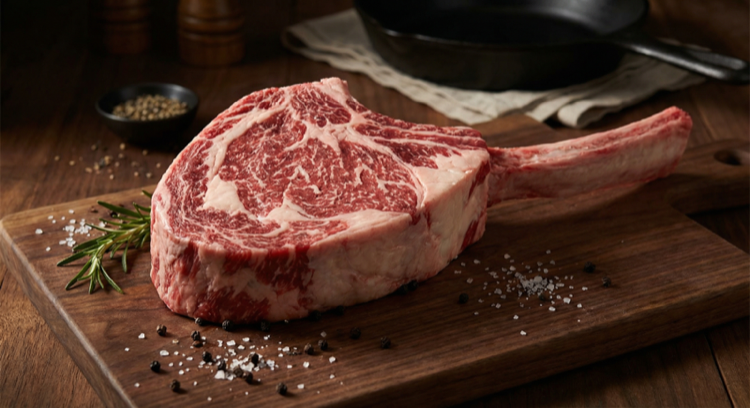
A tomahawk steak is a bone-in ribeye cut from the beef rib primal (ribs 6 through 12) with the entire rib bone left attached — typically 6 to 8 inches of bone extending from the eye of the meat. The bone is "frenched," meaning all meat, fat, and membrane are scraped completely clean, leaving nothing but bare bone.
The name comes from its resemblance to a single-handed axe, or tomahawk. The thick ribeye is the head of the axe; the long frenched bone is the handle. It's also sometimes called a tomahawk chop, bone-in cowboy ribeye, or simply a long-bone ribeye.
The Anatomy of the Tomahawk Steak Cut
The meat portion of a tomahawk is composed of the same muscles as any ribeye:
- Longissimus dorsi (the "eye") — The large, central oval of meat. This is the primary muscle, lean with consistent marbling throughout. It's what most people think of when they think "ribeye."
- Spinalis dorsi (the "cap" or "deckle") — The crescent-shaped muscle that wraps around the top of the eye. Many butchers consider this the single best-tasting muscle on the entire animal. Incredibly rich, buttery, and intensely beefy.
- Complexus — A smaller muscle that appears in steaks cut from ribs closer to the chuck end. It sits between the eye and the cap.
- Intercostal meat — The small bits of meat between the ribs, which are removed during frenching.
A typical tomahawk weighs between 30 and 45 ounces (roughly 2 to 3 pounds), though the bone accounts for a significant portion of that weight. The meat itself usually runs 20 to 28 ounces — easily enough for two people, sometimes three.
Where the Tomahawk Steak Cut Comes From
The tomahawk comes from the beef rib primal, which is one of the eight primal cuts of beef. The rib primal spans ribs 6 through 12, sitting between the chuck (shoulder) and the loin.
Not every rib position yields an equally good tomahawk. Here's what I look for:
- Ribs 6-8 (chuck end) — Larger eye, more fat seams, the complexus muscle is present. These steaks are bigger but can have more connective tissue. Good for people who want maximum size.
- Ribs 9-11 (center cut) — The sweet spot. Clean eye, beautiful spinalis cap, excellent marbling, minimal connective tissue. This is where your best tomahawks come from.
- Rib 12 (loin end) — Smaller eye, the cap starts to disappear. Still good, but not as dramatic.
When I'm selecting tomahawks for the case — or for a customer who specifically asks — I always reach for ribs 9 through 11. That center-cut position gives you the best balance of size, marbling, and that gorgeous spinalis cap that makes the ribeye the king of steaks.
How a Butcher Fabricates the Tomahawk Steak Cut
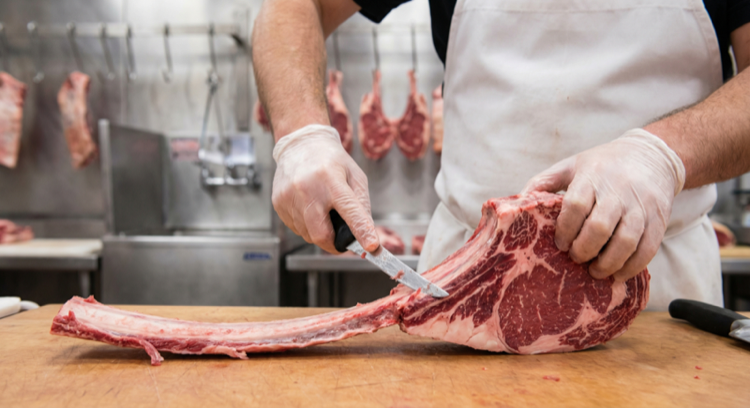
This is where the craft comes in. Any butcher can cut a boneless ribeye — that's basic fabrication. Cutting a proper tomahawk requires more skill, more time, and a willingness to sacrifice some sellable meat in the process.
Step 1: Breaking the Rib Primal
We start with a whole bone-in rib primal, also called a "standing rib roast" or "prime rib" in its uncut form. The primal arrives with the chine bone (backbone) still attached. First, we remove the chine bone using a band saw, cutting as close to the feather bones as possible.
Step 2: Removing the Short Ribs
Next, I measure down from the eye and cut off the short ribs — typically about 3 to 4 inches below the eye. This creates the flat bottom of the steak. Those short ribs don't go to waste; they're premium product in their own right.
Step 3: Frenching the Bones
This is what makes a tomahawk a tomahawk. Frenching means cleaning the rib bone completely bare. I score the meat and membrane along the bone, then use a combination of knife work and a clean towel to strip everything off. The goal is pristine white bone with zero meat, fat, or sinew remaining.
A good frenching job takes me about 3 to 4 minutes per bone. Rush it and you'll leave scraps that char and look messy on the plate. The intercostal meat between the ribs gets removed completely — that's sellable trim that goes toward ground beef or stew meat.
Step 4: Portioning the Steaks
I cut each tomahawk to a minimum of 2 inches thick. Anything thinner and you lose the whole point — the thickness is what allows you to get a hard sear on the outside while keeping the center perfectly medium-rare. Most of my tomahawks run 2 to 2.5 inches.
The cut goes right between the rib bones, with the bandsaw doing the heavy work and a knife for the final clean-up cuts.
Tomahawk Steak Cut vs. Regular Ribeye: What's the Difference?
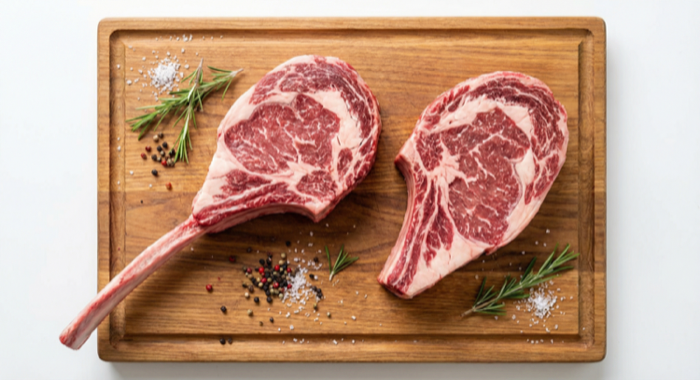
Let me be direct: the meat is the same. A tomahawk and a boneless ribeye from the same rib position, same animal, same grade — they will taste identical. The differences are in the presentation, the cooking dynamics, and (let's be honest) the price.
| Feature | Tomahawk | Bone-In Ribeye | Boneless Ribeye |
|---|---|---|---|
| Bone | 6-8" frenched rib bone | Short rib bone (2-3") | No bone |
| Typical weight | 30-45 oz | 16-24 oz | 12-20 oz |
| Thickness | 2-2.5" | 1-1.5" | 1-1.5" |
| Price per lb | Highest | Middle | Lowest |
| Cooking method | Reverse sear ideal | Pan sear / grill | Pan sear / grill |
| Presentation | Maximum drama | Classic | Clean and simple |
The bone does serve one practical purpose during cooking: it acts as an insulator. The meat closest to the bone cooks slightly slower, which means you get a natural gradient of doneness. Some people love this; others find it inconsistent. Personally, I think it adds character.
Is a tomahawk worth the premium? If you're cooking for a special occasion and want the "wow factor," absolutely. If you're just after great ribeye flavor, a standard bone-in ribeye from a reputable source like American Wagyu will deliver the same eating experience at a lower price point.
How to Choose the Best Tomahawk Steak Cut
Whether you're at the butcher counter or ordering online, here's what separates an excellent tomahawk from an average one:
Marbling
This is non-negotiable. The ribeye's reputation is built on marbling — those white flecks and streaks of intramuscular fat that melt during cooking, basting the meat from within. Look for consistent marbling throughout both the eye and the cap. USDA Choice is the minimum I'd recommend; Prime is significantly better. And if you can get your hands on Japanese A5 Wagyu, you're in a different universe entirely.
Thickness
Don't accept anything under 2 inches. The whole cooking strategy for a tomahawk depends on that thickness — it's what makes the reverse sear work. A thin tomahawk is just an overpriced bone-in ribeye with a handle.
The Frenching Job
Look at the bone. Is it clean? Completely bare? Or are there scraps of meat and membrane still clinging to it? A sloppy frenching job tells you the butcher rushed — and if they rushed the fabrication, they probably weren't careful about other things either.
Color and Freshness
The meat should be a bright cherry red (if fresh) or a deep purplish-red (if vacuum-sealed). Brown or gray spots mean the meat is oxidizing. Not dangerous, but not ideal. The fat should be white to cream-colored — yellow fat indicates an older animal or grass-finished beef (which isn't bad, just different).
The Cap
Make sure the spinalis cap is intact and well-attached. Some lower-quality fabrication separates the cap from the eye with too much fat seam showing. You want them connected with a thin layer of fat between — they should cook as one piece.
How to Cook a Tomahawk Steak Cut to Perfection
Here's where I see people mess up the most. A tomahawk is NOT a regular steak and should NOT be cooked like one. That 2+ inch thickness means direct high heat alone will give you a charred exterior and a raw center. You need a two-zone approach.
The Reverse Sear Method (My Recommendation)
This is the gold standard for cooking any thick steak, and it's especially perfect for the tomahawk steak cut. Here's how I do it:
- Temper the steak. Pull it from the fridge 60 to 90 minutes before cooking. A room-temperature steak cooks more evenly. Season generously with coarse salt and freshly cracked black pepper — nothing else needed for a quality cut.
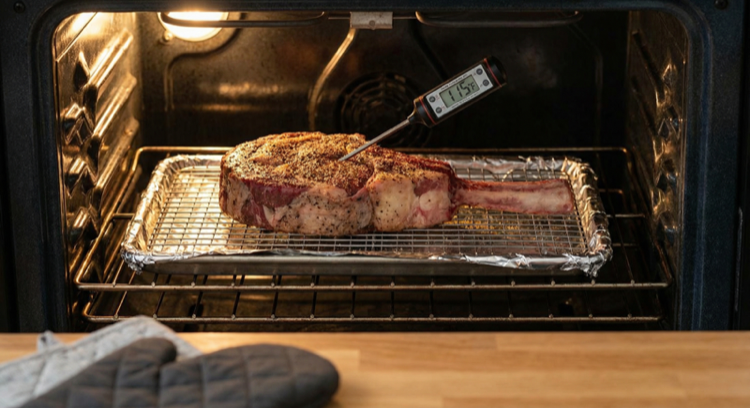
- Low and slow first. Place the steak on a wire rack over a sheet pan in a 250°F oven. Insert a probe thermometer into the thickest part of the eye. Cook until internal temperature reaches 115-120°F for medium-rare (this takes 45 to 60 minutes depending on thickness).
- Rest briefly. Pull the steak and let it rest for 10 minutes while you get your searing surface screaming hot.
- Sear hard and fast. Cast iron skillet, 2 tablespoons of high-smoke-point oil (avocado or refined peanut). Sear 60-90 seconds per side until you have a deep brown crust. Use the bone as a handle to sear the edges and the fat cap.
- Final rest. Rest another 5 to 10 minutes. The carryover cooking will bring you to a perfect 130-135°F internal temperature.
Grilling Method
If you're grilling, set up two-zone heat: one side blazing hot (direct), one side with no coals or burners off (indirect). Start the tomahawk on the indirect side with the lid closed, flipping every 10 minutes until you hit 115°F internally. Then move it to direct heat for 60-90 seconds per side to build the crust.
Pro tip: position the bone pointing toward the cooler side. The bone conducts heat and can overcook the meat near it if it's directly over the flame.
Temperature Guide
| Doneness | Pull Temp (before rest) | Final Temp (after rest) |
|---|---|---|
| Rare | 110°F | 120-125°F |
| Medium-Rare (recommended) | 118°F | 130-135°F |
| Medium | 128°F | 140-145°F |
| Medium-Well | 138°F | 150-155°F |
I strongly recommend medium-rare for a tomahawk. The high fat content in the ribeye means it stays juicy and tender at this temperature. Going past medium starts rendering out too much fat and drying the meat — especially the leaner eye portion.
Common Mistakes When Cooking a Tomahawk Steak Cut
I've watched a lot of people butcher a beautiful tomahawk (pun intended). Here are the mistakes I see over and over:
- Cooking it straight from the fridge. A cold steak this thick will have a massive temperature gradient — gray and overcooked on the outside, cold and raw in the center. Temper it. Every time.
- Skipping the thermometer. This isn't a burger where you can eyeball it. You're dealing with a $50-100+ piece of meat that's 2+ inches thick. Use a damn thermometer. No excuses.
- Only using direct heat. Throwing a tomahawk directly over high heat and leaving it there is a guaranteed way to char the outside and leave the center raw. Two-zone is mandatory.
- Not resting. When you cut into a steak immediately after cooking, the juices pool out onto the cutting board instead of redistributing through the meat. 10 minutes of patience saves your steak.
- Cutting with the grain. When you slice a tomahawk for serving (which I recommend — it's too big for most people to eat off the bone), cut against the grain in 1/2-inch slices. Cutting with the grain gives you chewy, stringy bites.
USDA Grades and the Tomahawk Steak Cut
The USDA grading system matters more with a tomahawk than almost any other cut, because marbling is the primary driver of flavor in the ribeye.
- Select: Minimal marbling. Will be lean and potentially dry. I wouldn't recommend it for a tomahawk — the whole point is richness and fat flavor.
- Choice: Moderate marbling. This is the baseline for a good tomahawk. Most supermarket tomahawks are upper Choice.
- Prime: Abundant marbling. Significantly more fat infiltration. This is where the tomahawk really shines. Only about 5-8% of all beef grades Prime.
- Wagyu: Off the charts. If you've never tried a wagyu ribeye, you owe it to yourself. The marbling is so intense it looks almost white. American Wagyu tomahawks are an incredible experience — the genetics deliver marbling levels that Prime can't touch.
Where to Buy Quality Tomahawk Steak Cuts
Your options, ranked by reliability:
- A dedicated butcher shop. A real butcher can cut a tomahawk to your exact specifications — thickness, rib position, everything. Build a relationship with your butcher. It's the single best thing you can do for your meat quality.
- Premium online retailers. Companies like The Meatery specialize in premium cuts including wagyu tomahawks. The advantage is access to grades and breeds your local grocery store will never carry. Everything ships frozen with proper cold chain, so quality is locked in.
- High-end grocery stores. Whole Foods, specialty markets, and some Costco locations carry tomahawks. Quality is generally good but you can't choose your rib position or customize thickness.
- Standard supermarkets. Hit or miss. Some carry tomahawks seasonally (especially around grilling holidays). Often Choice grade, sometimes uneven fabrication.
Serving and Presentation Tips
Half the point of cooking a tomahawk is the presentation. Here's how to make the most of it:
- Slice before serving. After resting, slice the meat off the bone in one piece, then cut into 1/2-inch slices against the grain. Fan the slices out on a board or platter with the bone propped alongside. This makes it easy for everyone to grab pieces and shows off the perfect medium-rare interior.
- Use a wooden cutting board. Not only does it look better than a plate, it catches the juices which you can drizzle back over the slices.
- Keep the seasoning simple. A great tomahawk needs salt, pepper, and maybe a finishing touch of flaky sea salt (like Maldon) after slicing. The meat should be the star, not a compound butter or sauce.
- Pair with bold sides. Creamed spinach, roasted bone marrow, charred broccolini, or a simple arugula salad with shaved parmesan. The richness of the ribeye pairs well with something that cuts through the fat.
How Much Tomahawk Steak Per Person?
A standard tomahawk (30-45 oz total) feeds 2 to 3 people comfortably when sliced and served family-style. If you're serving it as part of a larger meal with generous sides, one tomahawk can stretch to feed 4.
For a dinner party, I typically plan one tomahawk per 2 guests to be safe. It's better to have leftovers (cold sliced tomahawk makes an ungodly good sandwich the next day) than to leave anyone wanting.
The Bottom Line on the Tomahawk Steak Cut
After 30 years of cutting meat, the tomahawk remains one of the most satisfying cuts to fabricate and serve. Yes, you're paying a premium for that long bone — bone you can't eat. But the presentation is unmatched, the cooking dynamics of that thick cut produce incredible results, and there's something primal and deeply satisfying about eating a piece of meat off a bone handle.
Focus on getting the best grade you can afford (premium cuts make all the difference), use the reverse sear method, and don't you dare skip the meat thermometer. Do those three things and you'll produce a steakhouse-quality tomahawk that'll make people think you trained under a professional.
That's the butcher's honest truth. Now go cook one.
Frequently Asked Questions
What is a tomahawk steak cut?
A tomahawk steak is a bone-in ribeye with the entire rib bone (6-8 inches) left attached and frenched clean. The meat is identical to a regular ribeye — the difference is the long bone presentation that resembles a tomahawk axe. Typical weight is 30-45 ounces.
Why is a tomahawk steak so expensive?
Tomahawk steaks cost more because the frenching process is labor-intensive and you're paying for bone weight you can't eat. The butcher also sacrifices intercostal meat during fabrication. Expect to pay 30-50% more per pound compared to a boneless ribeye of the same grade.
How do you cook a tomahawk steak?
The best method is the reverse sear: cook low and slow in a 250°F oven until 115-120°F internal, rest 10 minutes, then sear hard in a screaming hot cast iron skillet for 60-90 seconds per side. This gives you an even medium-rare interior with a perfect crust.
How long does it take to cook a tomahawk steak?
Using the reverse sear method, plan for about 45-60 minutes in the oven at 250°F, plus 10 minutes rest, plus 3-4 minutes for the sear. Total time from oven to plate is roughly 60-75 minutes. Don't rush it — the thickness demands patience.
Is the bone on a tomahawk steak just for show?
Mostly, yes — but it does serve a practical purpose. The bone insulates the meat closest to it, creating a slight temperature gradient during cooking. It also makes a convenient handle for searing edges. And honestly, the presentation factor at the table is worth something.
How many people does a tomahawk steak feed?
One tomahawk steak (30-45 oz) comfortably feeds 2-3 people when sliced and served family-style. For a dinner party, plan one tomahawk per 2 guests to be safe.
More Expert Guides
What Is Chateaubriand? (Cut, Cooking, & Best Sources)
Chateaubriand is a thick-cut roast from the center of the beef tenderloin, traditionally served for two. Learn what makes this classic French cut special and how to cook it.
14 min readWhat Is Round Steak? The Complete Guide to Beef's Most Versatile Budget Cut
Round steak comes from the rear leg of the cow — it's lean, affordable, and misunderstood. A master butcher breaks down every sub-cut, cooking method, and technique to turn this budget workhorse into genuinely delicious meals.
14 min readWhat Is Eye of Round? The Complete Butcher's Guide to This Lean Cut
Eye of round is one of the leanest, most affordable cuts in the entire beef case — and one of the most misunderstood. A butcher explains how to turn this budget-friendly roast into something genuinely delicious.