Ribeye vs Strip Steak: A Master Butcher's Honest Comparison
If I had a dollar for every time someone leaned over my butcher case and asked "ribeye or strip — which one should I get?" I'd have retired years ago. The ribeye vs strip steak debate is the single most common question I hear, and after 30-plus years of cutting, cooking, and eating both, I'm going to give you the straightforward answer that most articles online dance around.
Here's the truth: neither one is objectively "better." They're different tools for different jobs. But by the time you finish this guide, you'll know exactly which one belongs on YOUR plate tonight. Let's break it down cut by cut, the way I'd explain it if you were standing right here at my counter.
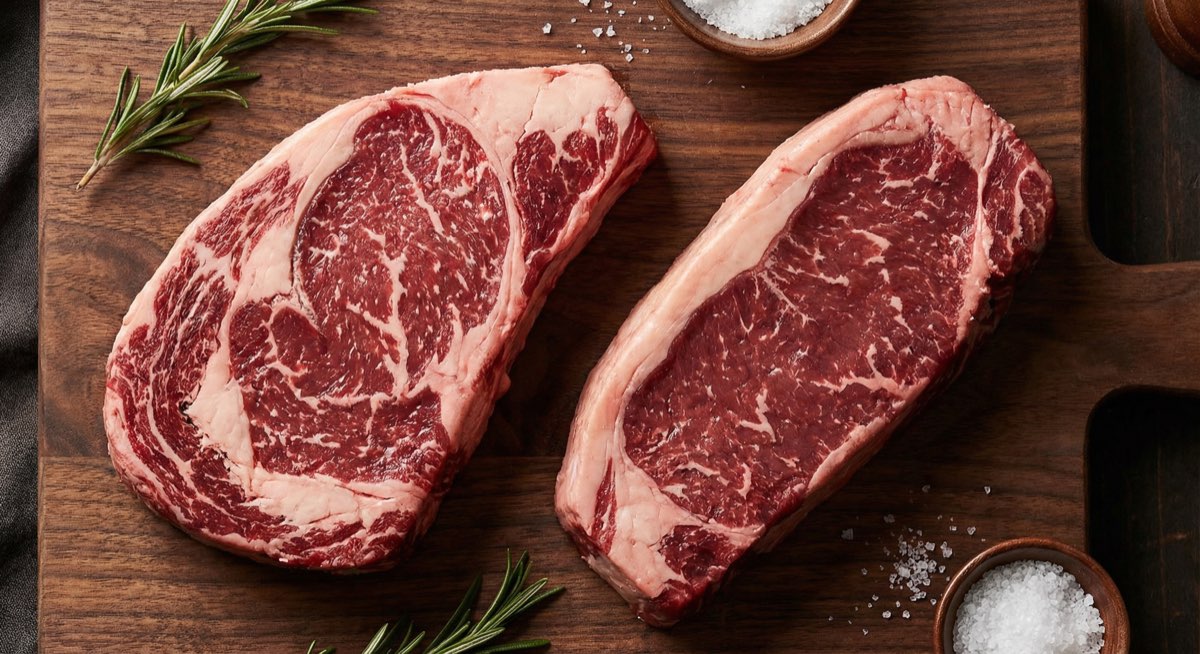
Where Ribeye and Strip Steak Come From
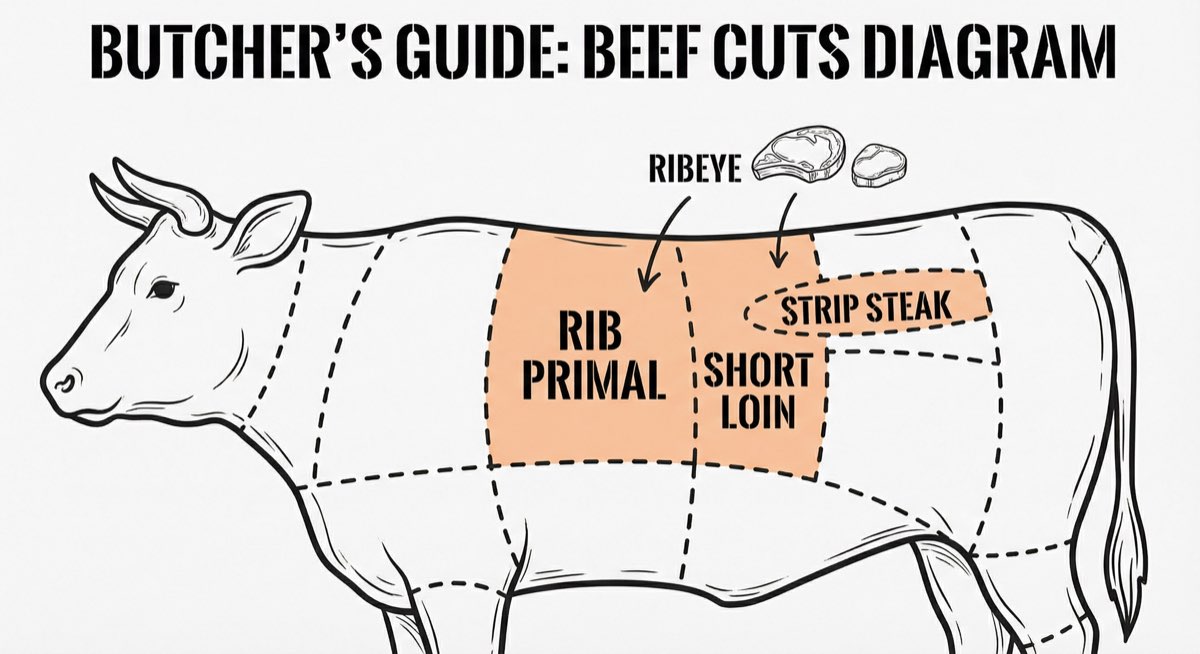
Before you can understand WHY these steaks taste different, you need to understand WHERE they come from. Both cuts sit along the back of the steer, but they come from different primal sections — and that matters more than most people realize.
The Ribeye: From the Rib Primal
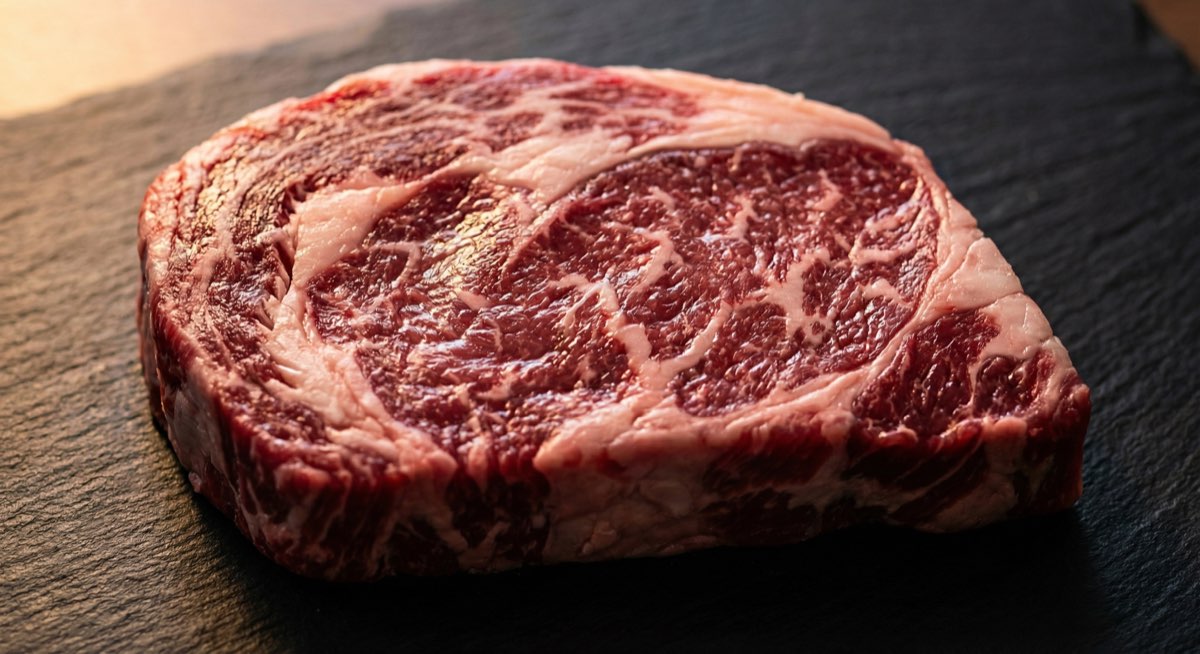
The ribeye is cut from the rib primal, specifically ribs 6 through 12. This section of the animal does very little work during the steer's life. Less work means less developed muscle fiber, which means more tenderness and — crucially — more intramuscular fat. That fat is what we call marbling, and it's the ribeye's calling card.
A ribeye is actually composed of several muscles. The main one is the longissimus dorsi (the "eye"), but the real star is the spinalis dorsi — that crescent-shaped cap muscle that wraps around the top. If you've ever had a bite of steak that made you close your eyes and say something inappropriate, it was probably the spinalis. It's the single most flavorful piece of beef on the entire animal.
The Strip Steak: From the Short Loin
The strip steak — also called the New York strip, Kansas City strip, or just "strip loin" — comes from the short loin primal, which sits directly behind the rib section. It's the longissimus dorsi muscle continuing backward, but without the spinalis cap and with a different fat structure.
The short loin does slightly more work than the rib section. Not a lot — we're not talking about a chuck roast here — but enough to create a firmer, more structured texture. The strip has a thick band of fat running along one edge rather than fat distributed throughout the meat.
Ribeye vs Strip Steak: The Key Differences
Now that you know the anatomy, let's compare these two heavyweights across the categories that actually matter when you're spending good money on steak.
Marbling and Fat Content
Ribeye wins this one, and it's not close. The rib primal naturally carries more intramuscular fat than any other section of the animal. A well-marbled ribeye looks like a roadmap — white streaks of fat running through every square inch of red meat. When that fat renders during cooking, it bastes the steak from the inside out, creating that buttery, almost unctuous mouthfeel ribeye lovers chase.
The strip steak has marbling too, but it's more moderate. You'll see some intramuscular fat, but the primary fat deposit is that thick strip along the edge (which is why some people trim it off — though I'd argue that's a mistake). This gives the strip a leaner, cleaner eating experience.
If you're shopping for either cut and want the best marbling, look for Japanese A5 wagyu for the ultimate experience, or American wagyu for an incredible middle ground between marbling and traditional beef flavor.
Flavor Profile: Ribeye vs Strip Steak
Ribeye delivers a rich, beefy, almost buttery flavor. The fat marbling melts during cooking and saturates every bite with flavor. It's bold, indulgent, and unapologetically rich. That spinalis cap? It tastes like what beef dreams about being when it grows up.
Strip steak has a tighter, more concentrated "steak" flavor. Without as much fat diluting the meat's natural taste, you get a purer beef experience. It's not as rich as ribeye, but many steak purists prefer it precisely for that reason — you taste the MEAT, not the fat.
Think of it this way: the ribeye is a Cabernet Sauvignon — big, bold, rich. The strip is a well-made Bordeaux — structured, complex, elegant.
Tenderness and Texture
The ribeye is more tender overall, thanks to that higher fat content and the inclusion of the spinalis cap. Fat acts as a natural tenderizer — it literally melts between muscle fibers and makes every bite softer. The trade-off is that the ribeye has a looser, less uniform texture. Different bites can feel different because you're eating multiple muscles with varying fat deposits.
The strip steak has a firmer, more consistent bite. It's got a satisfying chew — not tough, but substantial. Every bite is essentially the same texture, the same experience. Some people call it "toothsome," and I think that's a perfect word for it. It feels like STEAK in a way that the softer ribeye sometimes doesn't.
Ribeye vs Strip Steak Price Comparison
This varies by grade and source, but generally:
- USDA Choice: Ribeye typically runs $2-4 more per pound than strip
- USDA Prime: The gap widens — ribeyes command a premium because Prime-grade marbling in a ribeye is spectacular
- Wagyu: Pricing varies enormously, but ribeyes remain the pricier option. Check current ribeye prices and current strip prices to compare
Here's what I tell budget-conscious customers: if you're buying Choice grade, the strip is the better value. The marbling difference between a Choice ribeye and Choice strip is less dramatic, so you're paying more for a smaller upgrade. But at Prime and wagyu grades? The ribeye's marbling advantage becomes massive, and the premium is worth every cent.
Best Cooking Methods for Each Cut
The biggest mistake I see home cooks make isn't buying the wrong steak — it's cooking the right steak the wrong way. Ribeyes and strips have different fat content, which means they respond differently to heat.
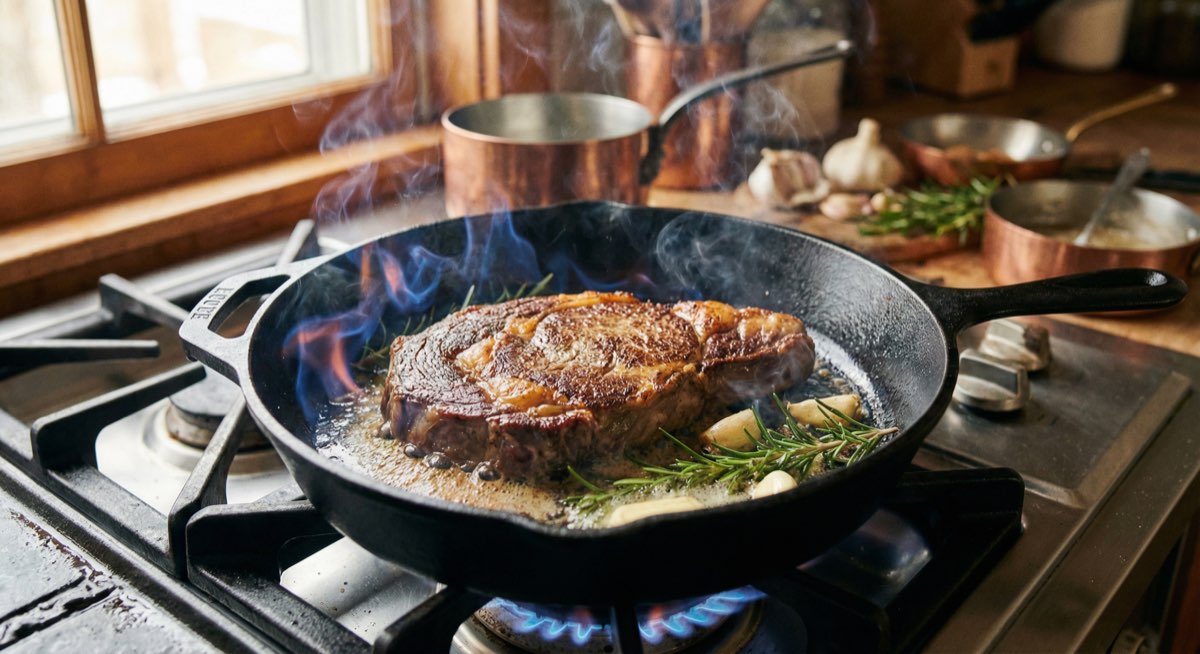
How to Cook a Ribeye
The ribeye's high fat content is a blessing and a curse. All that marbling means incredible flavor, but it also means flare-ups on the grill and rendered fat pooling in the pan. Here's how to handle it:
- Cast iron sear: My #1 recommendation. Get the pan screaming hot (500°F+), sear 3-4 minutes per side for a 1.5" steak, then finish in a 400°F oven if needed. The pan catches rendered fat instead of letting it cause flare-ups.
- Reverse sear: Start in a 250°F oven until 10-15°F below your target temp, then sear on blazing hot cast iron for 60-90 seconds per side. This is the method I use at home for thick-cut ribeyes over 1.5".
- Grill (carefully): Keep the steak over indirect heat for most of the cook, then move to direct high heat for the final sear. Have a cooler zone ready for flare-ups. Don't walk away from a ribeye on the grill.
Target temperature: 130°F internal for medium-rare. Ribeyes can handle medium (140°F) better than most cuts because the fat keeps them moist, but I wouldn't go past that.
How to Cook a Strip Steak
The strip is more forgiving on the grill because it has less fat to cause flare-ups, but it's less forgiving on temperature — overcook it and you'll notice faster because there's less fat to mask dryness.
- Grill (direct heat): The strip is a GRILL steak. High direct heat, 4-5 minutes per side for 1.25" thickness. The fat cap along the edge renders beautifully and creates a crust.
- Cast iron: Same technique as ribeye — screaming hot pan, 3-4 minutes per side. Baste with butter in the final minute.
- Reverse sear: Great for thick-cut strips (1.5"+). Low oven first, then hard sear.
Target temperature: 125-130°F internal for medium-rare. Because the strip is leaner, every degree past medium-rare costs you more moisture. I personally pull mine at 125°F and let carryover take it to 130°F.
Cooking Tips That Apply to Both
- Salt early. Season with kosher salt at least 45 minutes before cooking, or right before. The worst thing you can do is salt 5-15 minutes ahead — that pulls moisture to the surface without enough time for it to reabsorb.
- Room temperature is a myth. Taking a steak out 30 minutes early barely changes the internal temp. Don't bother. Just cook from the fridge.
- Use a thermometer. After 30 years, I STILL use a thermometer. The poke test is unreliable. Get an instant-read and stop guessing.
- Rest properly. 5-8 minutes on a wire rack. Not 15 minutes, not on a cutting board in a pool of juice. A wire rack, loosely tented.
Ribeye vs Strip Steak: Which Should You Buy?
Here's my honest recommendation based on thousands of conversations with customers over three decades:
Choose Ribeye If You:
- Love rich, buttery, indulgent flavor above all else
- Want the most forgiving steak (harder to overcook)
- Are cooking with cast iron or reverse searing
- Want to impress someone who doesn't eat steak often — the ribeye's richness is immediately impressive
- Are buying Prime grade or wagyu, where the marbling advantage is maximized
Choose Strip Steak If You:
- Prefer a cleaner, more concentrated beef flavor
- Like a firm, consistent texture with satisfying chew
- Are grilling — strips are the superior grill steak
- Want a slightly leaner option without sacrificing quality
- Are buying Choice grade, where the value proposition is better
Or Get Both — Seriously
Here's what I've started telling customers lately: buy one of each. Cook them side by side. The comparison will teach you more about your own preferences than any article (including this one) ever could. Browse premium cuts for both options in one place.
What About Bone-In vs Boneless?
Both cuts come in bone-in and boneless versions, and I get asked about this constantly.
Bone-in ribeye (also called a "cowboy steak" or, with the full rib bone, a "tomahawk") looks spectacular but cooks unevenly. The meat near the bone cooks slower than the outer edges. If presentation matters, go bone-in. If even cooking matters more, go boneless.
Bone-in strip (sometimes called a "shell steak") is less common but has a loyal following. The bone adds some extra flavor from the marrow and provides insulation for more gentle cooking near the bone.
My honest take: the bone adds a small amount of flavor, but it's mostly about presentation and the fun of eating off the bone. Boneless is easier to cook evenly, easier to sear (more surface contact with the pan), and easier to slice. If I'm cooking for myself, I usually go boneless. If I'm cooking for guests, bone-in makes the table look incredible.
USDA Grades: How They Affect the Ribeye vs Strip Debate
The USDA grade changes the equation significantly. Here's how:
- Select grade: At this level, neither steak has much marbling. The strip actually performs better because its natural texture doesn't rely on fat as heavily. Skip Select ribeyes — they're disappointing.
- Choice grade: Both are solid. The ribeye starts showing its marbling advantage, but the gap isn't massive. Best value tier for strip steaks.
- Prime grade: Now the ribeye really separates itself. Prime-grade marbling in a ribeye is stunning — the fat web is dense and beautiful. This is where the ribeye premium is 100% justified.
- Wagyu: Both cuts are extraordinary at wagyu grades. A wagyu strip steak has MORE marbling than a USDA Prime ribeye, so the traditional "ribeye has more marbling" rule gets blurred.
Common Myths About Ribeye and Strip Steak
Myth: "Ribeye is always more tender than strip"
Mostly true, but not always. A well-marbled Prime strip can be more tender than a Select ribeye. Grade matters more than cut when it comes to tenderness. And within the ribeye itself, the spinalis cap is incredibly tender while the center eye can be only moderately so.
Myth: "Strip steak is healthier than ribeye"
Slightly, but not meaningfully. A trimmed strip has maybe 2-3 fewer grams of fat per serving than a trimmed ribeye. If you're eating steak for health reasons, that marginal difference isn't moving the needle. Eat whichever one you enjoy more.
Myth: "You can substitute one for the other in any recipe"
Not quite. Recipes designed for ribeye account for its higher fat content (like stir-fry or Philly cheesesteak). Recipes designed for strip account for its leaner profile (like steak salad). Use the cut the recipe calls for, or adjust your cooking technique accordingly.
The Butcher's Final Word on Ribeye vs Strip Steak
I've been cutting both of these steaks since before most of you were born, and I still get excited every time I break down a whole rib or short loin. These are two of the greatest cuts beef has to offer, and the fact that they're different is what makes them both special.
If someone put a gun to my head and said "pick one for the rest of your life," I'd pick the ribeye. That spinalis cap is something I could eat every day and never get bored. But my wife would pick the strip — she loves that clean, firm bite and the way it takes to the grill.
Neither of us is wrong. And neither are you, regardless of which one you choose. Just buy the best grade you can afford, don't overcook it, and enjoy every bite. That's the only rule in steak that actually matters.
Frequently Asked Questions
Is ribeye or strip steak better?
Neither is objectively better — it depends on preference. Ribeye is richer, more marbled, and more buttery. Strip steak has a firmer texture and cleaner beef flavor. Ribeye is better for cast iron cooking; strip excels on the grill. Choose based on whether you prefer richness (ribeye) or a leaner, more concentrated steak flavor (strip).
Which is more expensive, ribeye or strip steak?
Ribeye typically costs $2-4 more per pound than strip steak at the same grade. The gap widens at Prime and wagyu grades because the ribeye's superior marbling commands a premium. At Choice grade, strip steak offers better value since the marbling difference is less dramatic.
Is ribeye or strip steak more tender?
Ribeye is generally more tender due to its higher intramuscular fat content, which melts between muscle fibers during cooking. However, a Prime-grade strip can be more tender than a Select-grade ribeye. The ribeye's spinalis cap is the most tender part, while the center eye is only moderately tender.
What is the difference between a ribeye and a New York strip?
The ribeye comes from the rib primal (ribs 6-12) and features heavy marbling plus the spinalis cap muscle. The New York strip comes from the short loin and has moderate marbling with a fat strip along one edge. Ribeye is richer and more buttery; strip is firmer with more concentrated beef flavor.
Can you grill both ribeye and strip steak?
Yes, but strip steak is the superior grill steak. Its lower fat content causes fewer flare-ups and it develops an excellent crust over direct heat. Ribeye's heavy marbling can cause flare-ups on the grill — use indirect heat for most of the cook, then sear over direct heat at the end. Or cook ribeyes on cast iron instead.
More Expert Guides
What Is Chateaubriand? (Cut, Cooking, & Best Sources)
Chateaubriand is a thick-cut roast from the center of the beef tenderloin, traditionally served for two. Learn what makes this classic French cut special and how to cook it.
14 min readWhat Is Round Steak? The Complete Guide to Beef's Most Versatile Budget Cut
Round steak comes from the rear leg of the cow — it's lean, affordable, and misunderstood. A master butcher breaks down every sub-cut, cooking method, and technique to turn this budget workhorse into genuinely delicious meals.
14 min readWhat Is Eye of Round? The Complete Butcher's Guide to This Lean Cut
Eye of round is one of the leanest, most affordable cuts in the entire beef case — and one of the most misunderstood. A butcher explains how to turn this budget-friendly roast into something genuinely delicious.