Prime Rib vs Ribeye: What's the Difference and Which Should You Buy?
Here's a question I've heard at the meat counter more times than I can count: "What's the difference between prime rib and ribeye?" And honestly, it's a great question — because they come from the exact same part of the cow. Same primal, same muscles, same incredible marbling. The difference is in how the butcher breaks it down and how you cook it.
Get this wrong and you'll either overcook an expensive roast or underbuy for a dinner party. Get it right and you'll know exactly when to reach for each cut — and why one costs twice as much per pound at a steakhouse.
After thirty-plus years of breaking down rib primals, here's everything you need to understand about these two closely related but fundamentally different cuts.
The Short Answer
Prime rib is a large roast cut from the rib primal — typically containing two to seven ribs — that's cooked whole and then sliced into servings. Ribeye is a single steak cut from that same primal, sold individually and cooked as one portion. Think of it this way: every slice of prime rib contains a ribeye. But not every ribeye was part of a prime rib roast.
The name "prime rib" doesn't refer to USDA Prime grade, despite what many people assume. It refers to the primal cut — the rib section — and historically to the fact that this was considered the prime (best) roasting cut on the animal. You can absolutely have a Choice-grade prime rib. The naming is confusing, but once you understand it, everything else falls into place.
Where They Come From on the Cow
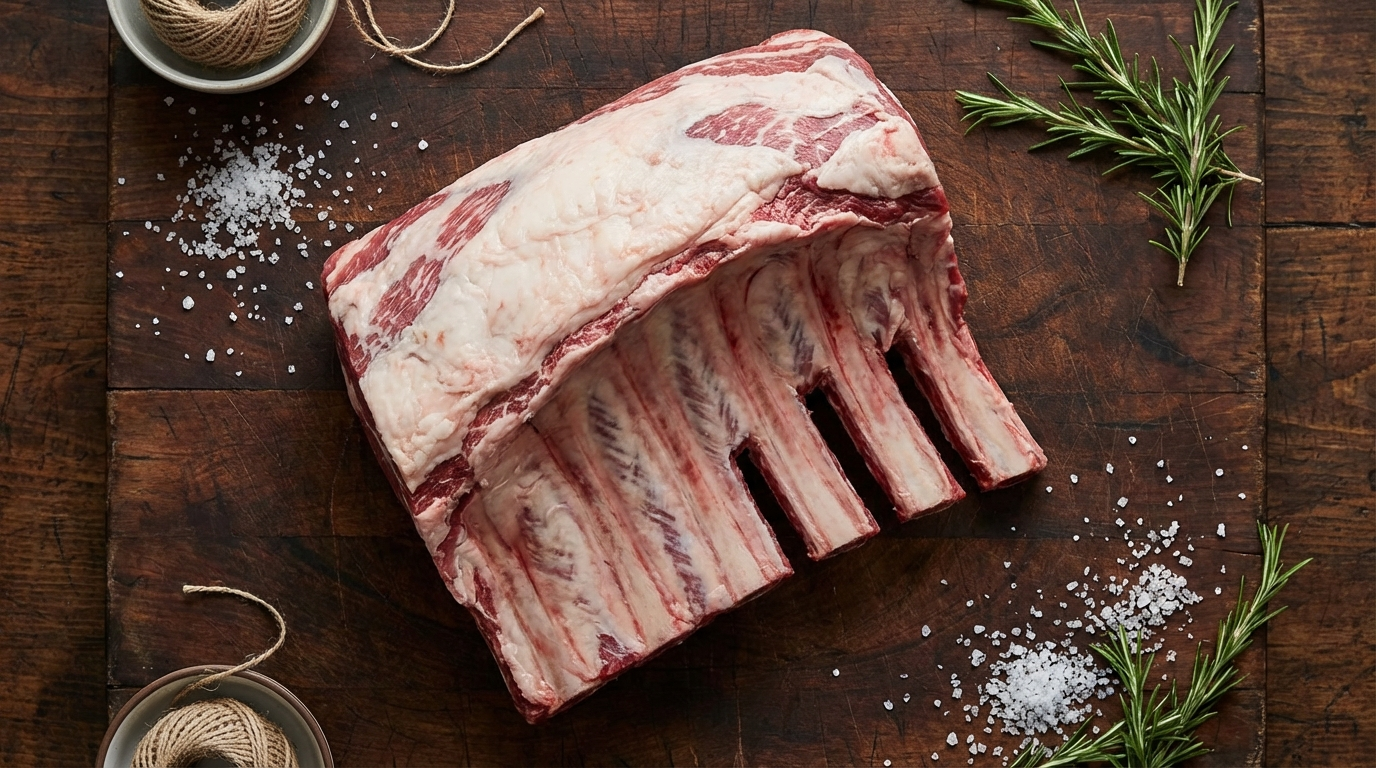
Both prime rib and ribeye come from the beef rib primal, which spans ribs 6 through 12 on the animal. This section sits between the chuck (shoulder) and the short loin (where you find strip steaks and T-bones). It's one of the least-worked muscle groups on the cow, which is why it's so naturally tender and well-marbled.
The rib primal contains several muscles, but three matter most:
- Longissimus dorsi (the eye) — The large, oval center muscle. This is what becomes the "eye" of the ribeye and makes up the bulk of each prime rib slice.
- Spinalis dorsi (the cap) — The crescent-shaped muscle that wraps around the top of the eye. Many butchers and chefs consider this the single best-tasting muscle on the entire animal. It's incredibly marbled and buttery.
- Complexus — A smaller muscle present on some ribs, usually toward the chuck end. It adds to the varied texture of prime rib slices.
When you buy a prime rib roast, you're getting all of these muscles intact, connected by fat seams and held together by the rib bones (if bone-in). When you buy a ribeye steak, the butcher has already separated these muscles into individual cross-section slices.
Prime Rib: The Full Roast
A prime rib roast — also called a standing rib roast — is the whole rib section cooked as one piece. A full seven-bone roast weighs 15 to 20 pounds and feeds 14 to 16 people. Most home cooks buy a three- or four-bone roast (6 to 10 pounds), which serves 6 to 8.
The "standing" part of the name comes from the traditional cooking method: the roast stands on its rib bones in the pan, which act as a natural rack. This elevates the meat, promotes even air circulation, and keeps the bottom from sitting in its own drippings.
The Chuck End vs the Loin End
Not all prime rib roasts are equal. The rib primal has two distinct ends:
- Chuck end (ribs 6-9): More fat, more connective tissue, more muscle variation. The slices from this end have that classic "messy" prime rib look with pockets of fat and multiple muscle sections. More flavorful but less uniform.
- Loin end (ribs 10-12): Cleaner, more uniform, with a larger eye and less surrounding fat. These slices look more like thick ribeye steaks. More tender but slightly less complex in flavor.
If you're ordering from a butcher, ask for the "first cut" or "loin end" for a cleaner presentation. Ask for the "second cut" or "chuck end" if you want maximum flavor and don't mind a rustier look.
Ribeye: The Individual Steak
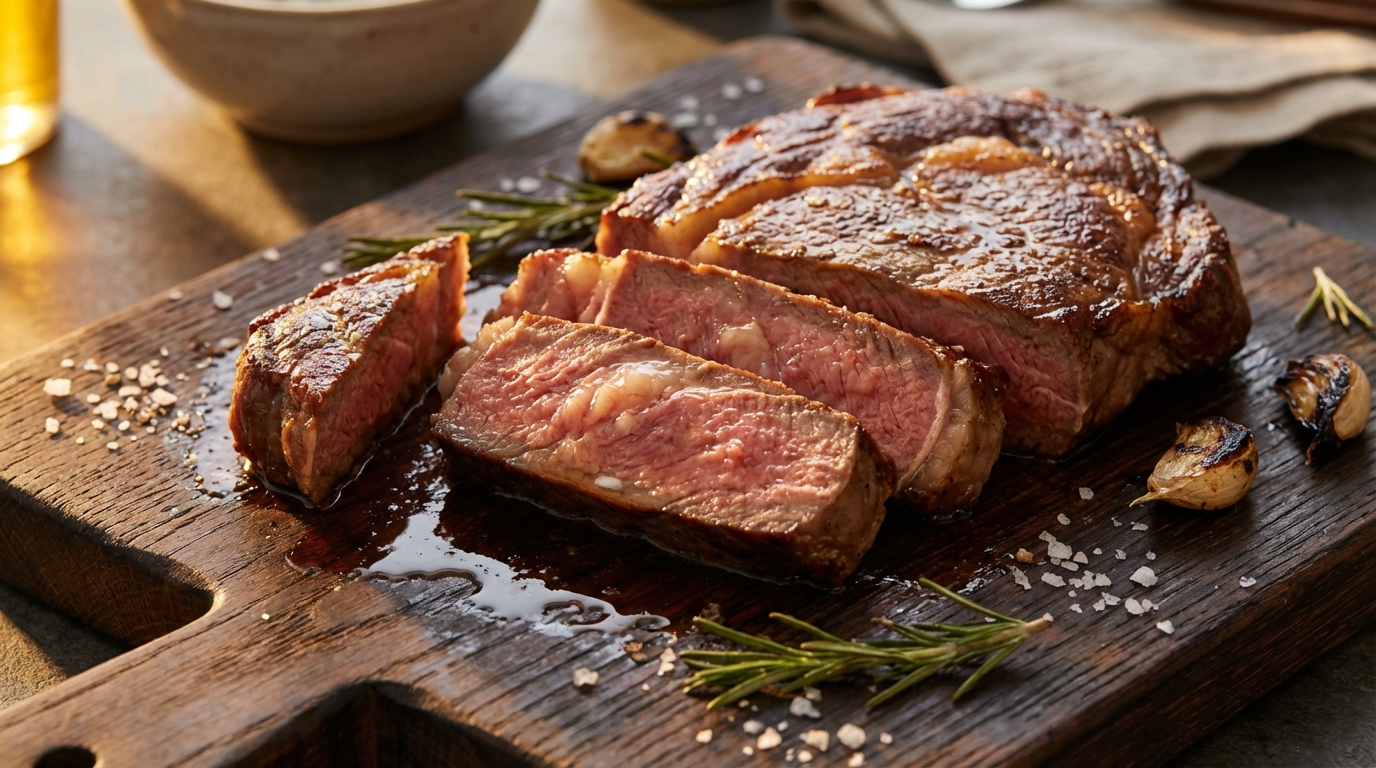
A ribeye steak is cut from the same rib primal, but it's sliced into individual steaks — typically 1 to 1.5 inches thick. You'll find them bone-in (sometimes called a cowboy steak or bone-in ribeye) or boneless.
The ribeye's defining characteristic is its marbling. Because the rib section does relatively little work, the muscles accumulate generous intramuscular fat — those white streaks running through the meat. This fat melts during cooking, basting the steak from the inside and creating that rich, buttery flavor ribeye is famous for.
Bone-In vs Boneless Ribeye
The bone-in vs boneless debate generates strong opinions, but here's what actually matters from a butcher's perspective:
- Bone-in ribeye: The bone acts as an insulator, meaning the meat closest to it cooks more slowly. This creates a gradient of doneness that some people love. The bone also makes for better presentation and gives you something to gnaw on. Expect to pay a bit more per pound — but some of that weight is bone.
- Boneless ribeye: More uniform cooking, easier to get an even sear, and every ounce you pay for is meat. Most practical for pan-searing or sous vide.
Flavor-wise, controlled tests haven't shown a significant difference. The bone doesn't "add flavor" to the meat in any meaningful way during a quick steak cook. It's mostly about texture preference and presentation.
Cooking Methods: Where They Really Diverge
This is the most important practical difference between prime rib and ribeye. They require completely different cooking approaches, and using the wrong method will waste an expensive piece of meat.
How to Cook Prime Rib
Prime rib is a roasting cut. Period. You're cooking a large, thick piece of meat and you need gentle, even heat to bring the center up to temperature without overcooking the exterior.
The best method for most home cooks:
- Season generously with salt, pepper, garlic, and fresh herbs. Do this at least 24 hours before cooking and leave it uncovered in the fridge — this dry-brines the meat and dries the surface for better browning.
- Reverse sear: Start in a 250°F oven until the internal temperature hits 120°F for medium-rare (this takes 3 to 4 hours for a four-bone roast).
- Rest for 30 minutes — this is non-negotiable with a roast this size. The internal temperature will rise another 5-10°F during rest.
- Blast at 500°F for 8-10 minutes to develop the crust, or sear in a screaming-hot pan if your roast is small enough.
The key with prime rib is patience. Rushing it with high heat from the start gives you a gray band of overcooked meat around a raw center. Low and slow keeps the roast edge-to-edge pink.
How to Cook Ribeye
Ribeye is a high-heat cut. You want aggressive searing to develop a deep, caramelized crust while keeping the interior at your target doneness.
- Bring to room temperature (30-45 minutes out of the fridge).
- Season with salt and pepper. That's it. The marbling provides all the flavor you need.
- Screaming hot cast iron or grill — you want the pan smoking before the steak touches it. Sear 3-4 minutes per side for a 1.25-inch steak.
- Baste with butter in the last minute, spooning it over the top.
- Rest 5-8 minutes before cutting.
For thicker cuts (1.5 inches or more), use the reverse sear: low oven first (250°F to 115°F internal), then a hard sear in cast iron. This gives you the best of both worlds — even doneness with a killer crust.
Cost Comparison
Here's where it gets interesting. Per pound, prime rib and ribeye are often priced similarly at the butcher counter — both in the $15 to $25 per pound range for Choice grade, and $25 to $45 for Prime grade (as of 2026). But the economics play out very differently.
A bone-in prime rib roast includes the bones, the fat cap, and some trim — maybe 15-20% of the weight isn't edible meat. But you're buying in bulk, which usually means a lower per-pound price. When you factor in yield, a prime rib dinner for eight might cost $120 to $180 total.
Eight individual ribeye steaks at the same grade? You're looking at $160 to $280, depending on thickness and source. The steaks are all meat (especially boneless), but the per-portion cost is higher.
At restaurants, the gap widens dramatically. A prime rib dinner typically runs $35 to $55. A ribeye steak? $45 to $75 or more. Steakhouses charge a premium for individual steaks because of the higher per-portion food cost and the skill required to cook each one perfectly.
Flavor and Texture Differences
Even though they're the same muscles, prime rib and ribeye taste noticeably different because of how they're cooked.
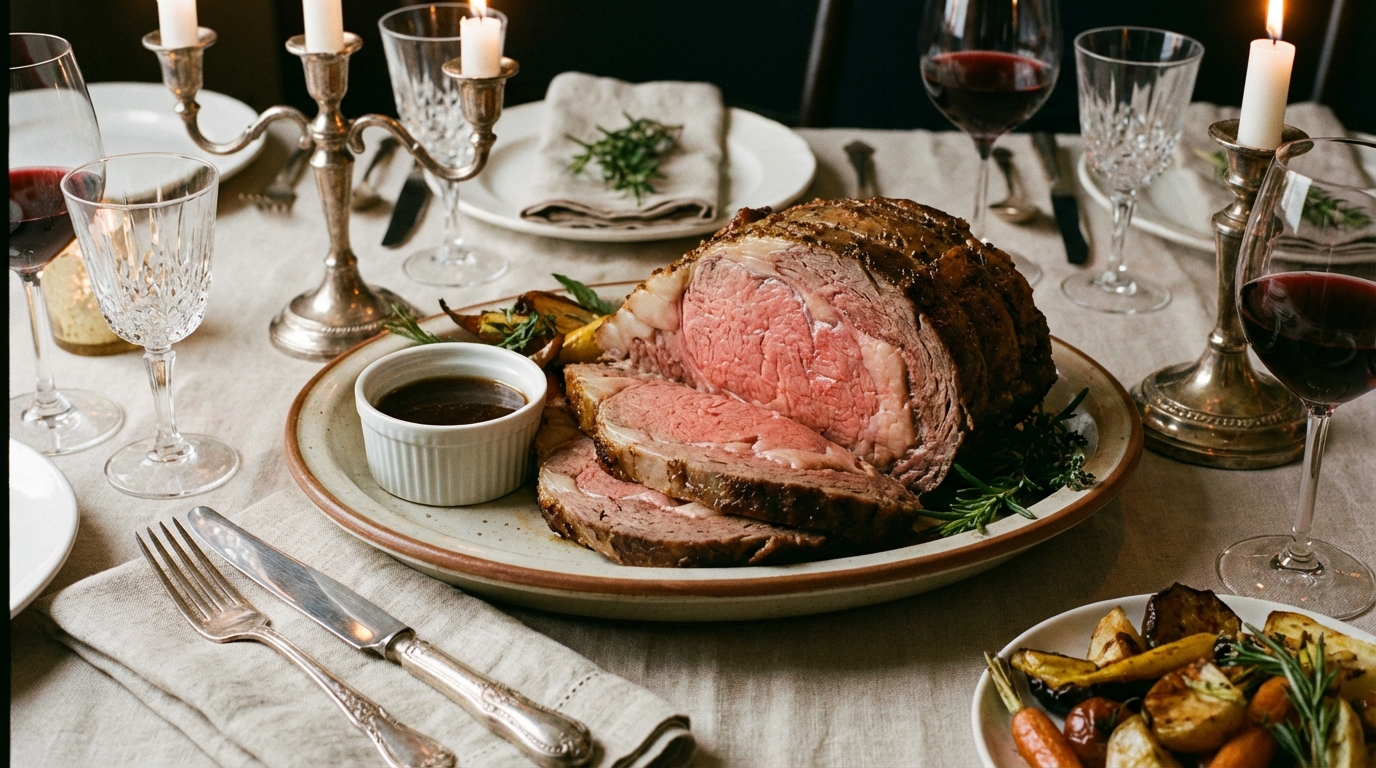
Prime rib is roasted slowly, which means the fat renders gently over hours. The meat stays incredibly juicy and tender — almost soft. The flavor is rich but mellow, with a pronounced beefy taste that comes from the slow rendering of intramuscular and intermuscular fat. The exterior develops a savory herb crust, and the au jus (the natural drippings) adds another layer of flavor. Prime rib is the most luxurious eating experience in beef — it practically melts.
Ribeye gets high-heat treatment, which creates Maillard reaction compounds — the complex, nutty, caramelized flavors that only extreme heat produces. The crust on a properly seared ribeye is intensely savory, almost smoky. The interior is tender but has more chew and structure than prime rib. Where prime rib is about pure richness, ribeye is about contrast: crispy exterior against a juicy, fatty center.
Neither is better. They're different experiences from the same starting material, shaped entirely by technique.
When to Choose Prime Rib vs Ribeye
Use this as your decision framework:
Choose prime rib when:
- You're feeding four or more people
- You want a show-stopping centerpiece for a holiday or special occasion
- You have 4-5 hours of cooking time (plus resting)
- You want the most cost-efficient way to serve premium beef to a group
- You prefer a tender, melt-in-your-mouth texture
Choose ribeye when:
- You're cooking for one to three people
- You want dinner on the table in 30 minutes
- You love a hard sear and caramelized crust
- You're grilling outdoors
- You want individual portions with precise doneness control
Buying Tips from a Butcher
Whether you're buying prime rib or ribeye, here's what to look for:
For prime rib:
- Ask for the first cut (loin end) for cleaner slices, or second cut (chuck end) for more flavor
- Request that the butcher "french" the bones for presentation — they'll scrape the ends clean
- Look for even marbling throughout, not just on the fat cap
- Buy one rib per two guests, plus one extra
- USDA Prime grade makes the biggest difference in roasts because slow cooking gives the extra fat time to render fully
For ribeye:
- Look for steaks at least 1.25 inches thick — thinner cuts are nearly impossible to sear without overcooking
- Check that the spinalis (cap) is present and well-attached — some budget cuts trim it off
- Abundant marbling is key, but avoid steaks with large chunks of hard fat in the center — you want fine, webbed intramuscular fat
- Bone-in for the grill, boneless for the pan — as a general rule
- USDA Choice is a great value for ribeye since the cut is naturally well-marbled even at this grade
Common Mistakes to Avoid
I see these errors constantly, and they're all easily preventable:
- Not salting early enough. Salt your prime rib 24-48 hours ahead. Salt your ribeye at least 40 minutes ahead (or right before cooking — never in the 5-40 minute window where salt draws out moisture without time to reabsorb).
- Skipping the rest. Prime rib needs 30 minutes of rest. Ribeye needs at least 5. Cut too early and you lose a tablespoon of juice per pound.
- Cooking prime rib like a steak. High heat on a 10-pound roast guarantees an overcooked exterior and raw center. Go low and slow.
- Cooking ribeye like a roast. A gentle bake on a single steak just steams it. You need aggressive heat for crust development.
- Overcooking either cut. Both are best at medium-rare (130-135°F). Going past medium (145°F) renders out too much of the fat that makes these cuts special, leaving them dry and chewy.
Frequently Asked Questions
Is prime rib the same as ribeye?
They come from the same part of the cow — the rib primal — but they're not the same cut. Prime rib is a large roast containing multiple ribs, cooked whole and sliced. Ribeye is an individual steak cut from that same section. The muscles are identical; the size, cooking method, and eating experience are different.
Why is prime rib called "prime" if it's not always USDA Prime?
The name "prime rib" refers to the primal cut (the rib section) and historically to the fact that this was considered the best roasting cut on the animal. It has nothing to do with the USDA Prime grade. You can buy prime rib in Choice, Select, or any other USDA grade.
Which is more expensive, prime rib or ribeye?
Per pound at the butcher, they're often similar in price. But per serving, prime rib is usually more economical because you're buying in bulk. At restaurants, ribeye steaks typically cost more than prime rib dinners because of higher per-portion food costs.
Can you cut ribeye steaks from a prime rib roast?
Yes — in fact, that's exactly what a ribeye is. If you buy a boneless prime rib roast and slice it into 1.25-inch steaks before cooking, you've got boneless ribeyes. Some savvy shoppers buy whole rib roasts on sale and cut their own steaks to save money.
What temperature should prime rib and ribeye be cooked to?
Both are best at medium-rare: 130-135°F after resting. For prime rib, pull from the oven at 120°F (it rises during the 30-minute rest). For ribeye, pull at 125°F (it rises during its shorter 5-8 minute rest). Going past 145°F (medium) renders out the marbling that makes these cuts special.
More Expert Guides
What Is Chateaubriand? (Cut, Cooking, & Best Sources)
Chateaubriand is a thick-cut roast from the center of the beef tenderloin, traditionally served for two. Learn what makes this classic French cut special and how to cook it.
14 min readWhat Is Round Steak? The Complete Guide to Beef's Most Versatile Budget Cut
Round steak comes from the rear leg of the cow — it's lean, affordable, and misunderstood. A master butcher breaks down every sub-cut, cooking method, and technique to turn this budget workhorse into genuinely delicious meals.
14 min readWhat Is Eye of Round? The Complete Butcher's Guide to This Lean Cut
Eye of round is one of the leanest, most affordable cuts in the entire beef case — and one of the most misunderstood. A butcher explains how to turn this budget-friendly roast into something genuinely delicious.