Grass Fed vs Grain Fed Beef: A Butcher's Honest Breakdown
Every week, someone stands at my counter and asks the same question: "Is grass fed really better?" And every week, I give the same answer: it depends on what you mean by better. Better for you? Probably. Better tasting? That's where it gets complicated.
The grass fed vs grain fed debate has turned into a marketing war, and most of what you read online is written by people who've never broken down a carcass. I've been cutting beef for four decades. I've processed grass fed cattle from small ranches and grain-finished animals from major feedlots. I've tasted the difference hundreds of times, and I've watched the labeling game evolve from straightforward to downright misleading.
Here's what I actually know — no agenda, no sales pitch, just a butcher's honest take on two very different ways of raising beef.
What "Grass Fed" and "Grain Fed" Actually Mean
All cattle start on grass. Every calf in America spends its first six to eight months eating grass and its mother's milk on pasture. The difference comes after weaning — what happens during the finishing phase, the final three to six months before slaughter, is what determines whether beef gets labeled grass fed or grain fed.
Grain Fed (Conventional)
After weaning, grain-fed cattle are moved to feedlots — concentrated animal feeding operations, or CAFOs. There, they're fed a diet heavy in corn, soy, and other grains, supplemented with vitamins and minerals. The goal is rapid weight gain. A grain-finished steer can put on 3 to 4 pounds per day on a feedlot diet, reaching market weight of 1,200 to 1,400 pounds in 14 to 18 months total.
This concentrated energy diet produces the heavy intramuscular fat — marbling — that the American grading system rewards. The vast majority of USDA Choice and Prime beef comes from grain-finished cattle.
Grass Fed
Grass-fed cattle stay on pasture their entire lives, eating grasses, legumes, and forage. They grow more slowly — it typically takes 24 to 28 months for a grass-fed steer to reach market weight, nearly twice as long as grain-finished animals. That longer growing period means higher production costs per pound, which is a big reason grass-fed beef costs more at the counter.
Here's where labeling gets tricky. The USDA withdrew its official "grass fed" standard in 2016, which means the term isn't regulated the way most consumers think it is. Any producer can slap "grass fed" on a label without third-party verification. If you want assurance, look for certifications from the American Grassfed Association (AGA) or the Food Alliance, which require 100% forage diet, no confinement, and no antibiotics or hormones.
The Flavor Difference: What I Taste Behind the Counter
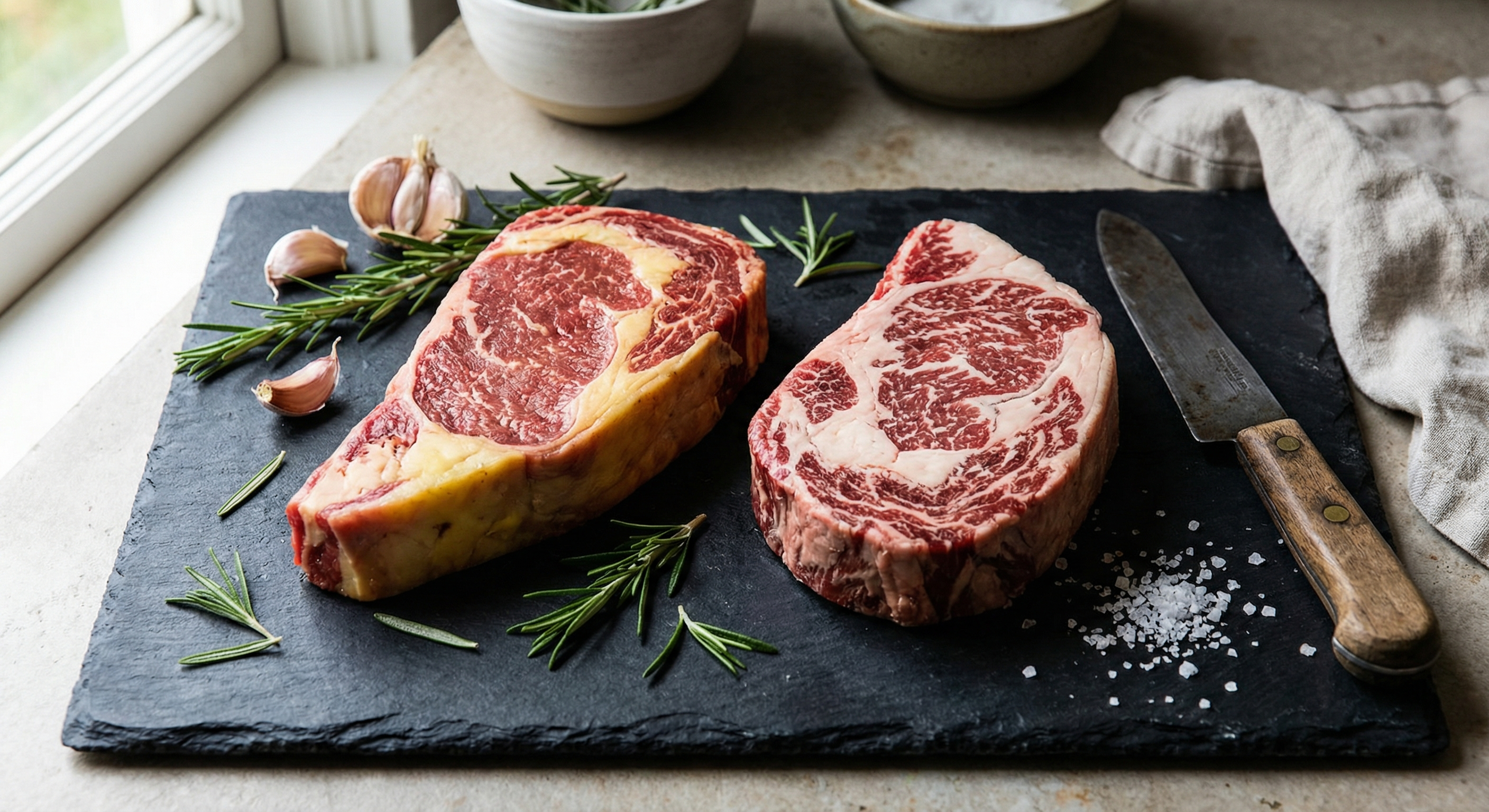
This is where most articles get it wrong, because they present flavor as objective fact. It's not — it's preference. But I can tell you exactly how the two differ, and you can decide which sounds better to you.
Grain Fed Flavor Profile
Grain-finished beef has a rich, buttery flavor that most Americans associate with "steak." The heavy marbling melts during cooking, basting the meat from the inside. It's milder, sweeter, and fattier. The fat itself is white to cream-colored and has a clean, neutral taste. If you grew up eating steakhouse ribeyes, this is the flavor you know.
Grass Fed Flavor Profile
Grass-fed beef is leaner and more complex. The flavor is often described as "beefier" or more mineral-forward. Some people detect earthy, herbal, or slightly gamey notes — this varies enormously depending on what the cattle ate. Beef from cattle grazed on diverse pastures with clover, chicory, and native grasses tastes different from beef raised on a single grass species.
The fat on grass-fed beef is yellowish, tinted by beta-carotene from the forage. It has a more pronounced flavor that some people love and others find off-putting. This is the honest truth: about 30% of my customers who try grass-fed beef for the first time don't prefer it. That doesn't make it worse — it makes it different.
Marbling and Grading: Why the System Favors Grain
The USDA beef grading system — Select, Choice, Prime — is based primarily on intramuscular fat, evaluated at the ribeye between the 12th and 13th ribs. This system was designed around grain-finished beef, and it shows.
Grain-fed cattle routinely grade Choice or Prime. The concentrated energy diet deposits fat within the muscle fibers in the heavy, web-like pattern that graders reward. Most feedlot cattle produce Choice-grade beef, and the best produce Prime — the top 8% of all graded carcasses.
Grass-fed cattle almost never grade Prime. Most land in the Select range, with some reaching low Choice. This doesn't mean the meat is inferior — it means the grading system measures one specific quality (intramuscular fat) that grain feeding excels at producing. Grass-fed beef has its own qualities — higher omega-3 content, more conjugated linoleic acid, a different amino acid profile — that the grading system simply doesn't measure.
Nutrition: What the Science Actually Says
This is the area where grass-fed beef has the clearest advantage, and the research is robust enough to make definitive statements.
Fat Composition
Grass-fed beef is significantly leaner overall. A grass-fed strip steak typically contains 2 to 4 grams of fat per 100 grams of meat, compared to 8 to 12 grams for grain-fed. But the composition of that fat is where it gets interesting:
- Omega-3 fatty acids: Grass-fed beef contains 2 to 5 times more omega-3s than grain-fed beef. The ratio of omega-6 to omega-3 in grass-fed beef is roughly 2:1 to 3:1, compared to 6:1 to 10:1 in grain-fed. A healthier ratio is associated with reduced inflammation.
- Conjugated linoleic acid (CLA): Grass-fed beef contains 2 to 3 times more CLA, a fatty acid linked to reduced body fat and potential anti-cancer properties in animal studies.
- Saturated fat: Grass-fed beef contains less total saturated fat per serving, simply because it's leaner overall.
Vitamins and Antioxidants
- Vitamin A: Grass-fed beef contains significantly more beta-carotene (precursor to vitamin A) — that's what gives the fat its yellow color.
- Vitamin E: Grass-fed beef contains roughly 3 times more alpha-tocopherol (vitamin E) than grain-fed, which also acts as a natural antioxidant that slows spoilage.
- B vitamins and minerals: Both types are excellent sources of B12, zinc, iron, and selenium. The differences here are minimal.
The Bottom Line on Nutrition
If you eat beef a few times a week, the nutritional differences between grass-fed and grain-fed are meaningful over time. The omega-3 ratio alone is worth paying attention to. But if you eat beef once or twice a month, the difference is negligible — you'd get far more nutritional bang from eating more fish or vegetables.
Cost: What You're Actually Paying For
Grass-fed beef typically costs 20% to 50% more than conventional grain-fed beef at retail. Premium grass-fed brands can run double the price. Here's why:
- Longer growing time: 24-28 months vs 14-18 months means more feed, more land, and more labor per animal.
- Lower carcass weight: Grass-fed cattle yield smaller carcasses — typically 600 to 700 pounds hanging weight vs 800 to 900 for grain-finished.
- Higher land requirements: Pasture-raised cattle need significantly more acreage than feedlot animals.
- Lower grading: Without the Prime or high-Choice grade, grass-fed producers can't command premiums through the conventional grading system — they rely on the "grass fed" label itself as their value proposition.
- Smaller scale: Most grass-fed operations are smaller, which means less efficiency in processing and distribution.
Is it worth the premium? That depends on your budget and priorities. If you can afford it and the nutritional profile matters to you, yes. If you're feeding a family of five on a tight budget, conventional Choice-grade beef is still excellent protein. Don't let anyone make you feel guilty about that.
Cooking Differences: Why Grass Fed Needs Different Treatment
This is the section most guides skip, and it's the reason many people try grass-fed beef once, overcook it, and never buy it again. Grass-fed beef cooks differently because it's leaner, and if you treat it like grain-fed beef, you'll get a tough, dry result.
Key Adjustments for Grass Fed Beef
- Lower heat: Reduce your cooking temperature by about 25°F compared to what you'd use for grain-fed. The lack of insulating fat means the meat heats through faster.
- Shorter cook time: Grass-fed steaks can cook 30% faster than grain-fed steaks of the same thickness. Use a meat thermometer — don't rely on timing.
- Pull earlier: Remove grass-fed steaks from heat at 120°F for rare, 125°F for medium-rare. Carryover cooking will add 5 to 8 degrees. Going past medium (145°F) with grass-fed beef is a mistake you'll taste.
- Rest longer: Give grass-fed steaks a full 8 to 10 minutes of rest. The leaner muscle fibers need more time to relax and reabsorb juices.
- Add fat externally: A pat of butter, a drizzle of olive oil, or cooking in tallow compensates for the lower internal fat. This isn't cheating — it's smart cooking.
Best Cuts for Each Type
If you're new to grass-fed beef, start with cuts that are naturally forgiving:
- Ground beef: The difference is subtle, and the fat content is controlled during grinding. A great entry point.
- Chuck roast: Low-and-slow cooking melts collagen regardless of feed type. Grass-fed chuck makes excellent pot roast.
- Flat iron or tri-tip: These cuts have enough intramuscular structure to stay moist even when lean.
Save the ribeye and strip steak experiments for after you've dialed in your cooking technique. A $25 grass-fed ribeye cooked to well-done is a waste of good beef and good money.
Environmental Impact: It's Complicated
Both sides of this debate cherry-pick data, so let me lay out the full picture.
Arguments for Grass Fed Being Better for the Environment
- Well-managed rotational grazing can sequester carbon in soil, potentially offsetting some of the methane cattle produce.
- Pasture-based systems support biodiversity — grasslands maintained by grazing animals host more species than monoculture cropland.
- Grass-fed operations avoid the environmental costs of growing feed grain — the fertilizer runoff, pesticide use, and soil depletion associated with corn and soy production.
Arguments for Grain Fed Being Better for the Environment
- Grain-fed cattle reach market weight faster, which means fewer total days producing methane per pound of beef.
- Feedlots are more land-efficient. Producing a pound of grain-fed beef requires significantly less acreage than a pound of grass-fed beef.
- The carbon sequestration argument for grass-fed has limits — soil reaches a saturation point, and the benefit diminishes over time.
The Honest Assessment
Neither system is environmentally innocent. Beef production is resource-intensive regardless of how the cattle are raised. If environmental impact is your primary concern, eating less beef overall makes a bigger difference than switching from grain-fed to grass-fed. But if you're going to eat beef — and I think you should, it's one of the most nutrient-dense foods available — choosing well-managed grass-fed operations is a reasonable choice.
Labeling: How to Read What You're Buying
The label landscape is confusing by design. Here's what the common terms actually mean:
- "Grass fed" (no certification): Essentially meaningless since the USDA dropped its standard. The cattle may have eaten grass at some point, or the producer may simply be using the term to charge more.
- "Grass fed, grain finished": At least this is honest. The cattle ate grass for most of their lives but were finished on grain for the last 60 to 120 days. The meat will have more marbling than 100% grass-fed but less than conventional.
- "100% grass fed" with AGA or Food Alliance certification: The real deal. Lifetime forage diet, no confinement, third-party audited.
- "Pasture raised": Means the cattle had access to pasture, but doesn't specify diet. They could still be supplemented with grain.
- "Natural": A USDA term meaning minimally processed with no artificial ingredients. It says nothing about how the animal was raised or fed.
- "Organic": USDA Organic requires organic feed (which can include organic grain), access to pasture, and no antibiotics or synthetic hormones. Organic beef is not necessarily grass-fed.
My advice: if you're paying a premium for grass-fed beef, look for third-party certification on the label. If there's no certification seal, you're trusting the producer's marketing department, and I've seen enough of this industry to know that trust isn't always earned.
The Butcher's Verdict
After four decades of cutting both, here's my honest assessment:
Buy grass-fed if: You prioritize nutrition, you care about animal welfare and how your food is produced, you enjoy a leaner and more complex beef flavor, and your budget allows for the premium. Learn to cook it properly and you'll be rewarded with some of the best-tasting beef available.
Buy grain-fed if: You prefer the classic rich, buttery steak flavor, you're on a budget, or you're cooking for a crowd that expects traditional American steakhouse quality. There's no shame in this choice — USDA Choice grain-fed beef is a high-quality product.
The best of both worlds: If your budget is flexible, try grass-fed for ground beef, roasts, and slow-cooked cuts (where the price premium is smallest and the cooking difference is minimal), and use grain-fed for your special-occasion steaks. You'll get the nutritional benefits where it matters most and the marbling where you'll appreciate it most.
At the end of the day, the best beef is the beef you cook well and enjoy eating. Don't let anyone — on either side of this debate — make you feel like you're making the wrong choice. Just make an informed one.
More Expert Guides
What Is Chateaubriand? (Cut, Cooking, & Best Sources)
Chateaubriand is a thick-cut roast from the center of the beef tenderloin, traditionally served for two. Learn what makes this classic French cut special and how to cook it.
14 min readWhat Is Round Steak? The Complete Guide to Beef's Most Versatile Budget Cut
Round steak comes from the rear leg of the cow — it's lean, affordable, and misunderstood. A master butcher breaks down every sub-cut, cooking method, and technique to turn this budget workhorse into genuinely delicious meals.
14 min readWhat Is Eye of Round? The Complete Butcher's Guide to This Lean Cut
Eye of round is one of the leanest, most affordable cuts in the entire beef case — and one of the most misunderstood. A butcher explains how to turn this budget-friendly roast into something genuinely delicious.