Beef Tenderloin vs Filet Mignon: What's the Real Difference?
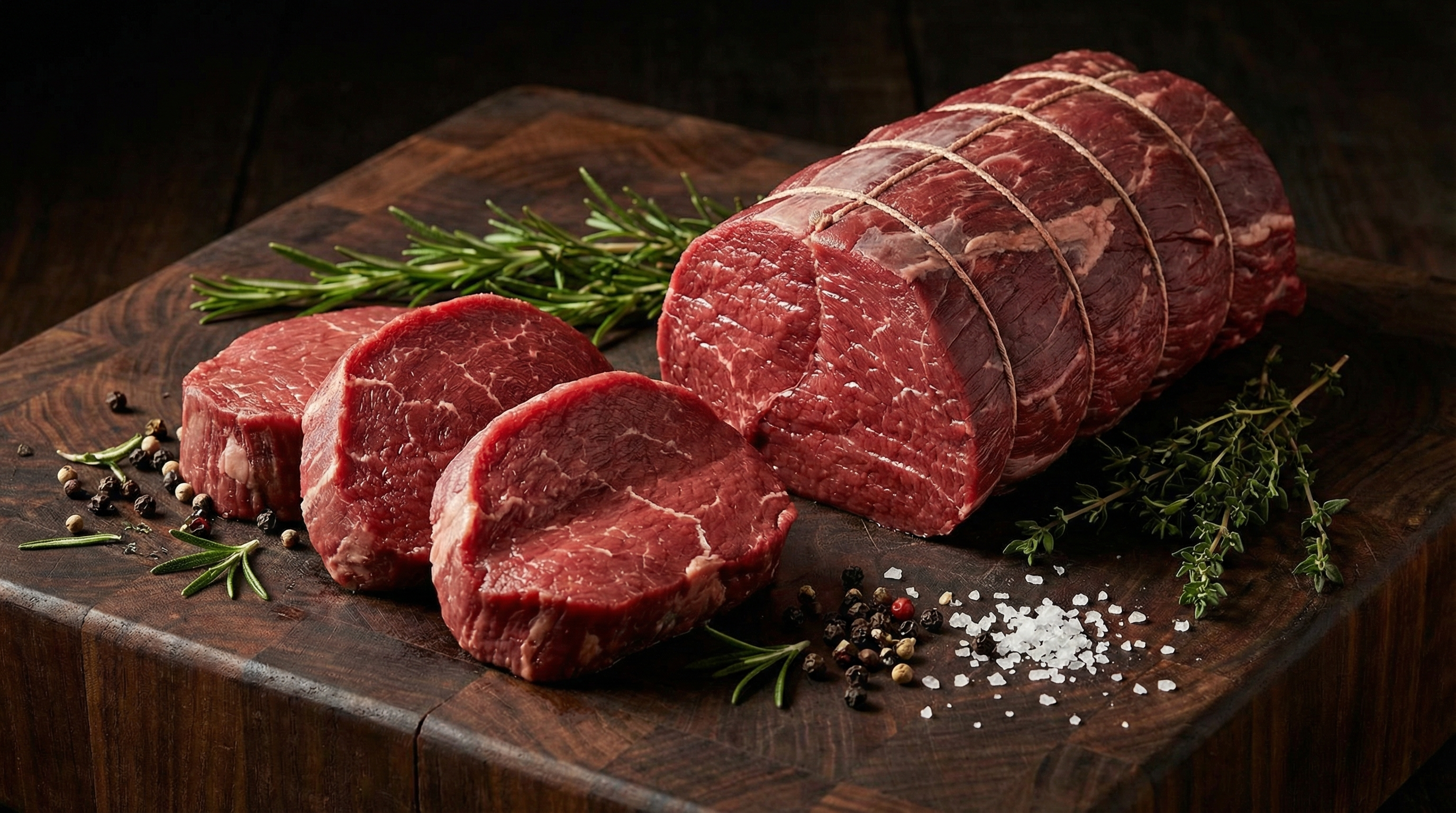
If I had to pick the single most confused pair of terms in the entire beef world, it would be beef tenderloin vs filet mignon. I hear it every single week at the counter: "I want a filet mignon roast" or "Can I get a tenderloin steak?" And every time, I have to gently explain that while these two terms are deeply related, they are NOT the same thing.
Here's the short version: beef tenderloin is the whole muscle. Filet mignon is a steak cut FROM that muscle. That's it. That's the core difference. But like most things in butchery, the details matter — and understanding those details will save you money, improve your cooking, and make you the smartest person at the meat counter.
I've been breaking down beef for over 30 years. Let me walk you through everything you need to know.
The Anatomy: Where Does the Tenderloin Come From?
The beef tenderloin is a long, narrow muscle called the psoas major. It runs along the inside of the spine, tucked beneath the ribs and along the lumbar vertebrae. If you've ever seen a T-bone or porterhouse steak, the tenderloin is the small, round piece of meat on one side of the bone — the other side is the strip steak.
What makes the tenderloin special is its location. This muscle does almost zero work during the animal's life. It doesn't bear weight, it doesn't power movement, it doesn't flex or extend the legs. It just sits there, cushioned against the spine, getting softer every day. That's why it's the most tender cut on the entire carcass — the name literally tells you what it is.
A whole beef tenderloin typically weighs 5 to 8 pounds (untrimmed) or 4 to 6 pounds after trimming. It's shaped like an elongated teardrop — thick and bulbous at one end, tapering to a thin point at the other. This uneven shape is one of the biggest challenges when cooking it, and it's a major reason why butchers break it down into different cuts.
The Three Sections of the Tenderloin
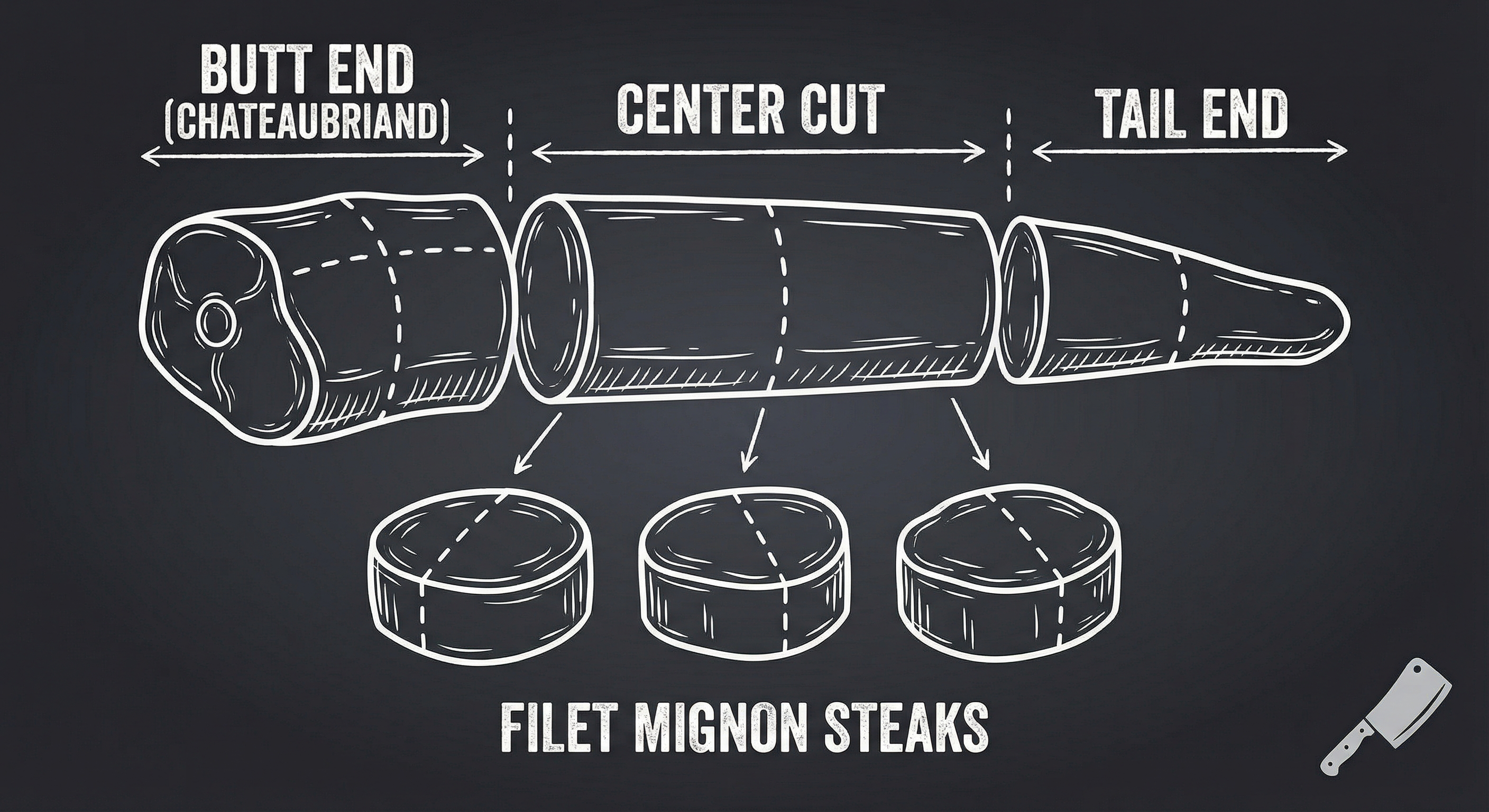
Every butcher mentally divides the tenderloin into three distinct sections, and each one has different characteristics and uses:
1. The Butt End (Head)
This is the thick, wide end of the tenderloin, closest to the sirloin. It's the fattest part of the muscle — and when I say "fat," I mean relatively speaking, because the tenderloin is still one of the leanest cuts on the animal. The butt end is typically 3-4 inches in diameter. When left whole and roasted, this section is sometimes called Chateaubriand — a classic French preparation that serves two people from a single thick roast cut from this end.
2. The Center Cut
This is the money section. The center cut is the most uniform part of the tenderloin — consistent thickness, consistent texture, consistent quality. This is where filet mignon steaks come from. The center cut is typically 2.5-3 inches in diameter, and when sliced into 1.5 to 2-inch thick steaks, it produces those beautiful, round, thick filets that you see at steakhouses for $50-$70 a plate.
3. The Tail End (Tip)
The thin, tapered end of the tenderloin. This section is too narrow to cut into proper steaks. Most butchers either fold it under and tie it (to create a more uniform roast), cut it into tips for stir-fry or stroganoff, or grind it into premium ground beef. Some shops sell tenderloin tips at a discount — they're the same quality meat, just an awkward shape.
So What Exactly Is Filet Mignon?
Now that you understand the whole tenderloin, the definition becomes simple: filet mignon is a steak cut from the center (and sometimes the butt end) of the beef tenderloin. The name comes from French — filet means "thick slice" and mignon means "dainty" or "delicate." So filet mignon literally translates to "dainty thick slice," which is a pretty accurate description of what you're getting.
In American butchery, a filet mignon is typically:
- 1.5 to 2.5 inches thick
- 2.5 to 3 inches in diameter
- 6 to 10 ounces per steak
- Round or slightly oval in shape
- Extremely lean with minimal marbling
Here's where it gets slightly complicated: in France, "filet mignon" actually refers to the tenderloin of pork, not beef. The beef version in French cuisine is simply called filet de bœuf. But in America (and most English-speaking countries), filet mignon has become synonymous with a premium beef tenderloin steak. Language is messy. Butchery even more so.
Beef Tenderloin vs Filet Mignon: The Key Differences
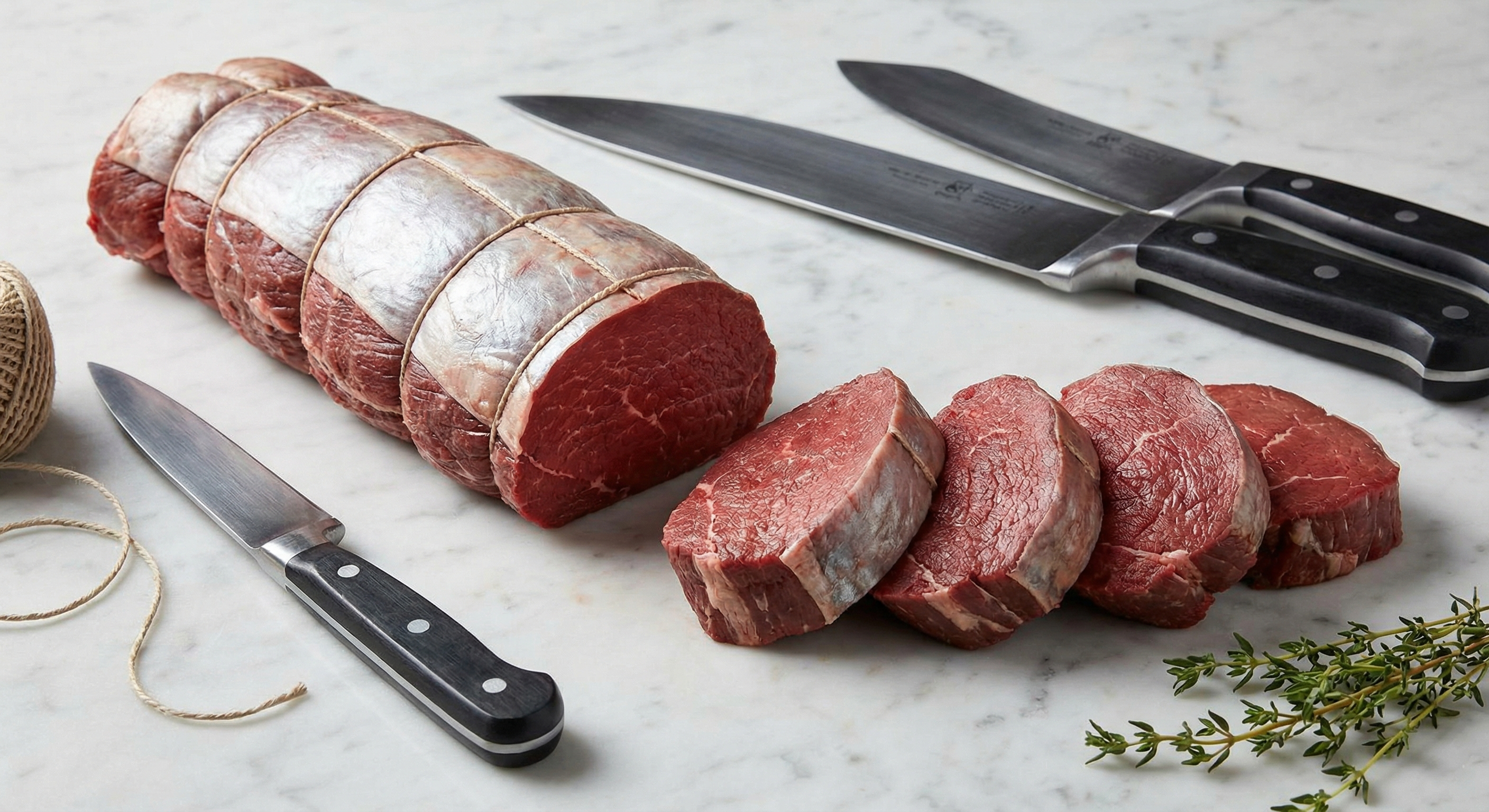
Let me lay this out clearly so there's no confusion:
| Feature | Beef Tenderloin | Filet Mignon |
|---|---|---|
| What it is | The whole muscle | A steak cut from that muscle |
| Weight | 4-8 lbs | 6-10 oz per steak |
| Shape | Long, tapered teardrop | Round medallion |
| Best cooking method | Roasting whole | Pan-searing, grilling |
| Price per pound | $22-$35 (whole PSMO) | $35-$60 (pre-cut steaks) |
| Serves | 6-10 people | 1 person |
| Sold as | Whole roast | Individual steaks |
The relationship is simple: all filet mignon is beef tenderloin, but not all beef tenderloin is filet mignon. It's like squares and rectangles. Every filet mignon comes from the tenderloin. But the tenderloin also produces other cuts (Chateaubriand, tenderloin tips, tournedos) that aren't filet mignon.
Why the Confusion Exists
Three reasons this mix-up is so persistent:
1. Restaurants use the terms interchangeably. Most steakhouse menus list "filet mignon" even when they're serving a thick slice from the butt end (which is technically Chateaubriand) or a smaller portion from the tail. The term "filet mignon" has become a marketing catch-all for "tenderloin steak," regardless of which section it actually comes from.
2. Grocery stores muddy the waters. You'll see packages labeled "tenderloin steak," "filet mignon," "tenderloin filet," and "filet of tenderloin" — all describing essentially the same product. There's no USDA regulation that dictates when you can and can't use the term "filet mignon," so retailers use whatever sounds most appealing (and justifies the highest price).
3. People conflate the cut with the experience. When someone says "I love filet mignon," they usually mean they love the tenderness, the elegance, the steakhouse experience. They're not making a precise anatomical statement. And that's fine — but it does create confusion when you're standing at the butcher counter trying to figure out what to buy.
The Flavor and Texture Question
Here's something that might surprise you: the tenderloin — whether served as a whole roast or as individual filet mignon steaks — is not the most flavorful cut of beef. Not even close.
The tenderloin's superpower is tenderness, not taste. Because the muscle does no work, it has very little connective tissue and very little intramuscular fat (marbling). And fat is where beef flavor lives. A well-marbled ribeye or NY strip will deliver significantly more beef flavor than a tenderloin of the same grade.
This is why filet mignon is almost always served with a sauce — béarnaise, peppercorn cream, red wine reduction, or wrapped in bacon (the classic filet mignon au lard). The cut provides the texture; the accompaniments provide the flavor. It's also why filet mignon benefits enormously from butter-basting during cooking. That external fat compensates for what the meat lacks internally.
Does this make tenderloin/filet mignon a bad cut? Absolutely not. The melt-in-your-mouth tenderness is genuinely extraordinary — nothing else on the animal comes close. But if someone tells you filet mignon is the "best" steak, they're really saying it's the most tender steak. That's a different claim.
How to Cook a Whole Beef Tenderloin
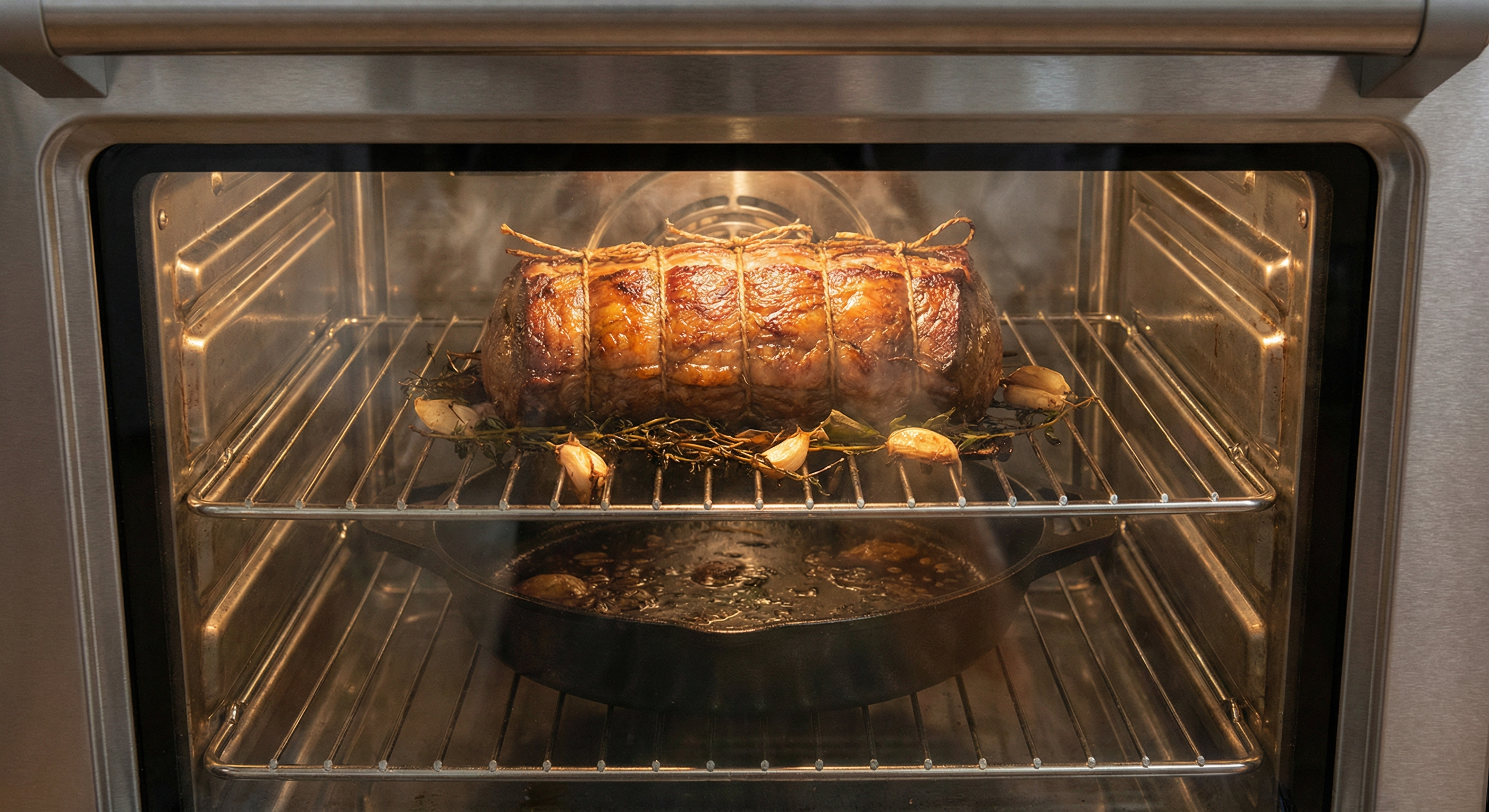
Cooking a whole tenderloin is one of the most impressive things you can do in a home kitchen. It feeds a crowd, it looks spectacular, and it's actually easier than most people think. Here's my method after roasting hundreds of these:
Step 1: Buy Smart
Buy a whole PSMO tenderloin (Peeled, Side Muscle On). This is the most economical way to get tenderloin — you'll pay $22-$35/lb versus $40-$60/lb for pre-cut filets. A PSMO comes with the side chain muscle still attached and some silver skin remaining, but the external fat has been removed. You can find quality options at The Meatery's premium cuts collection.
Step 2: Trim and Tie
Remove the chain (the long, narrow side muscle) — save it for stir-fry, stroganoff, or grind it for burgers. Peel off the silver skin by sliding a sharp knife under it and pulling it away in strips. Don't remove any actual fat — there isn't much to begin with.
Now fold the thin tail end under and tie the entire roast with butcher's twine at 2-inch intervals. This creates a uniform cylinder that cooks evenly from end to end. Without tying, the tail end will be well-done while the butt end is still rare.
Step 3: Season Aggressively
Because the tenderloin is so lean, it needs help in the flavor department. Salt generously — more than you think. I use about 1.5 teaspoons of kosher salt per pound. Add cracked black pepper, and optionally a thin coating of Dijon mustard (which adds flavor and helps form a crust). Let it sit uncovered in the fridge for at least 2 hours, ideally overnight.
Step 4: Reverse Sear
- Place on a wire rack over a sheet pan. Roast at 250°F until the internal temperature reaches 115°F — about 45-60 minutes for a 4-lb trimmed tenderloin.
- Remove from oven and rest 10 minutes.
- Heat a large skillet (or two) screaming hot with a thin layer of high-smoke-point oil.
- Sear the tenderloin on all sides — about 90 seconds per side, rolling it to get full coverage. The Maillard crust develops quickly on that pre-warmed surface.
- Rest another 10 minutes before slicing into 1-inch rounds.
Target temperature: Pull at 115°F from the oven. After searing and resting, the center will be a perfect 130-135°F (medium-rare). The beauty of reverse sear on a whole tenderloin is edge-to-edge pink with zero grey band.
How to Cook Filet Mignon Steaks
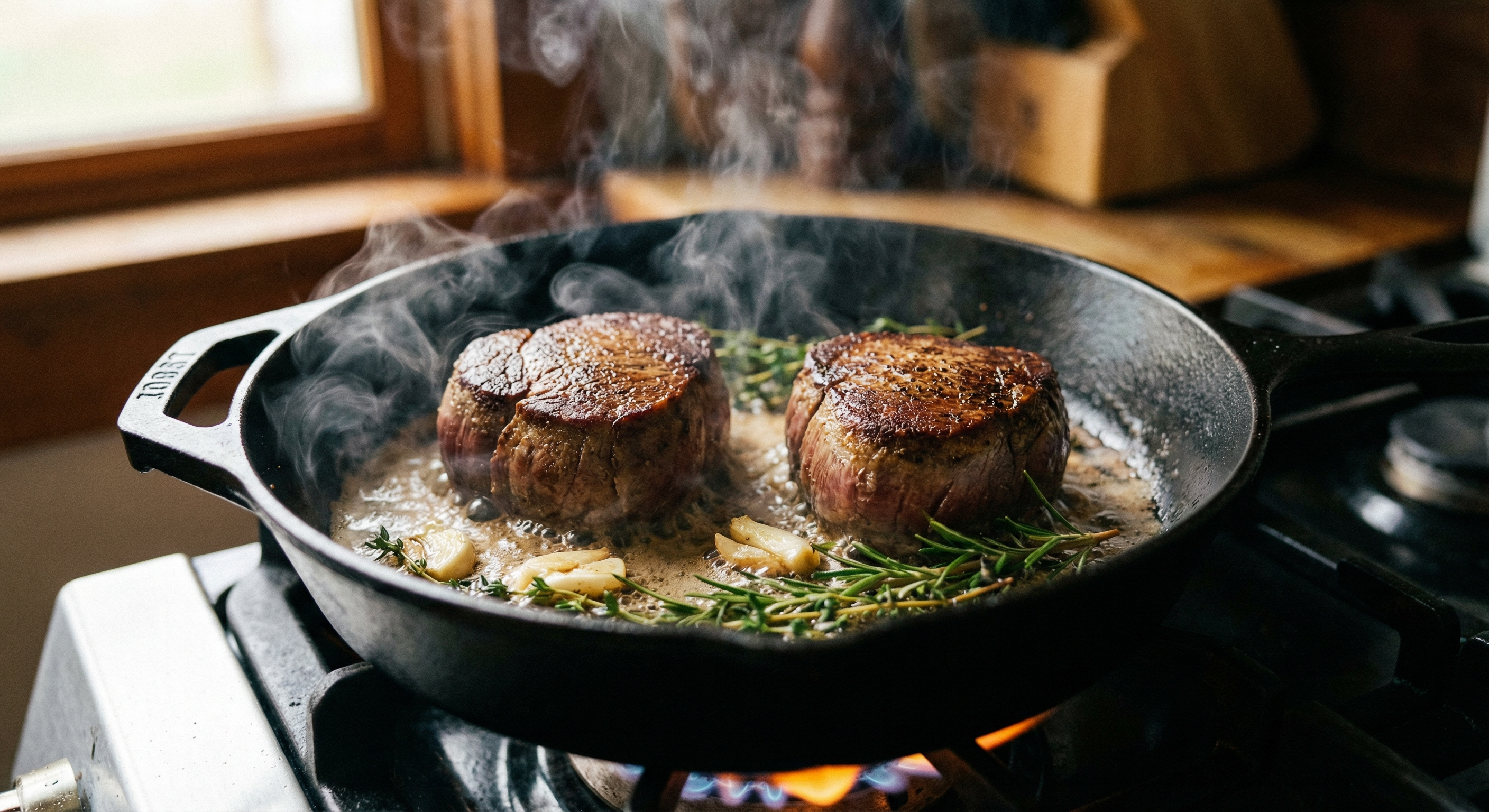
Individual filet mignon steaks require a different approach than the whole roast. Because they're thick but relatively small in diameter, the challenge is getting a great crust without overcooking the interior.
Method 1: Pan-Seared with Butter Baste (My #1 Pick)
- Pat completely dry with paper towels. Season with salt and pepper.
- Get a cast iron skillet ripping hot — medium-high heat, 2-3 minutes of preheating. Add a thin layer of avocado oil.
- Sear undisturbed for 3-4 minutes until a dark brown crust forms. Don't touch it.
- Flip once. Add 2 tablespoons of butter, 2 crushed garlic cloves, and a sprig of fresh thyme or rosemary to the pan.
- Baste continuously — tilt the pan and spoon the foaming butter over the top of the filet for 2-3 minutes.
- Pull at 120-125°F internal for medium-rare. Rest 5-8 minutes.
The butter baste is non-negotiable for filet mignon. It adds the richness and flavor that the lean meat lacks on its own. This is the method every high-end steakhouse uses, and it's dead simple at home.
Method 2: Reverse Sear (Best for Thick Filets 2"+)
- Season and place on a wire rack. Roast at 250°F until 110°F internal (about 25-35 minutes).
- Sear in a screaming hot pan for 60-90 seconds per side.
- Butter baste for the final 30 seconds.
- Rest 5 minutes.
Method 3: Grill
Filets can be grilled, but they're not the ideal grill steak — their low fat content means less protection against drying out over open flame. If grilling, use direct high heat for 4-5 minutes per side, and pull early. A fattier cut like picanha or ribeye is more forgiving on the grill.
Filet Mignon Temperature Guide
| Doneness | Pull Temp | After Rest | Notes |
|---|---|---|---|
| Rare | 115°F | 120-125°F | Very soft, cool red center |
| Medium-Rare | 125°F | 130-135°F | Ideal for filet. Warm pink throughout |
| Medium | 135°F | 140-145°F | Acceptable — still juicy enough |
| Medium-Well+ | 145°F+ | 150°F+ | Lean meat = dry at this temp. Avoid. |
Price Breakdown: Tenderloin vs Filet Mignon
This is where buying smart really pays off. The price difference between whole tenderloin and pre-cut filet mignon steaks is dramatic:
- Whole PSMO Tenderloin (untrimmed): $22-$30/lb for USDA Choice, $30-$40/lb for Prime
- Pre-cut Filet Mignon Steaks: $35-$50/lb for Choice, $50-$70/lb for Prime
- Restaurant Filet Mignon: $45-$80 per plate (8 oz)
That means buying a whole tenderloin and cutting it yourself saves you 40-50% versus buying pre-cut filets. A $150 whole tenderloin yields 6-8 filet mignon steaks that would cost $50-$70 each at a steakhouse. Do the math — that's $300-$560 worth of restaurant steaks for $150 in raw product.
The trimming takes 15 minutes with a sharp knife. It's the single best value play in premium beef, and I recommend it to every customer hosting a dinner party. Check The Meatery for whole tenderloins and individual filets.
Beef Tenderloin vs Filet Mignon: Which Should You Buy?
Buy a Whole Tenderloin When:
- You're feeding 6+ people and want an impressive centerpiece
- You want the best value per pound on premium beef
- You're comfortable with basic knife work (trimming silver skin, tying)
- You want a holiday or special occasion roast — Christmas, New Year's, anniversary dinner
- You want flexibility — cut some filets, roast the center, save the tips for another meal
Buy Filet Mignon Steaks When:
- You're cooking for 1-4 people
- You want individual portion control
- You prefer the pan-seared steakhouse method with butter baste
- You don't want to deal with trimming and tying a whole muscle
- You're wrapping in bacon (beef Wellington, filet au lard) — individual steaks work better
Common Misconceptions (Debunked)
Misconception: "Filet mignon comes from a different part of the cow than tenderloin"
Wrong. Filet mignon IS tenderloin. It's cut from the center portion of the exact same muscle. Different form, same source.
Misconception: "Tenderloin is tougher than filet mignon"
Wrong. They're literally the same muscle. A properly cooked whole tenderloin roast is exactly as tender as a properly cooked filet mignon steak. The tenderness comes from the muscle itself, not how you slice it.
Misconception: "Filet mignon is the best steak money can buy"
Debatable. It's the most tender, yes. But "best" is subjective. A Prime ribeye has dramatically more flavor. A picanha has better fat coverage. A tomahawk has more wow factor. Filet mignon wins on tenderness alone — and for some people, that's enough.
Misconception: "You should cook filet mignon well-done to be safe"
Please don't. Whole-muscle steaks (as opposed to ground beef) are safe at medium-rare because bacteria only live on the surface, and searing kills them. Cooking a lean cut like filet mignon past medium is a crime against the animal that gave its life for your dinner. Medium-rare. 130-135°F. End of discussion.
Misconception: "Wagyu filet mignon is the ultimate steak"
Actually, this one's complicated. Wagyu tenderloin does have more marbling than conventional tenderloin, which helps with the flavor deficit. But the tenderloin is still the leanest muscle relative to other cuts on the same animal. A Japanese A5 wagyu ribeye will have significantly more marbling than an A5 tenderloin. If you're splurging on wagyu, I'd spend the money on a fattier cut.
Other Cuts From the Tenderloin
Filet mignon gets all the glory, but the tenderloin produces several other cuts worth knowing:
- Chateaubriand: A thick roast (usually 12-16 oz) cut from the butt end. Roasted whole and carved tableside for two. Classic French fine dining.
- Tournedos: Smaller, thinner medallions (4-6 oz) cut from slightly closer to the tail. Often pan-seared and served with a sauce. Sometimes wrapped in bacon and tied with string.
- Tenderloin Tips: Irregular pieces from the tail end and trimming. Perfect for beef stroganoff, stir-fry, kebabs, or beef bourguignon. Same tender quality at a lower price.
- Beef Wellington: A whole center-cut tenderloin wrapped in mushroom duxelles and puff pastry. One of the most iconic dishes in Western cuisine, and the ultimate way to showcase this cut.
The Butcher's Bottom Line
The beef tenderloin vs filet mignon question has a simple answer: the tenderloin is the whole muscle, and filet mignon is a steak cut from that muscle. They're the same meat, just in different forms.
If you're hosting a dinner party, buy the whole tenderloin — it's cheaper per pound, more impressive as a presentation, and gives you flexibility. If you're cooking for date night, grab two filet mignon steaks and a good bottle of wine.
Either way, remember: the tenderloin's gift is tenderness, not flavor. Treat it accordingly. Season well, cook with butter, serve with a great sauce, and don't you dare go past medium. The cow worked hard to give you something special — and by "worked hard," I mean it literally did nothing. That's why it's so tender.
That's the beauty of the tenderloin. Laziness has never tasted so good.
Frequently Asked Questions
Is beef tenderloin the same as filet mignon?
Not exactly. Beef tenderloin is the whole muscle (psoas major), weighing 4-8 lbs. Filet mignon is a steak cut from the center portion of that muscle, typically 6-10 oz. All filet mignon comes from the tenderloin, but the tenderloin also yields other cuts like Chateaubriand and tenderloin tips.
Why is filet mignon so expensive?
Filet mignon is expensive because each steer only has two tenderloins (one on each side of the spine), yielding just 4-6 lbs of usable meat per animal. That scarcity, combined with the cut's reputation as the most tender steak, drives premium pricing of $35-60/lb for pre-cut steaks.
How should I cook filet mignon?
Pan-searing with a butter baste is the best method. Get a cast iron skillet ripping hot, sear 3-4 minutes per side, then baste with butter, garlic, and herbs. Pull at 125°F internal for medium-rare. The butter adds richness that the lean meat lacks on its own.
Is it cheaper to buy a whole tenderloin or individual filet mignon steaks?
Buying a whole PSMO tenderloin saves 40-50% versus pre-cut filets. A whole tenderloin runs $22-35/lb compared to $35-60/lb for individual steaks. You'll need to trim the silver skin and chain yourself, which takes about 15 minutes.
What is the best temperature for filet mignon?
Medium-rare (130-135°F after resting) is ideal. Because filet mignon is very lean with minimal marbling, it dries out quickly past medium. Pull it from heat at 125°F and let carryover cooking bring it to the final temperature during a 5-8 minute rest.
Does filet mignon have a lot of flavor?
Filet mignon is the most tender steak but not the most flavorful. Its low fat content means less beefy taste compared to well-marbled cuts like ribeye or NY strip. That's why it's traditionally served with sauces (béarnaise, peppercorn) or wrapped in bacon — to add the richness the meat lacks.
More Expert Guides
What Is Chateaubriand? (Cut, Cooking, & Best Sources)
Chateaubriand is a thick-cut roast from the center of the beef tenderloin, traditionally served for two. Learn what makes this classic French cut special and how to cook it.
14 min readWhat Is Round Steak? The Complete Guide to Beef's Most Versatile Budget Cut
Round steak comes from the rear leg of the cow — it's lean, affordable, and misunderstood. A master butcher breaks down every sub-cut, cooking method, and technique to turn this budget workhorse into genuinely delicious meals.
14 min readWhat Is Eye of Round? The Complete Butcher's Guide to This Lean Cut
Eye of round is one of the leanest, most affordable cuts in the entire beef case — and one of the most misunderstood. A butcher explains how to turn this budget-friendly roast into something genuinely delicious.