Beef Plate Ribs: The Massive, Meaty Cut That Changed BBQ
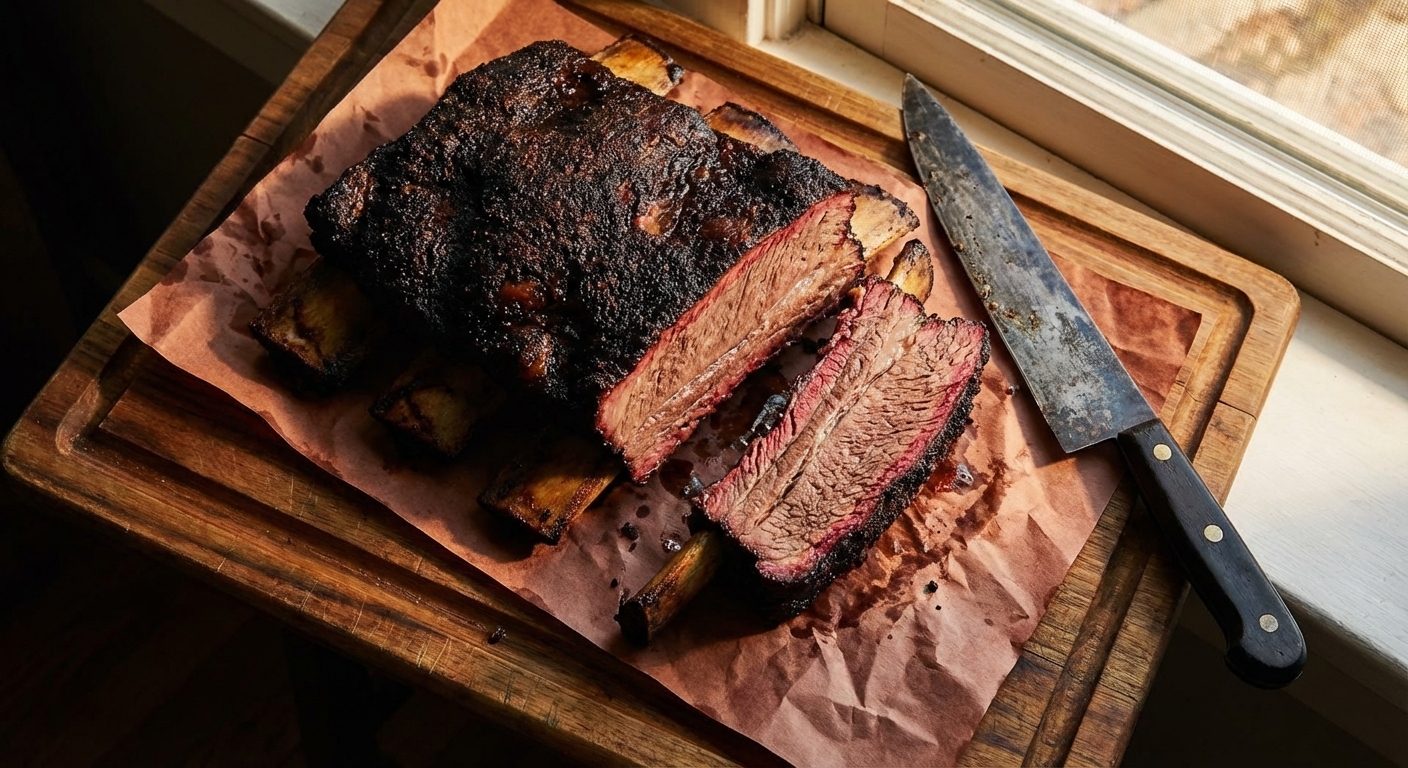
If you've ever seen a barbecue photo that stopped you mid-scroll — a massive bone with an impossibly thick slab of dark, smoky meat — you were probably looking at beef plate ribs. They're sometimes called "brisket on a bone," and once you understand why, you'll understand why they've become the most sought-after cut in competitive barbecue.
Beef plate ribs are not what most people picture when they think of ribs. They're not the curved, finger-food-sized pork ribs you eat at a backyard cookout. They're not even the relatively modest beef back ribs you find at the grocery store. Plate ribs are something else entirely — prehistoric-looking hunks of beef that can weigh over a pound per bone, with meat so thick and richly marbled that they rival prime rib in flavor and tenderness.
What Are Beef Plate Ribs?
Beef plate ribs come from the short plate primal, which sits on the lower belly of the cow beneath the rib primal. Specifically, they're cut from ribs 6 through 8 (sometimes extending to ribs 5 or 9 depending on the butcher). The short plate is one of the fattiest sections of the animal, which is why plate ribs carry so much intramuscular marbling.
A full 3-bone rack of beef plate ribs typically weighs between 5 and 8 pounds. The bones are shorter and straighter than back ribs, usually 8 to 12 inches long, and the meat sits on top in a thick slab — often 2 to 3 inches deep. This is the key distinction: while back ribs have meat primarily between the bones, plate ribs have a massive cap of meat sitting above the bones.
The meat itself is a combination of several muscles, including portions of the serratus ventralis and the external abdominal oblique. These muscles do moderate work during the animal's life, which means they develop significant connective tissue — collagen that breaks down during long, slow cooking into gelatin, creating that signature unctuous, melt-in-your-mouth texture.
Plate Ribs vs Back Ribs vs Short Ribs: The Complete Breakdown
The terminology around beef ribs is genuinely confusing, and it's made worse by the fact that butchers, restaurants, and grocery stores don't always use the same names. Here's the definitive guide to what's what.
Beef Plate Ribs (a.k.a. "Dino Ribs" or "Beef Short Ribs, Plate Style")
- Location: Lower rib cage, short plate primal (ribs 6-8)
- Bones: Short, thick, relatively straight
- Meat: 2-3 inch thick cap on top of bones. Heavily marbled, very fatty.
- Weight: 5-8 lbs per 3-bone rack
- Best cooking method: Smoking (low and slow), braising
- Price: $8-15/lb
- Cook time: 6-10 hours smoking at 250-275°F
Beef Back Ribs
- Location: Upper rib cage, attached to the spine (dorsal side)
- Bones: Long, curved, thinner
- Meat: Variable — mostly between bones (intercostal). Less marbled.
- Weight: 3-5 lbs per 7-bone rack
- Best cooking method: Smoking, grilling (indirect), braising
- Price: $4-8/lb
- Cook time: 3-5 hours smoking
Chuck Short Ribs
- Location: Forward rib area, ribs 1-5 (chuck primal)
- Bones: Shorter, often cut into individual bone sections
- Meat: Thick and well-marbled, but denser than plate ribs
- Weight: Varies by cut style (English vs flanken)
- Best cooking method: Braising, smoking
- Price: $6-12/lb
- Cook time: 3-4 hours braising, 5-8 hours smoking
The critical thing to understand: when a grocery store or restaurant says "beef short ribs," they could be referring to any of these cuts. The term "short ribs" is used broadly for ribs from the plate, chuck, and sometimes even the rib primal. Plate ribs are a specific subset — and if you want the BBQ showstopper, you need to ask for plate ribs specifically.
Why Plate Ribs Are Called "Brisket on a Bone"
This isn't just marketing hype. Plate ribs and brisket share several key characteristics:
- Fat content: Both are among the fattiest cuts on the animal. Plate ribs can have even more intramuscular fat than brisket flat.
- Collagen-rich connective tissue: Both require long, slow cooking to break down tough collagen into silky gelatin.
- Cooking method: Both are best prepared low and slow at 250-275°F until the internal temperature reaches 200-210°F.
- Texture when done: Both achieve that "pull apart with a slight tug" tenderness when properly cooked.
The key difference? Plate ribs are, in many ways, more forgiving than brisket. Because they have more fat and the bone acts as a heat buffer, it's harder to dry them out. Many pitmasters consider plate ribs the best way to learn the fundamentals of low-and-slow beef smoking before tackling a full packer brisket.
How to Buy Beef Plate Ribs
Finding plate ribs is the hardest part of the entire process. Most grocery stores don't carry them — the short plate is typically processed into ground beef, skirt steak, or pre-cut short ribs before it reaches retail. You'll need to do a bit of legwork.
Where to Find Them
- Your local butcher: Call ahead and ask specifically for "3-bone beef plate ribs, untrimmed, from ribs 6-8." Most butcher shops can order them even if they don't normally stock them. Give 3-5 days notice.
- Wholesale clubs: Costco and Sam's Club occasionally carry plate ribs, sometimes labeled as "beef short ribs" in large racks. Availability is inconsistent — check weekly.
- Online meat delivery: Several specialty meat companies ship plate ribs nationwide. Expect to pay a premium for shipping (these are heavy cuts), but the quality is often exceptional.
- Restaurant suppliers: If you have access to a restaurant supply store (Restaurant Depot, US Foods), they typically carry plate ribs at wholesale prices.
What to Look For
Not all plate ribs are created equal. Here's what separates a great rack from a mediocre one:
- Meat thickness: You want at least 2 inches of meat above the bones. If the meat cap looks thin or uneven, pass. Some racks are "shiners" — bones where the meat has been trimmed so close that bone is visible through the meat. Avoid these.
- Marbling: Look for visible white flecks throughout the meat. USDA Choice grade is the minimum you should consider; Prime is ideal. The more marbling, the more forgiving the cook and the better the final result.
- Fat cap: A moderate fat cap (¼ to ½ inch) on the exterior is good. You'll trim some of this before cooking, but you want enough to self-baste during the smoke.
- Bone alignment: The bones should be relatively straight and evenly spaced. Avoid racks where the bones look cracked or where the butcher has cut at an awkward angle.
- Color: Deep red meat with white (not yellow) fat. Yellowish fat isn't necessarily bad — it can indicate grass-fed beef — but for smoking, grain-fed (white fat) typically renders better.
How to Trim Beef Plate Ribs
Proper trimming is important but shouldn't be overdone. The goal is to remove anything that won't render during cooking while preserving as much flavorful fat as possible.
- Remove the membrane: Flip the rack bone-side up. There's a tough membrane (peritoneum) covering the back of the bones. Slide a butter knife under it at one end, get a grip with a paper towel, and pull it off in one sheet. This membrane won't break down during cooking and prevents smoke and seasoning from penetrating the meat.
- Trim the fat cap: Flip back to meat-side up. Trim the external fat cap to about ¼ inch thick. Remove any hard, waxy fat that feels stiff — this type won't render during cooking.
- Clean up loose bits: Remove any dangling meat or fat flaps. These will burn during the long cook and create bitter flavors.
- Square the edges (optional): Some cooks trim the edges of the meat cap to create a uniform rectangle. This helps with even cooking but isn't strictly necessary.
How to Smoke Beef Plate Ribs
This is where plate ribs truly shine. The smoking process is straightforward, but it requires patience — expect 6 to 10 hours depending on the size of your rack and your cooking temperature.
The Rub
Beef plate ribs have incredible natural flavor. A simple rub is all you need — and many champion pitmasters use nothing more than coarse black pepper and kosher salt in a roughly 50/50 ratio. This is the Texas tradition, and it works because the quality of the meat does the talking.
If you want to add more complexity, a beef-focused rub might include:
- Coarse black pepper (the dominant flavor)
- Kosher salt
- Granulated garlic
- Granulated onion
- A small amount of paprika (for color, not heat)
Apply the rub liberally at least 1 hour before cooking. Some pitmasters season the night before and let the ribs sit uncovered in the refrigerator — the salt draws out surface moisture, then reabsorbs, creating a dry pellicle that helps the bark form during smoking.
The Cook
- Setup: Configure your smoker for indirect heat at 250-275°F. For fuel, post oak is the traditional Texas choice. Hickory, mesquite (use sparingly), or fruit woods (cherry, apple) also work well.
- Placement: Place the ribs meat-side up on the smoker grate with the bones acting as a natural rack. The bones protect the bottom of the meat from direct heat.
- The cook (hours 1-4): Leave the ribs alone. Resist the urge to open the smoker. The bark is forming, and the smoke is doing its work. The meat will develop a deep mahogany crust.
- The stall (hours 4-7): Around 160-170°F internal, the temperature will plateau. This is the stall — evaporative cooling as moisture leaves the surface. You have two options: wait it out (traditional) or wrap in butcher paper to push through faster (the "Texas crutch").
- The finish (hours 7-10): Continue cooking until the internal temperature reaches 200-210°F and a probe slides into the meat with almost no resistance — like pushing into warm butter. Temperature is a guide, but probe tenderness is the true indicator of doneness.
- Rest: This step is non-negotiable. Wrap the finished ribs in butcher paper (if not already wrapped), then in a towel, and place in a cooler for at least 1 hour. Two hours is better. This allows the juices to redistribute and the collagen to finish setting. Cutting too early means juice loss.
Temperature Targets
- Smoker temperature: 250-275°F (consistent)
- Stall zone: 160-175°F (be patient or wrap)
- Done temperature: 200-210°F (check probe tenderness)
- Total cook time: 6-10 hours (size dependent)
- Rest time: 1-2 hours minimum
How to Braise Beef Plate Ribs
While smoking is the most popular method, braising is an excellent alternative — especially for those without a smoker. Braised plate ribs develop a completely different flavor profile: wine-rich, aromatic, fall-off-the-bone tender.
- Season generously with salt and pepper. Sear in a hot Dutch oven with oil until deeply browned on all sides — 3 to 4 minutes per side. Don't skip this step; the Maillard reaction creates flavor that braising liquid alone can't replicate.
- Build the braising liquid: Sauté onions, carrots, and celery in the same pot. Add garlic, tomato paste, and deglaze with red wine (a full-bodied cab or malbec). Add beef stock to come halfway up the ribs.
- Braise low and slow: Cover and cook at 300°F for 3 to 4 hours, or until the meat pulls easily from the bone. Check at 3 hours.
- Finish and serve: Remove the ribs. Strain and reduce the braising liquid into a rich sauce. Serve the ribs over mashed potatoes or polenta with the sauce spooned over top.
Common Mistakes to Avoid
- Cooking too hot: Anything above 300°F will render the fat too quickly and can leave the meat tough. Low and slow is the only way with plate ribs.
- Not removing the membrane: The membrane on the bone side will turn rubbery and prevent seasoning absorption. Always peel it off.
- Skipping the rest: Cutting into plate ribs immediately after cooking guarantees juice loss. Rest for at least an hour.
- Buying too lean: Select or lower-grade plate ribs don't have enough fat to stay moist during a 6+ hour cook. Always buy Choice or Prime.
- Wrapping too early: If you wrap in foil or paper before the bark has set (before about 165°F), the bark will turn soft and mushy. Wait until it feels firm and dry to the touch.
- Ignoring probe tenderness: A thermometer tells you temperature, not tenderness. A rib can read 203°F and still be tough if the collagen hasn't fully broken down. Probe multiple spots — it should feel like probing room-temperature butter.
How to Slice and Serve
Presentation matters with plate ribs — they're a showstopper cut and deserve to be treated like one.
- Individual bones: The most common approach. Slice between the bones to create individual ribs, each with its own massive portion of meat. One bone is typically a full serving.
- Sliced across the bones: For a more restaurant-style presentation, slice the meat cap off the bones in one piece, then cut across the grain into ½-inch slices. Fan the slices on a plate with the bones stacked alongside.
- Family style: Place the entire rack on a cutting board in the center of the table with a sharp knife. Let people cut their own portions. This is the most dramatic presentation and works perfectly for gatherings.
Nutrition and Yield
Plate ribs are not a lean cut — and that's the point. Here's what to expect:
- Yield: Expect roughly 50-60% of the raw weight as edible meat after cooking (bones and rendered fat account for the rest). A 7 lb rack yields approximately 3.5 to 4 lbs of cooked meat.
- Serving size: One bone per person is generous. A 3-bone rack feeds 3-4 adults comfortably.
- Calories: Approximately 350-400 calories per 4 oz serving of meat (varies by grade and trimming).
- Protein: About 25-30g per 4 oz serving.
The Bottom Line
Beef plate ribs are the king of barbecue ribs. They're big, dramatic, incredibly flavorful, and more forgiving to cook than brisket. The main challenge isn't cooking them — it's finding them. Build a relationship with a good butcher, order ahead, and don't settle for anything less than Choice grade with a thick meat cap.
Once you've nailed a rack of plate ribs on the smoker, everything else in barbecue feels like practice. This is the cut that separates casual grillers from serious pitmasters, and it's worth every hour of cook time.
More Expert Guides
What Is Round Steak? The Complete Guide to Beef's Most Versatile Budget Cut
Round steak comes from the rear leg of the cow — it's lean, affordable, and misunderstood. A master butcher breaks down every sub-cut, cooking method, and technique to turn this budget workhorse into genuinely delicious meals.
14 min readWhat Is Eye of Round? The Complete Butcher's Guide to This Lean Cut
Eye of round is one of the leanest, most affordable cuts in the entire beef case — and one of the most misunderstood. A butcher explains how to turn this budget-friendly roast into something genuinely delicious.
14 min readBottom Round vs Top Round: A Butcher Explains the Real Differences
Top round and bottom round look similar in the meat case but cook completely differently. A butcher with 30 years of experience explains where each cut comes from, which is more tender, and how to get the best results from both.